
Battus philenor
Battus philenor
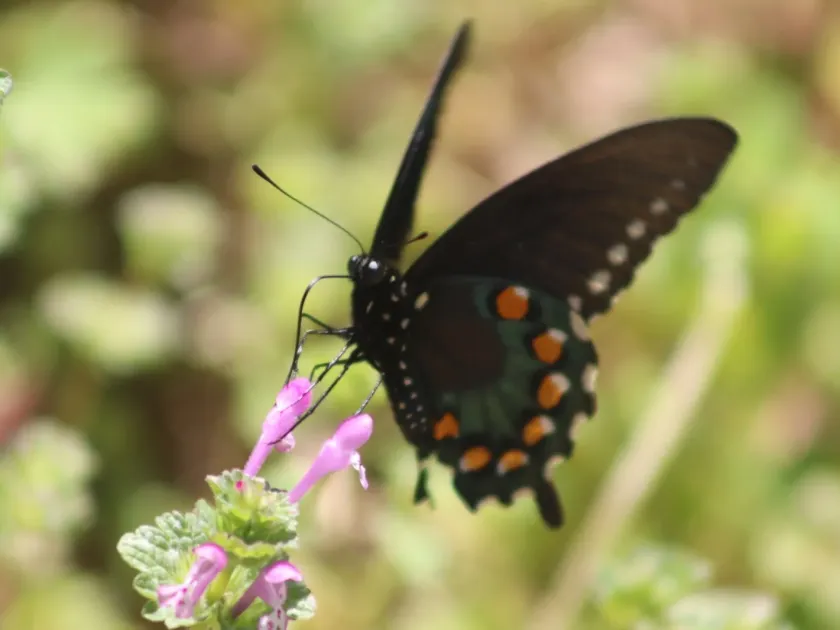
Description
How to identify
Battus philenor, known as the pipevine swallowtail, belongs to the order Lepidoptera and the family Papilionidae. Adult butterflies are large, with a wingspan of up to 10 cm, featuring iridescent dark blue or black wings.
The larvae of this species change color as they develop, transitioning from reddish-brown to bright orange or nearly black with distinct rows of fleshy tubercles on their bodies. This morphological feature helps distinguish larvae from other pest species at early stages.
The eggs are spherical and reddish-orange in color, typically laid in clusters on the undersides of the host plant's leaves. As they mature, the eggs darken, indicating imminent larval emergence.
Pupae exhibit variable coloration, ranging from greenish to brown, which provides excellent camouflage among plant stems and leaves during the diapause period.
Adult butterflies exhibit sexual dimorphism, with females generally being larger and having duller wing coloration compared to the intense metallic sheen observed in males.
What it damages
The primary food sources for this species are plants in the Aristolochiaceae family, specifically various species of the genus Aristolochia (pipevines).
Larvae are highly specialized feeders, actively consuming leaves, petioles, and young shoots, which can lead to significant defoliation during the summer months.
Mass infestations can result in the complete loss of foliage on ornamental plants, weakening their immune system and reducing winter hardiness.
The damage caused by caterpillars creates entry points for secondary infections, including fungal and bacterial diseases that penetrate through damaged tissues.
Although the species is limited in its host range, it can pose a serious threat to the aesthetic value of ornamental Aristolochia plantings in gardens and parks.
When it appears
The life cycle of Battus philenor depends on regional climatic conditions and typically includes two to three generations per growing season.
Adult activity is observed from mid-spring through late summer, when favorable temperatures facilitate mating and egg-laying.
The peak of larval damage occurs in the second half of summer, corresponding with maximum population density during the active feeding stage.
The overwintering stage occurs in the pupal phase, attached to a substrate in diapause until the return of warm weather in the following year.
Monitoring for the pest should be continuous starting from early May, focusing on the undersides of leaves of host plants for early detection of egg masses.
Signs of infestation
The first visual sign of infestation is the presence of characteristic holes in the leaf blades, often starting from the edges or the center of the leaf.
The presence of frass (excrement) on the leaf surface beneath feeding sites is a direct indicator of active caterpillar feeding.
Group feeding during early larval stages leads to the skeletonization of leaves, leaving only the tougher leaf veins behind.
Discovery of spherical orange eggs on the underside of a leaf signals an immediate need to initiate control measures.
In severe cases, plants appear stunted, growth is slowed, and shoots become thin due to the constant stress caused by the loss of photosynthetic area.
Control measures
Manual removal of eggs and caterpillars is the most effective and eco-friendly control method for small garden areas.
Biological products based on Bacillus thuringiensis demonstrate high selective efficacy against these caterpillars without harming beneficial predatory insects.
Regular pruning of heavily infested shoots helps reduce the overall pest population within a localized area.
The use of pheromone traps for adult butterflies helps monitor population levels and prevent mass egg-laying during critical development phases.
- Application of contact insecticides if the economic threshold is exceeded.
- Encouraging natural enemies such as birds and predatory insects in the garden.
- Timely removal of weeds that may provide secondary shelter or host sites for the pest.
Taxonomy
- Latin name
- Battus philenor
- Order
- Lepidoptera (butterflies)
- Family
- Papilionidae
- EPPO code
- BATTPH
Discussion
No discussions yet — be the first.