
Zebra Swallowtail
Eurytides marcellus
Description
How to identify
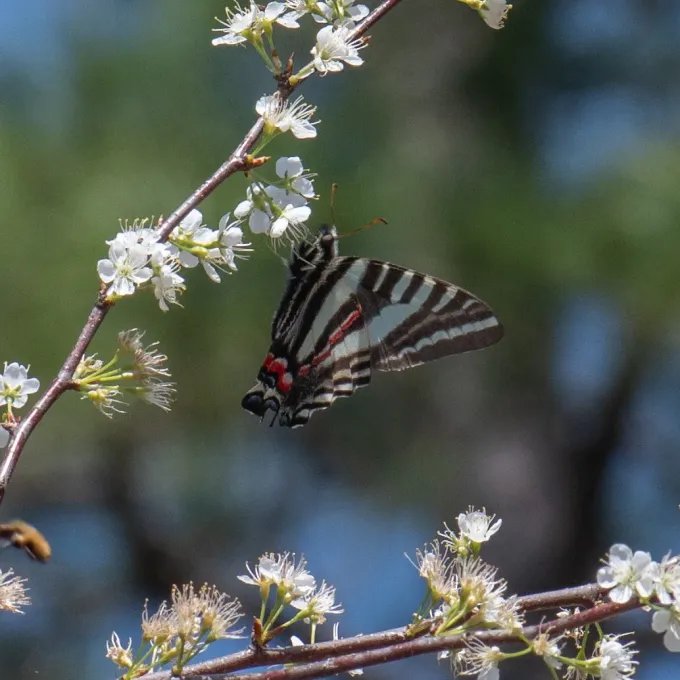
The Zebra Swallowtail (Eurytides marcellus) is a distinct butterfly species belonging to the Papilionidae family. Its appearance is characterized by a striking black-and-white striped pattern and elongated, sword-like tails on the hindwings.
The larvae, or caterpillars, undergo several instars. Early stages are often dark, while later stages turn a vibrant green with contrasting black and yellow crossbands, providing camouflage among the host plant foliage.
Adult butterflies exhibit seasonal dimorphism; spring generations are generally smaller and paler compared to the summer broods. The wingspan typically ranges from 6 to 8 centimeters.
The species is highly dependent on its primary host plant, the Pawpaw (Asimina triloba), which provides the essential nutrients for larval development. Their geographic distribution is inherently tied to the presence of this specific vegetation.
Pupae are attached to stems with a silk girdle, allowing them to remain securely in place during their transformation. This stage is crucial for overwintering, as the pupae are highly resistant to cold weather.
What it damages
The primary damage is caused by the caterpillars, which feed exclusively on the foliage of Pawpaw trees. In high-density infestations, they can lead to significant defoliation of young trees.
By consuming leaf tissue, the larvae reduce the tree's photosynthetic capacity. For saplings and young nursery stock, this can lead to stunted growth and increased susceptibility to environmental stress.
While the larvae are the destructive stage, their presence can be indicative of a broader management challenge in commercial Pawpaw orchards where leaf biomass is critical for fruit production.
The adult stage does not cause damage to plants as they feed solely on nectar. However, they serve as the reproductive vector that initiates the cycle of infestation in a garden environment.
Secondary damage can occur when the weakened leaves are colonized by fungal pathogens, which thrive on the damaged tissue and further degrade the tree's overall health.
##season##The seasonal activity of the Zebra Swallowtail begins in early spring, synchronized with the emergence of the first new leaves on the Pawpaw trees. This ensures that offspring have immediate access to food.
Depending on local climate conditions, multiple generations may occur within a single growing season. The peak population density is often reached during the mid-summer months.
As autumn approaches, the butterflies enter the pupal stage, which remains dormant until the following spring. This overwintering strategy is highly effective for population survival.
Predicting outbreaks requires monitoring temperature accumulations (degree-days) in the spring. Early, warm springs usually lead to an earlier emergence and potentially a higher number of generations.
Gardeners should begin inspection protocols as soon as the trees break dormancy to catch early-stage larvae before they cause widespread leaf damage.
Signs of infestation
The first signs of infestation are ragged, scalloped edges on the leaves of the Pawpaw tree. These are the result of young caterpillars feeding along the leaf margins.
Small, dark-colored frass (droppings) left on the leaf surfaces directly beneath the feeding area are reliable indicators of caterpillar presence and activity.
Careful observation of the underside of leaves may reveal solitary eggs. These eggs are small, light-colored, and typically laid individually by the female butterflies.
Leaves that appear curled or folded, often secured by fine silk threads, indicate that a caterpillar is using these structures for protection during its molting process.
In mature trees, infestation may be restricted to the lower branches or new growth, making them the primary focal points for routine visual inspections.
Control measures
Hand-picking caterpillars is the most straightforward and effective method for small-scale gardens. It is environmentally friendly and prevents the need for chemical intervention.
For larger infestations, biological controls such as products containing Bacillus thuringiensis (Bt) are highly effective. Bt targets caterpillars specifically while leaving beneficial insects unharmed.
Maintaining vigorous tree growth through proper irrigation and fertilization helps the Pawpaw tree recover quickly if some leaf loss occurs, mitigating the long-term impact of the larvae.
Promoting a diverse garden habitat encourages the presence of natural predators, such as birds and parasitic wasps, which can help keep caterpillar populations below economic thresholds.
- Monitor tree growth regularly during the peak growing season.
- Remove any discovered egg clusters manually during spring.
- Use protective netting on young, sensitive saplings during periods of high butterfly activity.
Taxonomy
- Latin name
- Eurytides marcellus
- Order
- Lepidoptera (butterflies)
- Family
- Papilionidae
- EPPO code
- PAPIMC
Discussion
No discussions yet — be the first.