
Zerynthia polyxena
Zerynthia polyxena
Description
How to identify
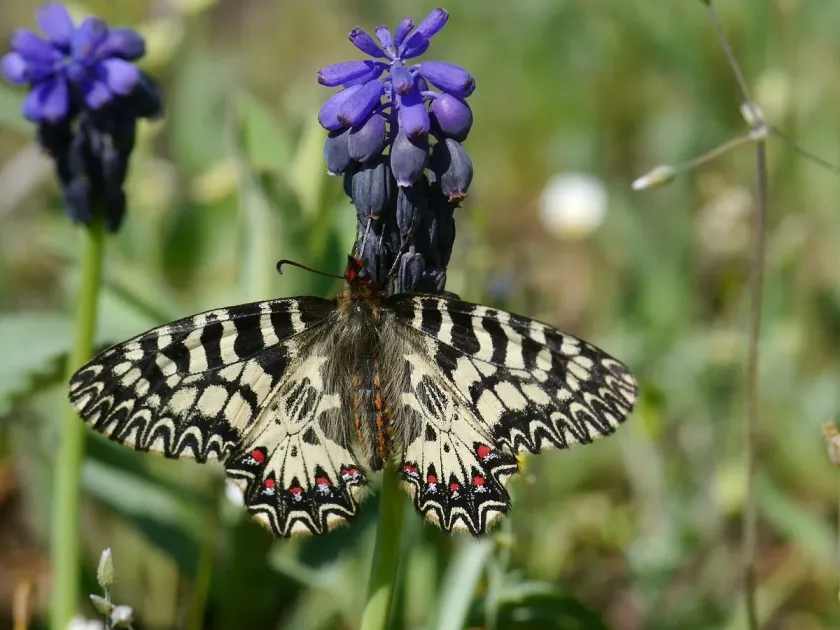
The Southern Festoon (Zerynthia polyxena) is a butterfly belonging to the Papilionidae family. Its wingspan ranges from 50 to 55 mm, characterized by a bright yellow color with black zig-zag lines and distinct red spots.
The butterfly's body is hairy, and the hindwings feature small tails and blue spots near the edge. The caterpillars are colorful with fleshy tubercles, which serve as a defense mechanism against potential predators.
The pupa mimics a dry, curled leaf, providing exceptional camouflage against the stems of its host plant. This stage is crucial as it lasts throughout the winter season for the insect's survival.
Females lay eggs individually on the underside of the host plant leaves. The eggs are spherical, smooth, and change from pale yellow to a darker shade just before the larvae emerge.
This species is found in sunny, warm regions such as forest clearings and ravines. Its presence is strictly tied to the distribution of its primary host plant, the birthwort (Aristolochia).
What it damages
The Southern Festoon is a specialist feeder, with the birthwort (Aristolochia clematitis) being its main host plant. In gardening, it may occasionally affect ornamental species of the Aristolochia genus.
Caterpillars consume leaves, buds, and young shoots. Heavy infestations can lead to significant defoliation, weakening the plant and damaging its aesthetic value in landscape designs.
This species is not a pest for common agricultural crops. Damage is generally confined to specific ornamental or wild patches of Aristolochia, making it a niche concern for gardeners.
The rate of damage is high when larvae are numerous. They can rapidly strip a plant of its foliage, which is particularly detrimental to young or recently planted ornamental specimens.
Since the Southern Festoon is a protected species in many countries, control methods must be moderate and targeted, focusing on localized management rather than widespread extermination.
When it appears
The species completes one generation per year. Adult butterflies emerge in the spring, typically from mid-April to May, coinciding with the active growth period of the birthwort plant.
The adult flight period lasts about a month, during which mating and egg-laying occur. The entire life cycle is closely linked to the phenology of the host plant.
Larval development takes place during late spring and early summer. This is the period of intensive feeding, during which the caterpillars grow rapidly and undergo several developmental stages.
Pupation occurs in late June. The pupa remains in diapause throughout the summer and winter, waiting for the optimal environmental conditions of the following spring to emerge.
Weather conditions significantly impact the emergence timing. A delayed spring can postpone the flight period, which directly affects the survival rates and health of the population.
Signs of infestation
The primary sign of infestation is ragged or eaten leaf margins on Aristolochia. Larvae often start feeding at the base of the plant before moving toward the terminal shoots.
Small, dark granular frass (excrement) on the leaves is a telltale sign of active larval presence. These deposits are usually found directly beneath the feeding areas.
Careful inspection of the leaf undersides reveals the presence of eggs. They are small and often difficult to spot due to their light color and solitary placement.
Deformed or curled leaves, sometimes tied together with thin silk threads, indicate the presence of older larvae using these structures for protection against the environment and predators.
During late autumn or early spring, one can find pupae attached to stems with silk girdles. They are highly mimetic and look like dried plant debris, making them hard to detect.
Control measures
Control of the Southern Festoon requires caution due to its protected status in many regions. Chemical pesticides are generally discouraged or prohibited to avoid harming non-target beneficial insects.
The most effective and safe method is the manual removal of larvae during the early morning or evening hours when they are most active and visible on the foliage.
Preventive measures include regular monitoring of Aristolochia plantings and removing leaves with egg clusters before the larvae hatch to keep the population density under control.
If protection of ornamental plantings is necessary, biological insecticides such as those based on Bacillus thuringiensis are recommended, as they selectively target lepidopteran larvae.
- Monitor host plant health regularly.
- Hand-pick caterpillars from the plants.
- Remove egg clusters mechanically.
- Use selective biological controls when necessary.
Taxonomy
- Latin name
- Zerynthia polyxena
- Order
- Lepidoptera (butterflies)
- Family
- Papilionidae
- EPPO code
- ZERYPO
Discussion
No discussions yet — be the first.