
Honeysuckle sawfly
Zaraea mutica
Description
How to identify
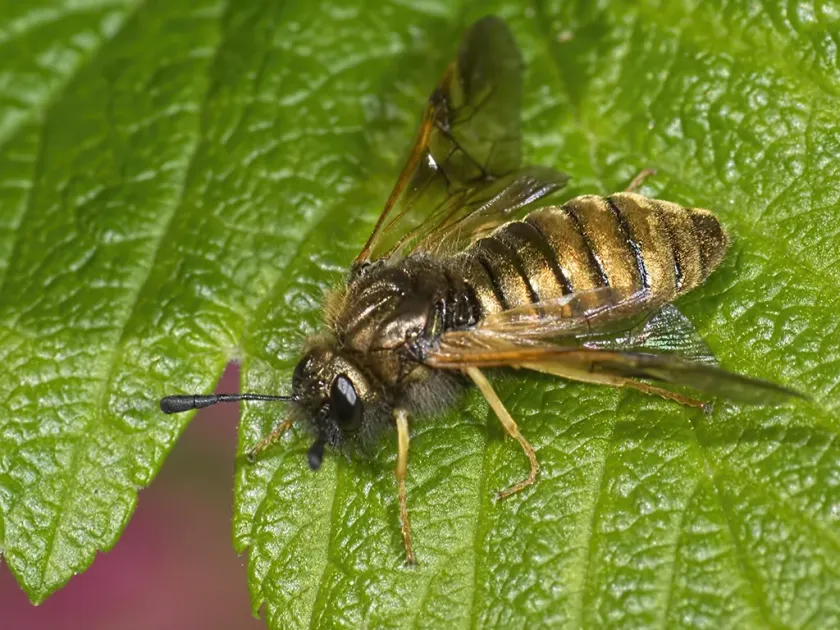
The honeysuckle sawfly (Zaraea mutica) belongs to the order Hymenoptera, family Cimbicidae. The adult insect resembles a small wasp, growing to about 10–12 mm in length, but it lacks a stinger, which is typical for this specific family of sawflies.
A key distinguishing feature is their club-shaped antennae, which help differentiate them from other common sawfly species. Their bodies range from dark brown to black, sometimes exhibiting a slight metallic luster or light stripes on the abdomen.
Larvae, often called false caterpillars, can reach up to 25 mm in length. Their bodies are grayish-green and covered with small black warts or spots, providing excellent camouflage against the foliage of the host plant.
Pupae develop inside tough cocoons, which are usually buried in the upper soil layer or leaf litter beneath the host bush. This survival strategy allows them to overwinter safely even in harsh weather conditions.
The biological cycle of the sawfly is strictly synchronized with the phenology of the honeysuckle, ensuring that larvae have immediate access to fresh leaves upon hatching.
What it damages
The primary host plant for this pest is the edible honeysuckle (Lonicera caerulea). However, during years of high population density, they can spread to various ornamental honeysuckle species, causing significant aesthetic and physical damage.
Only the larvae cause damage to the plants, as they possess chewing mouthparts. Adult sawflies feed mainly on flower nectar and do not cause any significant harm to the plant’s vegetative organs.
In cases of heavy infestation, larvae can completely skeletonize the leaves, eating away everything except the central midrib. This drastically reduces the plant's photosynthetic capacity, leading to weakened overall health.
Severe leaf loss inhibits the plant's ability to prepare for winter, reducing its cold hardiness. Furthermore, the loss of foliage negatively impacts the development of flower buds, leading to lower fruit yields in the following year.
If infestations recur over several years, the bushes may suffer from stunted growth, premature leaf drop, and an increased susceptibility to secondary fungal diseases.
When it appears
Adults typically emerge in May, coinciding with the flowering period of honeysuckle plants. Females lay eggs inside the leaf tissue by creating small slits, where the eggs incubate for approximately two weeks.
Larval hatching usually occurs in June, when the bushes are actively producing new foliage. During this period, the larvae are extremely active and represent the most vulnerable stage for pest control interventions.
The larval stage lasts for about 3 to 4 weeks. Once fully developed, the larvae drop to the ground, burrow into the soil, and form cocoons to pupate, usually completing one generation per year.
The insects overwinter as prepupae within their cocoons. This soil-based overwintering makes them sensitive to soil cultivation practices performed in the late autumn or early spring.
Monitoring should begin shortly after the honeysuckle finishes blooming, as this is when the first visible signs of leaf damage appear on the outer branches.
Signs of infestation
The first indicator of an infestation is the appearance of small, pin-prick holes on the leaves. Over time, these holes enlarge, and the larvae begin eating the edges of the leaf, leading to jagged, irregular margins.
Larvae are often found on the underside of leaves or along the edges. When disturbed or touched, they exhibit a characteristic defensive behavior, curling into a spiral shape and falling to the ground.
The presence of frass (larval excrement) is a reliable sign of an active infestation. These small, dark pellets often accumulate on the leaves or the soil surface directly beneath the infested branches.
Extensive skeletonization, where only the main veins of the leaves remain, is a sign of a high population density that requires immediate corrective action to save the bush.
Observing adult sawflies hovering around the blossoms during sunny spring days is an early warning sign that eggs have likely been laid and the next generation of larvae will soon appear.
Control measures
Cultural control is highly effective: cultivating or tilling the soil beneath the honeysuckle bushes during the pupation period (June-July) and in autumn destroys the cocoons hiding in the soil.
Manual collection of larvae is practical for smaller gardens. Since the larvae are sedentary and drop easily when shaken, placing a cloth under the bush and shaking the branches allows for easy removal.
If chemical control is necessary, use insecticides only after the harvest is complete. Selecting systemic or broad-spectrum insecticides should be done with care to avoid harming beneficial pollinators.
- Manual removal of larvae in the early morning.
- Soil cultivation around the base of the bushes to expose pupae.
- Application of biological insecticides if the infestation occurs during the fruiting season.
Biological control methods, such as utilizing bacteria-based sprays, are recommended during the berry ripening phase, as they effectively target the larvae while remaining safe for human consumption of the fruit.
Taxonomy
- Latin name
- Zaraea mutica
- Order
- Hymenoptera
- Family
- Cimbicidae
- EPPO code
- ZARAMU
Discussion
No discussions yet — be the first.