
Cimbex
Cimbex
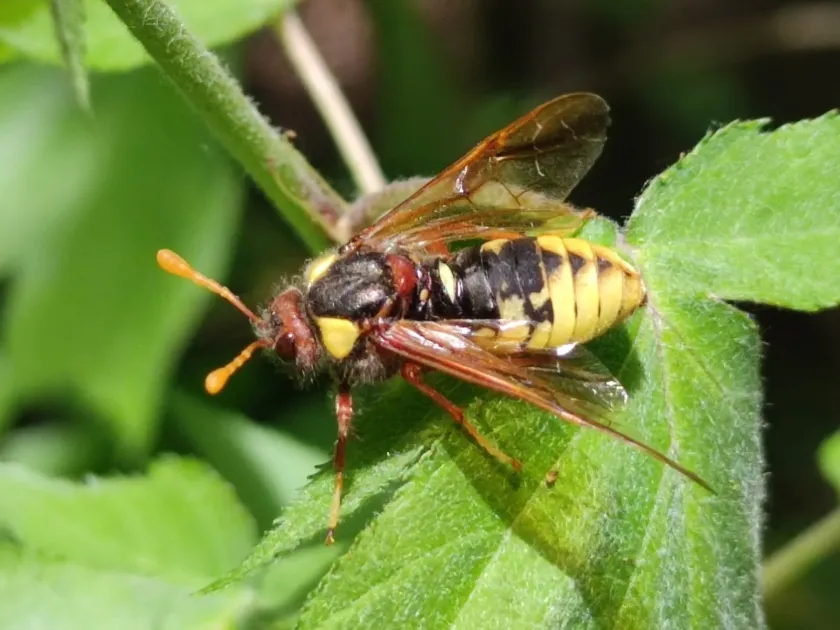
Description
How to identify
Cimbex is a genus of insects belonging to the family Cimbicidae, commonly known as club-horned sawflies. Adults are large, robust insects often resembling hornets, characterized by their distinct club-shaped antennae and powerful bodies.
The larvae, or false caterpillars, are soft-bodied and usually green or yellowish with characteristic markings. When disturbed, they typically coil into a tight spiral, which is a classic diagnostic feature for identifying this pest.
Their life cycle consists of complete metamorphosis: egg, larva (five instars), pupa, and adult. They typically overwinter as prepupae inside dense, papery cocoons hidden in the soil or protected crevices of tree bark.
Adult emergence generally occurs in late spring. While they feed on nectar, they also consume young bark, which can cause minor mechanical damage to twigs during the process of maturation and egg-laying.
Females possess a specialized ovipositor used to saw into leaf tissue, inserting eggs individually. This action creates visible scars or distorted leaf patches shortly after the eggs are deposited.
##damage##Cimbex larvae are primarily defoliators, causing significant damage to various deciduous trees, including fruit species like apples, pears, cherries, and plums, as well as forest trees like birch and willow.
The larvae are voracious feeders that strip leaves, often skeletonizing them by consuming the blade and leaving only the tough midribs. Severe infestations can result in total defoliation of the tree.
Adults contribute to the damage by gnawing on the bark of young shoots, which can lead to localized dieback, impaired sap flow, and increased susceptibility to other biotic stressors.
Constant defoliation weakens the overall tree health, reducing its ability to store energy for the following season, which leads to lower fruit yields and, in extreme cases, the death of young saplings.
The wounds made by adults and larvae serve as entry points for pathogens, potentially leading to bacterial or fungal infections that further damage the tree's vascular system.
When it appears
The appearance of adults usually coincides with the blooming period of fruit trees in the spring, as they require warm conditions for mating and active flight.
Larval activity reaches its peak in late spring and early summer (June and July). During this period, the larvae feed continuously, growing rapidly before they prepare for the pupal stage.
Pupation occurs in late summer or autumn. Larvae descend to the ground or seek shelter under bark to construct their cocoons, where they enter diapause to survive the winter.
Most Cimbex species are univoltine, meaning they produce only one generation per year, making the seasonal timing of control measures predictable and critical for effective management.
Weather patterns, particularly temperature and humidity, play a significant role in determining the survival rates of the population, often leading to fluctuations in infestation levels from year to year.
Signs of infestation
The first signs of infestation are the crescent-shaped scars on leaves created by the female's ovipositor during egg-laying. These scars often discolor and become prominent.
Finding coiled larvae clinging to the underside of leaves or petioles is the most reliable sign of a Cimbex infestation. Their tendency to curl up makes them easily distinguishable from lepidopteran caterpillars.
Incomplete leaf margins or "lacy" foliage caused by larval feeding are indicative of moderate to heavy infestations, as the larvae start eating from the edges inward.
The presence of frass (larval droppings) on leaves or lower branches is a tell-tale sign that active feeding is occurring in the upper canopy, even if the larvae are not immediately visible.
Girdling marks on young twigs, caused by adults feeding on bark, serve as a precursor warning that a new generation of larvae may soon appear on the foliage.
Control measures
Manual collection of larvae is highly effective for small gardens or young trees. Since larvae are relatively slow-moving and conspicuous, they can be easily hand-picked and destroyed.
Cultivating the soil beneath the canopy in autumn can help destroy overwintering cocoons by exposing them to frost, dehydration, and predatory birds or insects.
- Apply biological insecticides like Bacillus thuringiensis (Bt) when larvae are young and vulnerable.
- Use systemic or contact chemical insecticides only when thresholds are exceeded and damage is severe.
- Encourage natural predators such as birds, parasitic wasps, and predatory beetles that naturally keep sawfly populations in check.
Regular monitoring during late spring allows for early detection, which is essential because larvae become more resilient to pesticides as they reach their final instars.
Proper orchard sanitation, including the removal of heavily damaged or dead twigs, reduces the sites where adults might feed and larvae might seek protection, improving tree health.
Taxonomy
- Latin name
- Cimbex
- Order
- Hymenoptera
- Family
- Cimbicidae
- EPPO code
- CIMBSP
Discussion
No discussions yet — be the first.