
Birch sawfly
Cimbex femorata
Description
How to identify
The Birch sawfly Cimbex femorata belongs to the Cimbicidae family within the order Hymenoptera. This is a large insect, often reaching 20–28 mm in length, resembling a hornet.
Adults possess a shiny black body with yellow spots on the abdomen and clear wings with dark veins. Their hind legs have significantly thickened femurs, which is a key diagnostic feature.
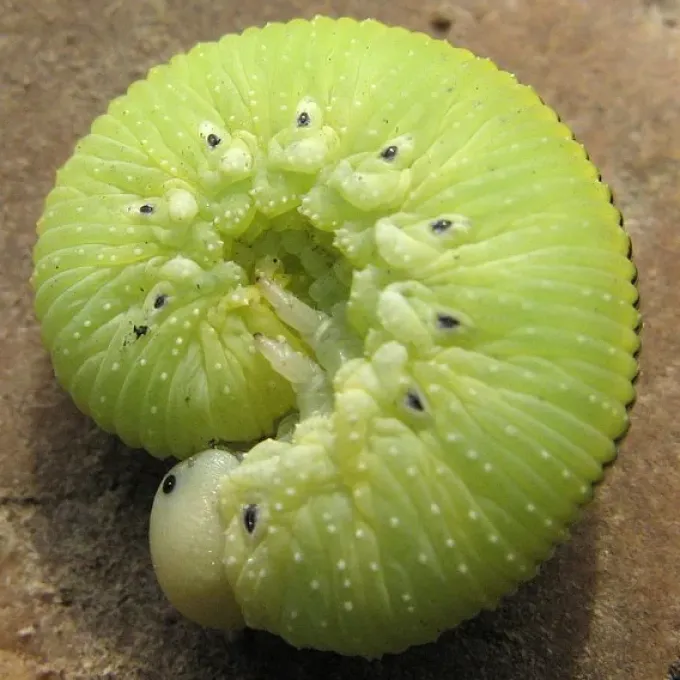
The larvae, known as false caterpillars, go through several developmental stages. Mature larvae reach up to 50 mm in size and display a yellowish-green color with a dark dorsal stripe.
The pupal stage occurs inside a firm, brown, parchment-like cocoon, which the larva builds within the soil or the leaf litter beneath the host tree.
The insect typically overwinters in the prepupal stage inside its cocoon, buried in the soil or protected under forest debris.
What it damages
This pest primarily attacks deciduous trees, with birch being the main host, though it also thrives on alder, willow, poplar, and aspen.
Young larvae initially skeletonize the leaves by consuming soft tissues. Older larvae strip the leaves entirely, leaving only the thickest veins intact.
During outbreak years, the sawfly can cause extensive defoliation, stripping entire trees of their foliage within a short period.
Such severe loss of leaf cover significantly stresses the tree, slowing its growth and increasing susceptibility to secondary pests like wood-boring beetles.
Repeated defoliation over several consecutive years can lead to the decline and eventual death of individual trees or entire stands.
When it appears
Adults emerge in late spring, typically in May or June, coinciding with the period of bud burst and fresh leaf development.
Females lay their eggs by inserting the ovipositor into the tissue of young leaves, creating characteristic small incisions.
Larval feeding occurs predominantly during the summer months, specifically June and July. The active feeding stage lasts about four to six weeks.
Once feeding is complete, the larvae descend to the ground to spin their cocoons and pupate, where they remain until the following spring.
The Birch sawfly has a univoltine life cycle, meaning it completes only one generation per year.
Signs of infestation
Small, circular or elongated slits on the leaf surface indicate where the female has deposited her eggs.
The presence of large, green larvae clinging to branches is a clear sign of an infestation, especially when they coil up upon being disturbed.
Thinning of the crown is an early visual indicator, as the leaves are rapidly consumed by the growing larvae.
Accumulation of dark larval frass on the ground under the canopy serves as a strong signal that the tree is currently being attacked.
Complete defoliation in mid-summer is the most severe sign of a high-density population causing significant stress to the host tree.
Control measures
For small-scale gardeners, manual collection and disposal of larvae in the morning when they are less active can be highly effective.
Cultivating the soil around the base of the tree in the fall helps disrupt the overwintering sites and exposes cocoons to predators.
Biological insecticides, specifically those containing Bacillus thuringiensis, provide an excellent eco-friendly control option.
Chemical treatments using registered insecticides may be necessary during severe outbreaks to protect valuable trees.
- Apply treatments during calm, dry weather to ensure maximum coverage.
- Encourage local bird populations, as they are natural predators of sawfly larvae.
- Monitor trees regularly from late spring to detect early egg-laying sites.
Taxonomy
- Latin name
- Cimbex femorata
- Order
- Hymenoptera
- Family
- Cimbicidae
- EPPO code
- CIMBFE
Discussion
No discussions yet — be the first.