
Alder sawfly
Cimbex connata
Description
How to identify
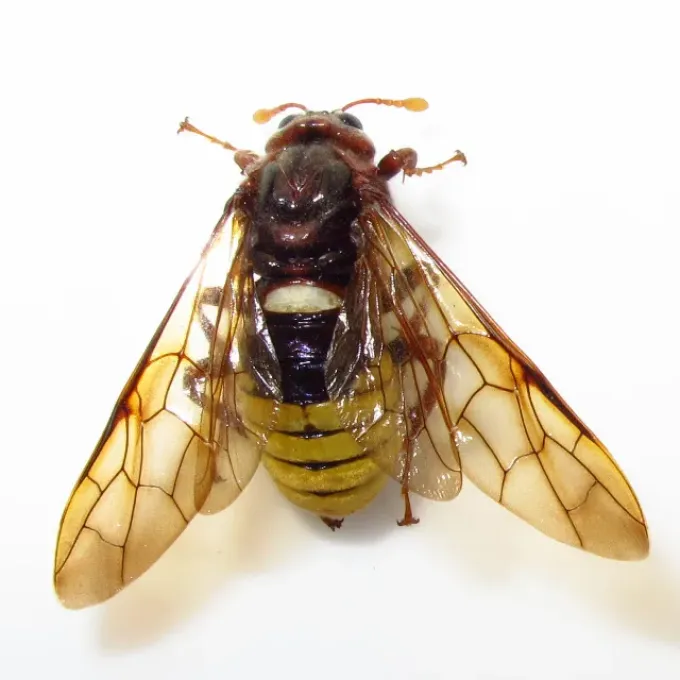
The alder sawfly (Cimbex connata) is a large insect belonging to the family Cimbicidae, order Hymenoptera. Adult specimens are robust, often resembling hornets, which is a common trait among many species of this family.
The key identification feature is the antennae, which are club-shaped at the ends. Their body color can range from reddish-brown to dark, almost black, with somewhat darkened or smoky wings.
Larvae look like butterfly caterpillars and can grow up to 50 mm long. They are typically green with a prominent dark dorsal stripe, which serves as camouflage while they feed on the leaves of their host plant.
The species undergoes complete metamorphosis. Females use their saw-like ovipositor to make incisions in the leaves, where they deposit their eggs, leading to the development of the larvae.
The insect overwinters as a prepupa within a tough cocoon, usually located in the soil or leaf litter beneath the canopy of the host tree, protecting it from winter environmental stressors.
What it damages
The primary host for this pest is alder (Alnus), particularly black alder. In some cases, populations may be found on other deciduous trees growing in the immediate vicinity of primary infestation sites.
The larvae are highly voracious feeders with strong chewing mouthparts. They can cause severe defoliation, often skeletonizing leaves until only the main veins remain, which stresses the tree significantly.
Mass outbreaks of the alder sawfly can lead to total canopy loss over vast areas. This severely reduces the photosynthetic capacity of the trees, leading to lower wood growth and diminished overall vitality.
Trees weakened by repeated seasonal defoliation are prone to secondary attacks from wood-boring insects and pathogenic fungi, which can ultimately lead to the death of the affected trees.
In ornamental settings, the loss of foliage creates significant aesthetic damage and can cause young trees to die if they lack the energy reserves to produce new leaves in a single season.
When it appears
Adults emerge in late spring or early summer, corresponding with the active growth stage of the alder trees. They spend their time feeding on nectar and seeking mates for reproduction.
Larvae are active throughout the summer months, with the peak of their feeding activity typically occurring from June to August. There is usually only one generation per year, making the summer period the most critical.
By late summer, larvae mature and descend into the soil to spin their overwintering cocoons, entering a state of diapause until the following spring season.
Signs of infestation
Early signs of infestation include tiny, distorted leaf incisions caused by female egg-laying. These marks can be observed upon close inspection of the leaf margins.
The most visible symptom is skeletonized foliage, where the soft tissue between the veins has been consumed. Frass (larval droppings) on the leaves or the ground beneath the tree is a clear indicator of high larval density.
The presence of the larvae themselves, which often curl into a spiral shape when disturbed, is the definitive sign of an ongoing infestation that requires management.
Control measures
In forest plantations, chemical control is often difficult, but in parks and home gardens, systemic or contact insecticides can be applied during the early stages of larval development to prevent widespread damage.
Biological control methods are highly effective, including the preservation of natural habitats for insectivorous birds and predatory wasps that naturally prey on sawfly larvae and eggs.
- Hand-picking larvae from smaller, ornamental trees.
- Tilling the soil beneath the canopy in late autumn to expose and destroy overwintering cocoons.
- Utilizing biological insecticides containing Bacillus thuringiensis.
Timing is crucial for chemical applications; they are most effective when the larvae are still young and have not yet caused extensive damage to the tree's canopy.
Maintaining tree vigor through proper watering and soil management helps trees recover from defoliation events and reduces their susceptibility to further pest attacks.
Taxonomy
- Latin name
- Cimbex connata
- Order
- Hymenoptera
- Family
- Cimbicidae
- EPPO code
- CIMBCO
Discussion
No discussions yet — be the first.