
Pacific cimbicid sawfly
Cimbex pacifica
Description
How to identify
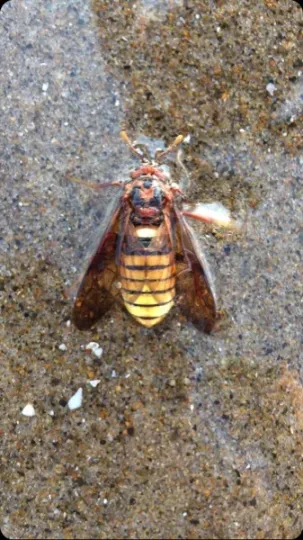
The Pacific cimbicid sawfly (Cimbex pacifica) belongs to the family Cimbicidae in the order Hymenoptera. Adults are robust, large insects that often mimic hornets in appearance, which is a common characteristic among the larger members of this family.
The defining feature of this species is its club-shaped antennae, which are thick and distinct. The body is usually robust, and the wings are translucent or slightly smoky with a well-developed network of veins characteristic of the Cimbicidae.
The larvae are known as false caterpillars. They are cylindrical, possess multiple pairs of abdominal legs, and have a unique defensive mechanism where they coil into a spiral shape when disturbed or threatened.
The life cycle undergoes complete metamorphosis, including egg, larval stages, pupa (protected inside a tough cocoon), and the adult stage. The larval stage is the primary period of plant tissue consumption.
This species is native to the forested regions of the Far East, where it has evolved to thrive in specific climatic conditions and interacts closely with local deciduous tree species.
What it damages
As a specialist pest, the Pacific cimbicid sawfly primarily targets various broad-leaved trees. Willow, birch, and alder are among the most frequently attacked host plants in natural and cultivated environments.
Larvae use their powerful mandibles to feed on leaves. During heavy infestations, they can cause severe defoliation, stripping the tree of its foliage and leaving only the main veins behind.
The loss of leaf tissue severely hampers the tree's ability to photosynthesize. This stress leads to reduced annual shoot growth and lower energy reserves, which are crucial for the tree's survival through winter.
Young trees are particularly susceptible. Repeated yearly attacks can lead to stunted growth, dieback of terminal branches, and, in severe cases, the complete death of the plant due to lack of nutrients.
Secondary damage occurs as well; defoliated trees become weakened and significantly more susceptible to opportunistic diseases, wood-boring insects, and environmental stressors.
When it appears
Adult emergence typically begins in late spring, generally around May and June, depending on the local temperature and humidity levels in the region.
Females utilize their saw-like ovipositor to cut slits into the leaf tissues of host plants, where they deposit their eggs. The incubation period is relatively short, allowing for rapid colonization of host foliage.
Larvae emerge in mid-summer and start an intensive feeding cycle that lasts through July and August. This is the period when the most significant damage to trees is observed in the landscape.
By late summer or early autumn, the mature larvae descend to the soil or leaf litter. They construct tough, parchment-like cocoons to pupate and remain in the soil throughout the winter months.
The species usually completes one generation per year (univoltine), although environmental variations can sometimes influence the pace of development for specific local populations.
Signs of infestation
The first signs of infestation include small, irregular holes or notches along the leaf margins. As the larvae grow, these notches expand into large, coarse sections of missing leaf tissue.
Visual identification of the larvae is a key indicator. You will often see them resting along the edge of a leaf or curled in a spiral, feeding or resting in the shade provided by the leaf canopy.
Fecal matter, appearing as small, dark, granular pellets beneath the infested branches, is a tell-tale sign that a population is actively feeding in the tree above.
Severe defoliation, characterized by leaves being reduced to just their central rib or a skeletonized web, indicates a well-established colony that requires immediate management.
In quiet environments, the feeding of a large group of larvae can actually be audible, sounding like a steady rustling or clipping of leaves as the insects consume the foliage.
Control measures
Mechanical control is effective for small-scale infestations; it involves hand-picking and removing the larvae from branches, especially during the early morning or evening hours.
Soil cultivation in the autumn is a highly recommended practice. Turning over the soil under the canopy destroys the overwintering cocoons and disrupts the sawfly's life cycle for the following year.
Biological control using microbial insecticides, such as formulations of Bacillus thuringiensis, is effective for targeting young larvae while preserving beneficial insects in the ecosystem.
In cases where infestations are extensive, systemic or contact insecticides registered for tree care may be necessary. Always ensure these are applied at the correct stage of the larvae's development.
Encouraging natural predators, such as insectivorous birds and parasitic wasps, is a key component of sustainable integrated pest management, helping to keep sawfly populations below damaging levels.
Taxonomy
- Latin name
- Cimbex pacifica
- Order
- Hymenoptera
- Family
- Cimbicidae
- EPPO code
- CIMBPA
Discussion
No discussions yet — be the first.