
Beech sawfly
Cimbex fagi
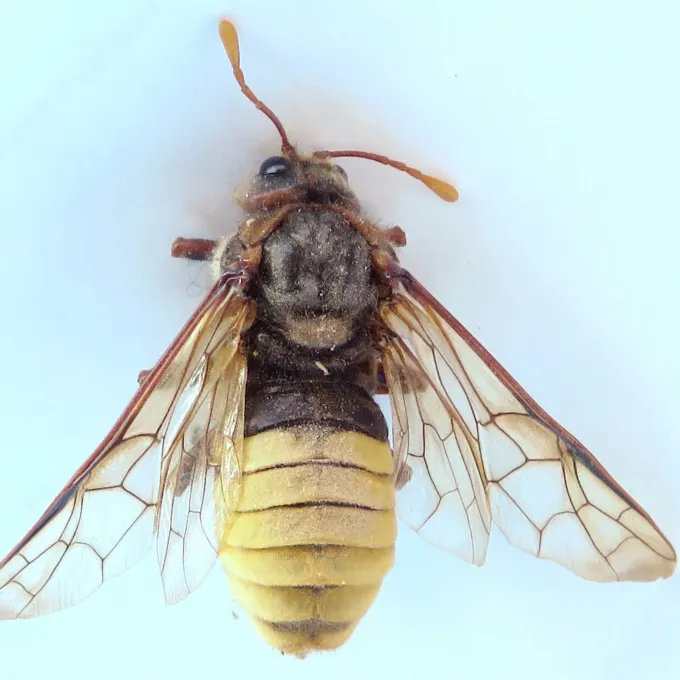
Description
How to identify
The beech sawfly (Cimbex fagi) is a member of the Cimbicidae family, part of the order Hymenoptera. Despite their size and resemblance to hornets, these insects do not possess a sting and are harmless to humans.
They are characterized by their club-shaped antennae, a key feature for identifying members of the Cimbicidae family. The adults are generally dark-bodied, sometimes with a metallic sheen, and possess darkened wings.
The larvae resemble butterfly caterpillars but can be distinguished by their greater number of prolegs. They are typically light in color, often yellowish or pale green, providing excellent camouflage against beech foliage.
The life cycle involves complete metamorphosis: egg, larva, pupa, and adult. The sawfly completes its development by spinning tough, parchment-like cocoons, often located in the soil or leaf litter beneath host trees.
Adults are most active during warm, sunny days, which facilitates mating and the search for suitable oviposition sites on the host plant's leaves.
What it damages
The primary host for this species is the common beech (Fagus sylvatica). The larvae feed voraciously on the leaves, causing significant physiological stress to the tree during the growing season.
Early-stage larvae typically create small holes in the leaf blades, whereas older, more mature larvae are capable of consuming entire leaves, leaving behind only the thicker midribs and main veins.
Heavy infestations can lead to widespread defoliation, which severely hampers the tree's ability to photosynthesize and store energy reserves for the following year.
Weakened trees become significantly more susceptible to secondary attacks from wood-boring insects and opportunistic fungal pathogens that exploit the tree's reduced vitality.
Persistent damage over multiple growing seasons can result in reduced timber increment and may contribute to the premature decline and dieback of beech stands.
When it appears
Adult sawflies emerge in the spring, typically between May and early June, once the beech canopy has fully developed its leaves to provide ample nutrition for the larvae.
Females use a specialized saw-like ovipositor to cut slits into the leaf tissue, where they deposit their eggs. The rate of larval development is highly dependent on ambient temperature conditions.
Larval feeding activity persists throughout the summer months, with the most severe damage usually observed in the latter half of the season as larvae grow in size.
As autumn approaches, the mature larvae descend to the ground, where they enter the soil or leaf litter to construct their cocoons and prepare for the winter diapause.
The species is univoltine, completing only one generation per year; however, their ability to concentrate on specific trees makes them a notable forest pest when population levels spike.
Signs of infestation
The first signs of infestation are irregular, jagged holes or missing sections along the margins of the beech leaves, indicating the presence of early larval feeding.
Close inspection of the foliage, particularly the underside, may reveal the pale-colored larvae. They often curl into a ring when disturbed or drop suddenly from the branch.
Accumulated frass (larval droppings) beneath the canopy is a clear indicator of a significant population of larvae feeding in the upper crown of the tree.
Yellowing of the foliage and premature leaf drop during the summer are common symptoms that indicate the tree is struggling with heavy feeding pressure from the pests.
A thinning canopy that appears more transparent than normal is a hallmark sign of a well-established infestation that has significantly reduced the tree's leaf surface area.
Control measures
Biological control methods are preferred in forest environments, involving the protection and encouragement of natural enemies such as parasitic wasps and predatory beetles that keep populations in check.
The use of biological insecticides, specifically those derived from Bacillus thuringiensis, offers an effective and environmentally friendly way to manage larval outbreaks.
In ornamental settings or high-value plantings, targeted applications of systemic insecticides can be used to protect the canopy if the infestation levels exceed damage thresholds.
Cultural practices, such as gently turning or tilling the soil beneath the canopy in the autumn, can help destroy the overwintering cocoons hidden in the ground.
- Conducting regular forest health monitoring.
- Removing deadwood and diseased branches to improve air circulation.
- Encouraging bird populations, which prey on sawfly larvae.
Taxonomy
- Latin name
- Cimbex fagi
- Order
- Hymenoptera
- Family
- Cimbicidae
- EPPO code
- CIMBFA
Discussion
No discussions yet — be the first.