
Zanna dohrni
Zanna dohrni
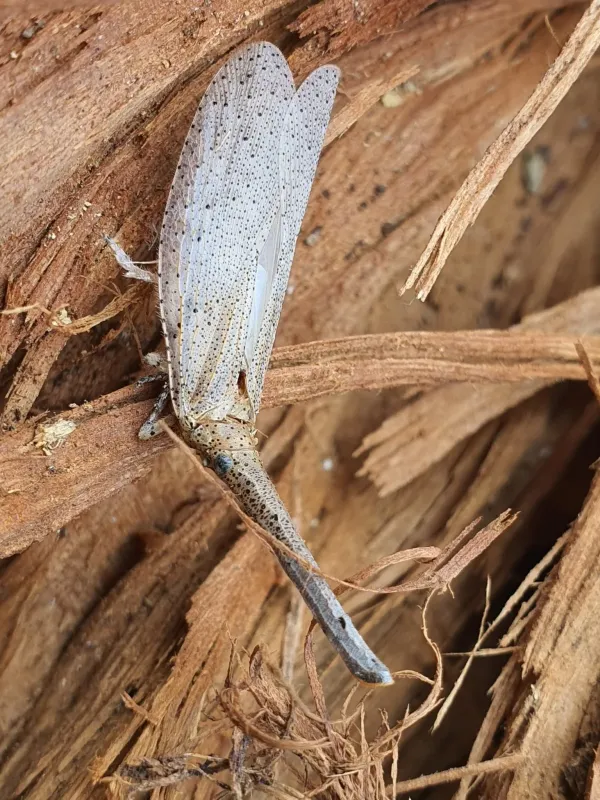
Description
How to identify
Zanna dohrni is a large insect belonging to the family Fulgoridae, order Hemiptera. The adult stage is characterized by a distinctive, horn-like growth on the head, which makes it easily recognizable among other members of the entomofauna.
The adult body has protective coloration that allows it to camouflage on tree bark. The wings feature complex venation, and the forewings are often covered with a mottled pattern, providing excellent mimicry in its natural habitat.
The nymphs of Zanna dohrni undergo several stages of development, gradually increasing in size and acquiring the traits of the adult insect. At different stages, they may change color, helping them remain unnoticed by predators.
This species prefers to settle on the trunks and large branches of woody plants, where the insects lead a secretive lifestyle. They rarely move abruptly unless disturbed, preferring to remain stationary during the daytime.
The taxonomy of this species places it in the subfamily Fulgorinae, whose members are known for their unusual morphological growths on the head, which can reach significant sizes in some species.
What it damages
The pest primarily affects woody crops, including fruit trees and certain types of ornamental plants. Significant damage occurs in regions with tropical and subtropical climates, where insect populations can reach high density.
The primary method of feeding for Zanna dohrni is sucking plant sap (phloem) from tree bark. During mass outbreaks, the pest can significantly weaken the plant, leading to stunted growth and reduced productivity.
During feeding, the insects secrete large amounts of honeydew (sugary excrement). These sticky secretions become an ideal breeding ground for sooty mold, which covers leaves and branches with a black coating.
Sooty mold interferes with photosynthesis, further stressing the tree and making it more vulnerable to secondary infections. In neglected cases, affected branches may begin to die off, affecting the overall health of the tree.
- Weakening of the overall immune system of fruit trees.
- Appearance of secondary fungal bark diseases.
- Interruption of photosynthesis due to sooty mold.
- Reduction in yield and fruit quality.
Signs of infestation
The first sign of infestation is the presence of adult specimens on tree trunks. Thanks to their specific head shape, they can be spotted upon careful inspection of the bark, especially after rain or during morning hours.
The presence of a sticky coating (honeydew) on the surface of leaves and branches is a reliable sign of sucking insect colonies. If you see mass gatherings of ants feeding on the honeydew, this also indicates pest activity.
The appearance of a black coating—sooty mold—on leaves indicates that the pest has been parasitizing the plant for a long time. This requires immediate intervention to prevent the death of affected parts.
Gradual drying of individual branches or areas of bark may indicate that intensive sap extraction is occurring in that location. In the spots where the insect's proboscis has punctured the bark, small amounts of sap or resin may be visible.
The presence of specific nymphal exuviae (shed skins) remaining on the bark confirms the pest's life cycle directly on the infested tree. This is an important signal to begin population monitoring.
Control measures
Control of Zanna dohrni begins with monitoring and mechanical cleaning of the bark to remove nymphs and egg masses. Using stiff brushes allows for the effective removal of pests from affected areas without harming the plant itself.
The application of contact insecticides based on pyrethroids is effective against adults. It is important to carry out treatments during the period of peak insect activity, thoroughly soaking the bark of trunks and branch forks.
For long-term protection, it is recommended to use systemic pesticides that penetrate the plant tissues. The sap containing the active ingredient makes the plant unsuitable for the pest to feed on, leading to population decline.
An important element of protection is agrotechnical control, aimed at thinning out tree canopies. Good ventilation and light exposure make the tree a less attractive place for pest colonization.
Biological control methods include the use of entomophages—natural predators and parasitoids that limit the population of Zanna dohrni. In some cases, the use of fungal preparations that infect insects in natural conditions can be effective.
Taxonomy
- Latin name
- Zanna dohrni
- Order
- Hemiptera (bugs, aphids, leafhoppers)
- Family
- Fulgoridae
- EPPO code
- ZANNDO
Discussion
No discussions yet — be the first.