
Spotted lanternfly
Lycorma
Description
How to identify
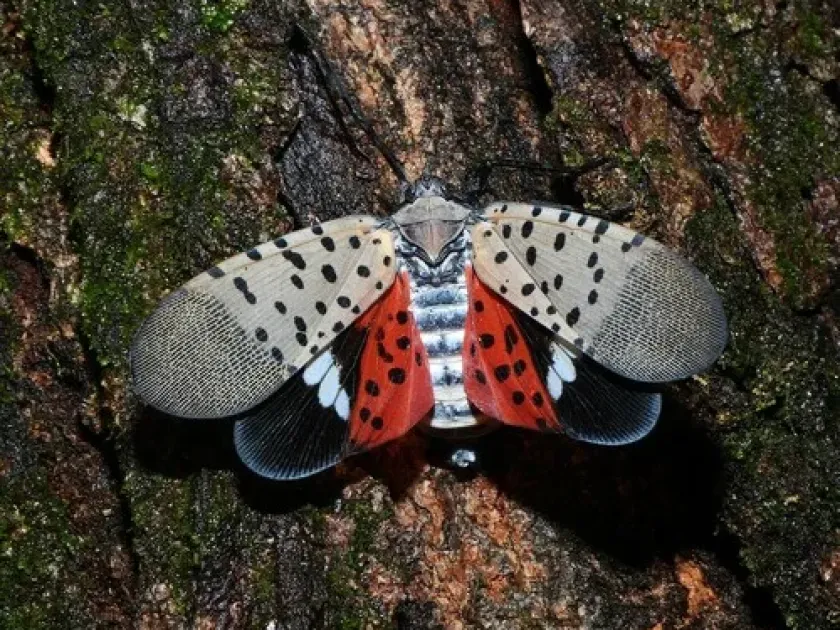
The spotted lanternfly (Lycorma delicatula) is a planthopper belonging to the family Fulgoridae. Adult specimens grow up to 2.5 cm long and are easily recognizable by their wings: forewings are grey with black spots, while hindwings are bright red with black patches at the base.
Nymphs go through several stages of development. Early-stage nymphs are small, black insects with white spots. As they grow, they develop a distinctive bright red color with black stripes and white dots, making them highly visible on infested plants.
Egg masses laid by females look like patches of grey mud or putty. They are protected by a waxy substance that hardens over time, making the eggs extremely resilient and difficult to notice on tree bark, stone surfaces, or man-made objects.
The Tree of Heaven (Ailanthus altissima) is a preferred host plant for the spotted lanternfly. Finding these trees on your property is a strong indicator that the area may be suitable for the lanternfly to establish a population.
Adult insects are highly mobile and possess strong jumping capabilities, which makes them difficult to catch manually. They often gather in large, dense colonies on tree trunks, particularly during the early morning or late evening hours.
What it damages
The spotted lanternfly is a polyphagous pest, known to feed on over 70 different plant species. It poses a significant threat to vineyards, fruit trees like peaches and apples, and various ornamental hardwoods.
The insect feeds by piercing the plant tissue and extracting sap from the phloem. This process severely weakens the plant, stunts its growth, and in cases of heavy infestation, can eventually lead to the death of the host plant.
While feeding, the insect excretes large amounts of honeydew. This sticky substance encourages the growth of sooty mold, a black fungus that covers the leaves, blocks sunlight, and significantly hinders the plant’s ability to photosynthesize.
Vineyards are particularly vulnerable to lanternfly damage. Beyond direct sap depletion, the pest reduces the cold hardiness of grapevines, often causing them to die back during the winter months after an infestation season.
Large-scale infestations result in substantial economic losses, forcing farmers to implement rigorous and costly pesticide programs to save their crops from total ruin and to prevent the spread of the insect to nearby fields.
When it appears
The spotted lanternfly completes one generation per year. It overwinters in the egg stage. Eggs are laid in late autumn on virtually any hard surface, including tree trunks, wooden fences, vehicles, and gardening equipment.
In the spring, usually around May, the eggs hatch into first-instar nymphs. These nymphs start feeding on various soft-stemmed plants and shoots, moving frequently between hosts to find the most nutrient-rich sap available.
As the season progresses, the nymphs develop into later stages. By mid-summer, they become much larger and begin to target larger branches and trunks of woody trees, where they continue their aggressive feeding cycle.
Adult lanternflies emerge in late summer. This is the period of peak mobility and activity, as adults seek mates and find suitable locations to lay their eggs for the next year’s generation before the frost settles.
When autumn temperatures drop consistently, the insects’ activity decreases. Females focus entirely on finding protected surfaces to deposit their egg masses, ensuring the survival of the species throughout the cold winter months.
Signs of infestation
The most common sign of an infestation is observing clusters of insects on tree trunks. They often appear as moving patches and can be heard due to the sound their wings make when they take flight in groups.
A shiny, sticky residue (honeydew) on the leaves and at the base of the tree is a classic symptom of lanternfly presence. This residue often attracts other insects such as wasps, ants, and bees to the infested area.
The appearance of black sooty mold on the leaves and bark is a secondary symptom. It indicates that the tree has been colonized by lanternflies for some time and the resulting honeydew has provided enough fuel for the fungus to thrive.
Finding egg masses during the dormant season is a critical sign of a local population. These masses are often found on tree trunks, but also on outdoor furniture, stone walls, and recreational vehicles.
Wilting of branches or premature leaf drop, in the absence of other obvious pathogens, can be a sign that the tree is suffering from the intense stress of hosting a large colony of sap-sucking lanternflies.
Control measures
Mechanical removal of egg masses during the winter is the most effective way to keep the population in check. Scrape the masses off the surfaces and dispose of them using alcohol or by crushing them to ensure they cannot hatch.
Applying sticky bands to tree trunks during the spring and early summer is highly recommended to trap nymphs. Since the nymphs must climb up the tree to feed, these bands prevent them from reaching their destination.
Chemical control involving systemic insecticides is the standard for managing heavy infestations of adults. These chemicals are absorbed by the plant, making it toxic to the lanternflies that feed on the sap.
Quarantine measures are essential for prevention. Always inspect vehicles and cargo moved from infested regions to prevent the accidental transport of egg masses or adult insects into non-infested areas.
Management of the landscape, specifically the removal of the Tree of Heaven, can drastically reduce the attractiveness of your property to the pest, making it harder for the lanternfly to find a suitable breeding and feeding ground.
Taxonomy
- Latin name
- Lycorma
- Order
- Hemiptera (bugs, aphids, leafhoppers)
- Family
- Fulgoridae
- EPPO code
- LYCMSP
Discussion
No discussions yet — be the first.