
Spotted lanternfly
Lycorma delicatula
Description
How to identify
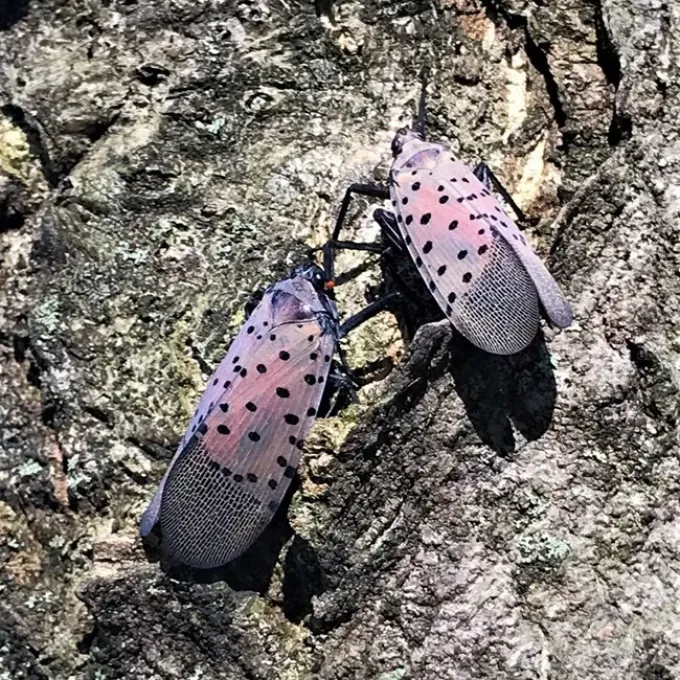
The Spotted lanternfly (Lycorma delicatula) is an invasive planthopper from the Fulgoridae family. An adult is approximately 1 inch long with grayish forewings featuring black spots and vibrant red hindwings with black patches, often seen when they are in flight.
The egg masses of this pest are distinctive yet camouflaged. They resemble smears of gray mud or putty plastered on tree trunks, stones, or smooth surfaces. These masses are covered with a waxy substance that hardens to protect the eggs throughout the winter months.
Nymphs develop through four stages. In the first three stages, they appear as small black insects with white spots. In their fourth stage, they turn a striking red color with black and white markings, making them highly visible during the mid-to-late summer months.
The insect possesses a specialized piercing-sucking mouthpart designed to feed on the phloem of plants. They are agile jumpers and fliers, which makes them difficult to catch manually without specialized equipment or traps designed for their behavior.
As a highly invasive species, they have become a major concern globally, traveling on vehicles and wood products. Their ability to adapt to various environments has led to rapid expansion across multiple geographical regions.
What it damages
The Spotted lanternfly is a polyphagous feeder that attacks over 70 different plant species. Primary targets include fruit trees, grapevines, maple trees, and ornamental woody plants, causing significant economic stress to both the agricultural and forestry sectors.
Tree of Heaven (Ailanthus altissima) serves as the preferred host plant for the lanternfly. The presence of this invasive tree often facilitates larger infestations, acting as a breeding ground that supports the survival and growth of the pest population.
Both nymphs and adults cause damage by extracting large quantities of sap from the host plant. This excessive feeding weakens the plant, reducing its ability to photosynthesize and survive harsh winters or periods of drought.
The secretion of honeydew—a sugary substance excreted during feeding—triggers the growth of sooty mold. This fungus coats leaves and branches, blocking sunlight and further stressing the tree's health while also attracting ants and wasps.
Severe infestations can lead to heavy branch dieback and, in vulnerable crops like grapevines, can eventually result in the total death of the vine if left untreated over several consecutive seasons.
When it appears
The life cycle initiates in the spring when nymphs emerge from over-wintered egg masses, typically beginning in May. These early stages are highly mobile and start searching for succulent plant growth to feed upon immediately.
Throughout the summer months (June to August), nymphs undergo multiple molts, increasing in size and moving across the host trees. This is the period when they are most frequently observed by residents and farmers alike.
Adults emerge in late summer, usually around August, and remain active until the first hard frosts. This is the stage when mating occurs, and adults are prone to long-distance dispersal, often hitchhiking on vehicles or moving to new hosts.
Egg-laying takes place in autumn, starting in September and continuing until the first freezing temperatures arrive. Once the eggs are deposited, the adults die off, leaving the hardy egg masses to endure the winter.
The seasonality of this pest is crucial for management, as the late-summer and early-autumn window offers the most significant opportunity to observe adult swarms and implement control measures before the next year's generation is established.
Signs of infestation
A primary sign of infestation is the buildup of honeydew on the leaves, branches, and the ground directly beneath the tree. The presence of this sticky substance is a strong indicator of a high concentration of feeding nymphs or adults.
The appearance of a thick, black, powdery sooty mold on the tree canopy or the ground below is a definitive sign of long-term infestation. This mold thrives on the honeydew and indicates that the pest has been active for some time.
Increased activity of ants, wasps, and bees around the trunk of a tree is a secondary indicator. These insects are attracted to the sugary honeydew and often swarm the area, providing a visual cue of the pest’s presence.
Finding egg masses on tree bark, outdoor furniture, or stone walls during the late autumn or winter is a critical sign of a potential localized population, especially in areas where host trees are present.
If you encounter a tree that appears to have an unusual number of jumping insects or sudden swarms when the branches are disturbed, it is highly likely that a colony of Spotted lanternfly has established itself nearby.
Control measures
The most effective strategy is the removal of the Tree of Heaven (Ailanthus altissima) from your landscape. By eliminating this preferred host, you significantly reduce the attractiveness of your property to the pest and limit its ability to reproduce successfully.
Manual destruction of egg masses is a highly recommended practice during the winter months. Using a hard scraper or stiff brush to remove the egg masses from trunks and destroying them in alcohol will prevent those eggs from hatching in the spring.
Sticky traps and tree bands can be wrapped around the trunks of trees to capture nymphs as they move up and down. It is essential to use protective screening or netting over the tape to ensure that birds and other beneficial creatures are not accidentally harmed.
Chemical control using contact insecticides may be necessary for heavy infestations. These treatments should be applied following the specific guidelines provided by agricultural extension services to maximize effectiveness while minimizing the impact on non-target species.
- Conduct regular monitoring of your garden.
- Use professional insecticidal treatments as needed.
- Report sightings to local agricultural authorities.
- Support the growth of natural predators.
Taxonomy
- Latin name
- Lycorma delicatula
- Order
- Hemiptera (bugs, aphids, leafhoppers)
- Family
- Fulgoridae
- EPPO code
- LYCMDE
Discussion
No discussions yet — be the first.