
Lanternfly
Fulgora
Description
How to identify
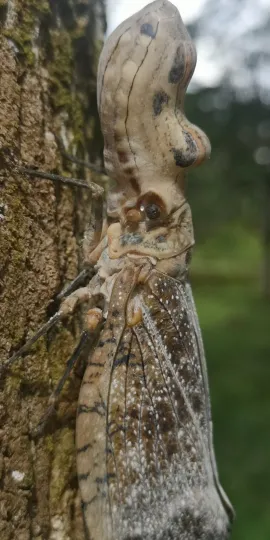
The lanternfly (genus Fulgora) belongs to the order Hemiptera, family Fulgoridae. These are large insects, often characterized by bright coloration and a distinctive head shape that resembles a lantern or a peanut.
Adults possess well-developed wings, frequently featuring an "eye" pattern that serves as a deterrent against natural predators. Their body size can reach several centimeters.
Larval stages undergo several instars, gradually developing adult features. Unlike adults, nymphs are less mobile and prefer to remain on the undersides of leaves.
Systematically, this genus is part of a broad group of jumping insects known for their ability to move rapidly when threatened.
Morphologically, lanternflies are adapted to tropical and subtropical environments, utilizing a specialized proboscis to pierce plant tissues and feed on sap.
What it damages
This pest primarily affects woody and shrubby crops. Tropical fruit trees, vines, and certain ornamental species are particularly susceptible to infestations.
The insect feeds by sucking sap from the plant's phloem, which leads to significant losses of moisture and nutrients in the affected plant parts.
Beyond direct mechanical damage, lanternflies act as vectors for various phytopathogens, including fungal diseases and viral infections of woody plants.
Secondary infections often develop at the sites of proboscis punctures, as the plant becomes weakened and vulnerable to pathogenic microflora.
During mass outbreaks, lanternflies can suppress the growth of young shoots, reduce the quality of fruit, and even kill severely weakened individual plants.
When it appears
The life cycle of the lanternfly is closely linked to seasonal rainfall and the temperature regime of its habitat. Insect activity increases during the warm, wet season.
Egg-laying typically occurs in bark crevices or on leaf surfaces, protected by a special secretion produced by the female to prevent the clutch from drying out.
The population peak is observed in the middle of the growing season when environmental conditions are most favorable for the development of multiple generations.
As the dry season or colder temperatures arrive, the metabolic activity of the lanternfly decreases, and they may enter a diapause state at specific developmental stages.
The speed of the life cycle depends heavily on the availability of nutrients in the host plant tissues and the prevailing climatic conditions.
Signs of infestation
The first sign of lanternfly presence is the discovery of sticky excrement on leaves, known as honeydew, which quickly fosters the growth of sooty mold.
Visually, the pest can be identified by the presence of adults on tree trunks or large branches, which are easily spotted due to their unique appearance.
In damaged areas, one may observe yellowing and premature leaf drop, indicating a disruption in photosynthesis due to sap depletion.
- Development of "black residue" (sooty mold) on leaves and branches.
- Curling of young shoots and deformation of leaf plates.
- Presence of insect clusters on branches during evening or morning hours.
A slowdown in overall plant growth and a noticeable decline in seasonal yield are critical indicators of severe infestation.
Control measures
The primary control method is good horticultural practice, including timely sanitary pruning of infested branches and maintaining an optimal water balance.
The use of biological control agents, such as natural entomophagous predators, has shown success in reducing lanternfly populations in both greenhouses and open fields.
Chemical control with contact insecticides is recommended only during high-level infestations when other methods do not provide sufficient results.
An essential element of management is monitoring orchard conditions using sticky traps, which helps to detect the onset of mass outbreaks early.
Cleaning tree trunks of old bark helps to destroy potential egg-laying sites, thereby reducing the risk of re-infestation in the following season.
Taxonomy
- Latin name
- Fulgora
- Order
- Hemiptera (bugs, aphids, leafhoppers)
- Family
- Fulgoridae
- EPPO code
- FLGRSP
Discussion
No discussions yet — be the first.