
Xylotrechus sagittatus
Xylotrechus sagittatus
Description
How to identify
Xylotrechus sagittatus belongs to the Cerambycidae family, commonly known as longhorn beetles, within the order Coleoptera.
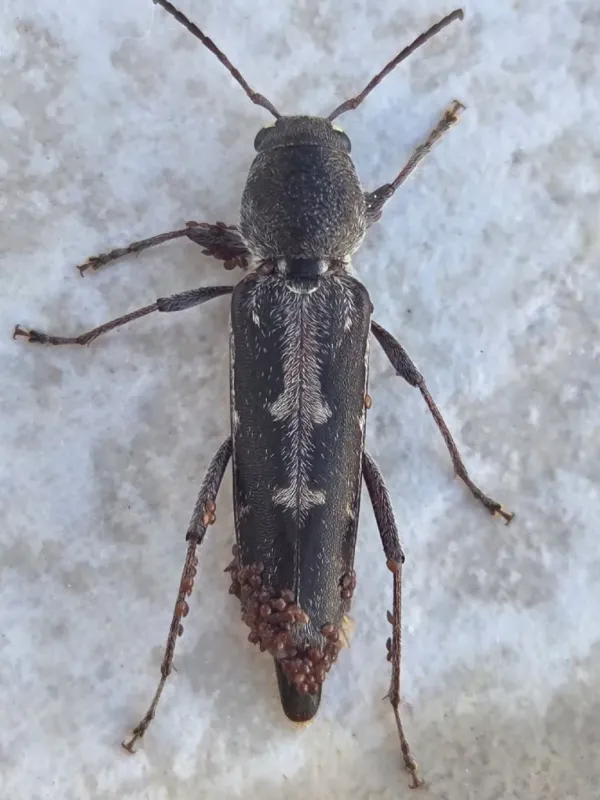
The adult beetle is recognized by its distinct arrow-shaped pattern on the elytra, which provides an effective camouflage against the bark of coniferous trees.
Its body is generally dark brown or black, densely covered with short hairs that accentuate its unique markings and cylindrical structure.
The larvae are typical of wood-boring longhorn beetles, featuring a soft, creamy-white, legless body with powerful, dark, sclerotized mandibles.
Identifying this species requires an understanding of its specific preferences for host trees, primarily focusing on pine and other softwood species.
What it damages
The primary hosts for this pest are coniferous trees, where the larvae tunnel deep into the sapwood and outer heartwood layers.
Feeding activity disrupts the vascular system of the tree, significantly impairing the transport of water and essential nutrients to the crown.
This physiological stress leaves the trees highly susceptible to secondary attacks by other bark beetles, wood-boring insects, and various pathogens.
The mechanical damage caused by larval tunneling reduces the timber quality, making the wood unsuitable for construction or high-value carpentry.
Under heavy infestation, the cumulative damage can lead to the rapid decline and death of mature tree stands, causing significant economic losses.
When it appears
Adult beetles typically emerge during the late spring and summer months when weather conditions are warm enough for their mating activities.
Females seek out suitable host trees, often choosing those already weakened or freshly felled, to deposit their eggs into bark crevices.
The developmental cycle of the beetle is relatively long, often spanning one to two years, depending heavily on the prevailing environmental temperatures.
Overwintering usually occurs in the larval stage, deep within the wood, which provides insulation against harsh winter temperatures and predation.
Pupation takes place inside the wood; once the transformation is complete, the adults emerge by chewing distinct exit holes through the bark.
Signs of infestation
Visible piles of frass, or fine wood dust, accumulating on the bark surface or at the base of the tree are primary indicators of larval feeding activity.
Circular or oval exit holes found on the trunks serve as definitive proof that adult beetles have completed their development and escaped.
Foliage symptoms such as chlorosis, yellowing, or browning needles indicate that the tree's health is severely compromised by the infestation.
Peeling away a portion of the bark reveals the intricate, winding galleries left behind by the larvae as they forage through the wood.
A weakened or thinning crown, coupled with the presence of multiple exit holes, is a strong sign of long-term infestation and potential tree failure.
Control measures
Sanitation measures, including the prompt removal and disposal of infested trees, are the most effective way to break the pest's reproductive cycle.
Reducing the availability of fresh slash and wood debris in forest areas prevents the attraction of new beetle populations to the site.
Fermone traps or chemical attractants can be deployed to monitor and manage local beetle populations, especially during the peak flight season.
In high-value ornamental plantings, preventative systemic or contact insecticides may be used to protect the trunks from egg-laying females.
- Implementing regular forest health inspections.
- Promoting biodiversity to encourage natural predators such as woodpeckers and parasitic wasps.
- Ensuring proper storage of harvested timber to prevent colonization by the beetle.
Taxonomy
- Latin name
- Xylotrechus sagittatus
- Order
- Coleoptera (beetles)
- Family
- Cerambycidae
- EPPO code
- XYLOSA
Discussion
No discussions yet — be the first.