
Longhorn beetle
Xylotrechus arvicola
Description
How to identify
The longhorn beetle (scientific name Xylotrechus arvicola) belongs to the family Cerambycidae, known for their long antennae and larvae that bore into the wood of living or dead trees.
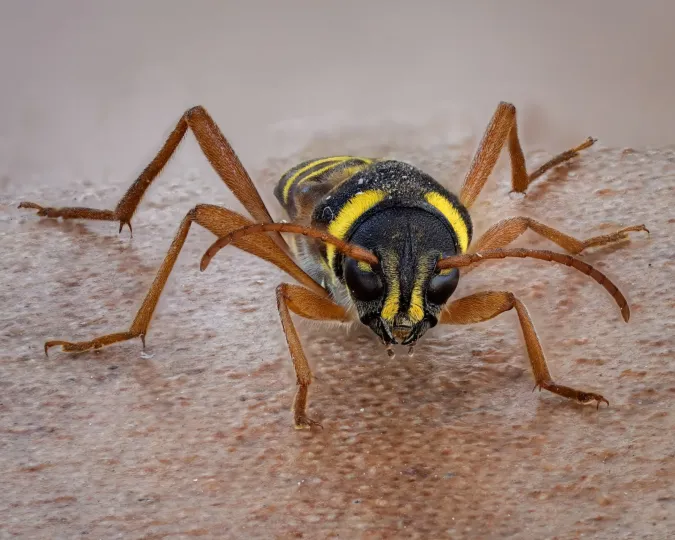
The adult beetle has an elongated body ranging from 10 to 20 mm in length. Its body color is dark brown or black, featuring distinct yellow or white transverse bands on the wing covers (elytra).
The larvae are cream-colored, legless, and possess a robust head with powerful mandibles designed for excavating wood. This internal phase of life makes them particularly difficult to detect.
The pupal stage occurs inside the host plant's wood. After completing their development, the pupae transform into adult beetles, which then chew their way to the surface to exit.
The life cycle of this beetle typically takes one to two years, depending on environmental temperatures and the health of the host plant species.
What it damages
This species is a significant threat to vineyards, where larvae burrow into the vines and trunks. Such damage severely compromises the structural integrity of the plant.
In addition to grapes, it attacks various fruit trees, including apples, pears, peaches, and plums, causing extensive damage to the heartwood and sapwood.
The primary harm is the disruption of the vascular system. As larvae cut through xylem and phloem, the flow of nutrients and water is obstructed, leading to wilting and death.
Once the wood is weakened, the plant becomes highly susceptible to secondary pathogens, including fungi and bacteria that cause wood rot and decline.
High infestation rates often lead to reduced fruit quality, loss of vigor, and the eventual death of the affected vine or tree, causing significant economic losses.
When it appears
The flight period for adult beetles usually occurs from late spring through early summer, typically peaking between May and July, when they mate.
Females deposit their eggs in crevices, pruning wounds, or areas of damaged bark, prioritizing weakened trees or vines for their offspring.
Upon hatching, the young larvae tunnel into the bark and move into the wood, where they spend the majority of their life cycle, feeding throughout the warm months.
Larvae overwinter inside the wood galleries. This protection allows them to survive low winter temperatures and provides shelter from most environmental predators.
Development concludes in the spring when larvae pupate. They remain in the pupal stage for several weeks before emerging as adults to start the cycle again.
Signs of infestation
The most reliable sign of an infestation is the presence of small, round, or oval exit holes on the trunk or stems, indicating where adults have emerged.
Fine wood shavings, often called frass or boring dust, can usually be found at the base of the tree or on the surface of the bark, pushed out by the larvae.
Visual symptoms on the plant include yellowing of leaves (chlorosis), stunted shoot growth, and a general lack of vitality that cannot be explained by nutrient deficiency.
Careful inspection of the wood reveals complex, winding galleries carved into the interior tissue, often clogged with wood fibers and larval excrement.
Rapid wilting and death of specific branches or entire sections of a vine are definitive signs that the larval galleries have girdled the wood internally.
Control measures
Effective management begins with sanitation. Pruning and removing severely infested branches or entire vines is essential to lower the pest population.
Maintaining high plant vigor through proper fertilization, irrigation, and avoiding unnecessary mechanical injuries to the trunks is the best preventative strategy.
Chemical control should be timed to match the adult emergence period. Once the larvae are deep within the wood, contact insecticides become ineffective.
Monitoring using pheromone traps is a useful tool to determine the exact flight time, allowing for precision in applying protective treatments to the bark.
- Prune and destroy all wood showing signs of larval activity.
- Seal pruning wounds with horticultural paste to prevent egg-laying.
- Apply contact insecticides during the peak flight of adult beetles.
- Monitor vine health and remove severely damaged specimens annually.
Taxonomy
- Latin name
- Xylotrechus arvicola
- Order
- Coleoptera (beetles)
- Family
- Cerambycidae
- EPPO code
- XYLOAR
Discussion
No discussions yet — be the first.