
Four-spotted carrion beetle
Xylodrepa quadripunctata
Description
How to identify
The four-spotted carrion beetle (Xylodrepa quadripunctata) belongs to the Silphidae family, order Coleoptera. Despite its name, this species is primarily predatory rather than a scavenger.
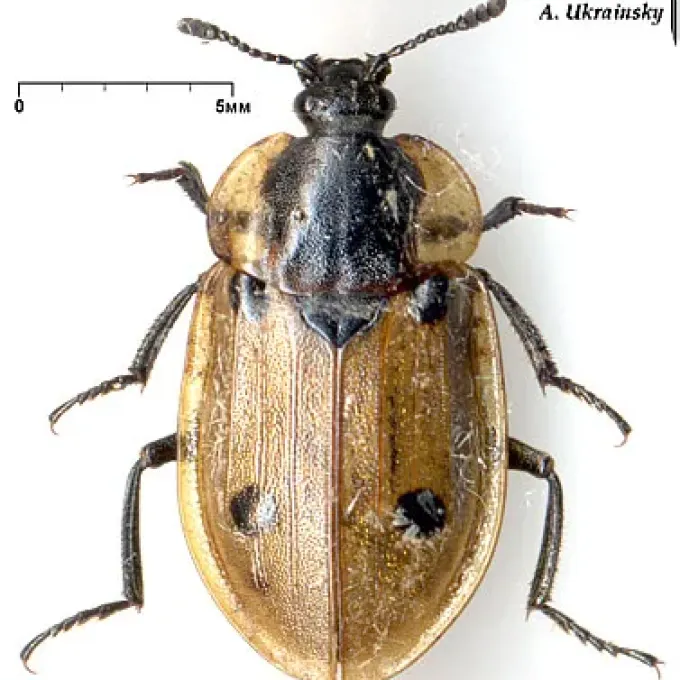
Adult beetles are identified by their yellowish-brown elytra, each marked with two distinct black spots, totaling four spots on the back. The pronotum is black with a yellow border.
They typically reach 12–16 mm in length. Their body shape is flattened, allowing them to crawl easily across tree bark and foliage while hunting for prey.
The larvae of this beetle are dark-colored, flattened, and resemble woodlice. They are highly active and demonstrate excellent climbing abilities on trees and shrubs.
The complete life cycle includes egg, larval, pupal, and adult stages, with metamorphosis occurring primarily within the soil or forest litter.
What it damages
The four-spotted carrion beetle is not a pest of agricultural or garden plants. It does not feed on leaves, fruits, or any plant tissues, making it harmless to crops.
Instead, it serves as a specialized predator of leaf-eating caterpillars, particularly those of the Lymantriidae family and various Geometridae moths.
Both the larvae and the adult beetles are voracious hunters, capable of consuming significant numbers of caterpillars during their growth phase.
By controlling pest populations, they provide a valuable ecological service to forests, orchards, and woodland areas, preventing severe defoliation.
This beetle is considered an important natural enemy of forest pests, contributing to the biological balance of ecosystems.
When it appears
Adults emerge from their overwintering sites in the soil or forest litter during spring, typically in April and May, coinciding with rising temperatures.
Their activity period is synchronized with the hatching and development of the caterpillars they prey upon, ensuring an abundant food supply for their larvae.
Larval development occurs throughout late spring and early summer. Once they reach maturity, they descend to the ground to pupate in the soil.
New adults appear in late summer or early autumn, preparing for hibernation as temperatures begin to drop for the coming winter.
This seasonal synchronization allows the beetle to maximize its reproductive success and impact on pest population control.
Control measures
There is no need to control the four-spotted carrion beetle as it is a beneficial insect and a natural ally in plant protection programs.
Agricultural and forestry practices should focus on preserving the habitat of these beetles rather than applying broad-spectrum pesticides that could harm them.
When chemical pest management is necessary, it is highly recommended to use selective products that minimize impact on beneficial predatory insects.
Maintaining hedgerows, wild patches, and diverse vegetation helps support a stable population of this predator, which in turn reduces the need for chemicals.
Protecting these beetles is a key component of sustainable integrated pest management (IPM) in forest and orchard environments.
Taxonomy
- Latin name
- Xylodrepa quadripunctata
- Order
- Coleoptera (beetles)
- Family
- Silphidae
- EPPO code
- XYODQU
Discussion
No discussions yet — be the first.