
Beet carrion beetle
Blitophaga opaca
Description
How to identify
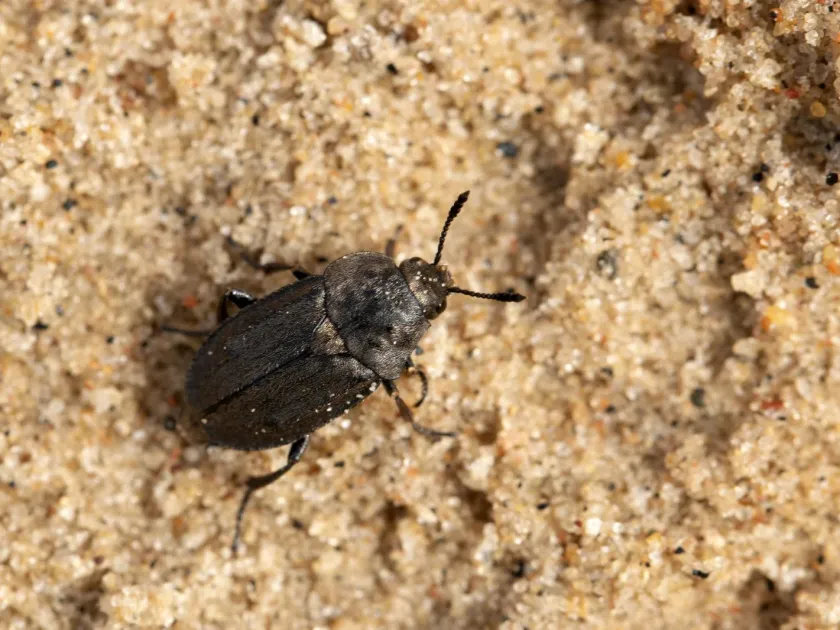
The beet carrion beetle (Blitophaga opaca) belongs to the family Silphidae within the order Coleoptera. Adult beetles are 9–12 mm long, characterized by a dull, matte body surface and a dark brown to black coloration.
The larvae of this species have a distinct, flattened appearance resembling woodlice. They are dark, have clearly segmented bodies with expanded lateral margins, and reach lengths of up to 18 mm in the final instar.
These insects are highly mobile, and adults are capable of flight, allowing them to migrate efficiently between fields in search of host plants.
The life cycle is holometabolous, meaning they undergo complete metamorphosis. After mating, females deposit eggs directly into the soil.
Pupation takes place in the soil, and the new generation of adults typically emerges in mid-summer, before seeking shelter for the winter season.
What it damages
This beetle is a significant pest primarily for crops in the Amaranthaceae family, with a particular preference for sugar beets, fodder beets, and table beets.
Both adult beetles and larvae are harmful, as they consume the foliage of host plants, causing extensive damage to the leaf tissue.
The most critical damage occurs during the seedling stage, where the insects can completely defoliate young plants or consume the growing point, leading to plant death.
Massive infestations can result in significant yield losses, often necessitating the reseeding of large areas of agricultural fields.
Even if plants survive, the loss of leaf area reduces the overall photosynthetic capacity, which negatively impacts the final yield and root quality.
When it appears
Overwintered adults emerge from the soil in early spring as soon as temperatures rise, often coinciding with the emergence of beet seedlings.
The peak period of activity and feeding for the adult population occurs during April and May, posing the greatest threat to young crops.
Larval activity is most intense during late spring, usually spanning May and June, which is a period of rapid plant growth.
New generation adults appear by mid-summer, but their impact on the crop is generally lower compared to the damage caused by the spring generation.
As temperatures begin to drop in late summer and autumn, the beetles move into the soil to enter diapause and overwinter.
Signs of infestation
The primary visual indicator of an infestation is the presence of irregular, ragged holes in the leaves of sugar beet plants.
- Ragged leaf edges or leaves reduced to mere skeletons.
- Presence of flat, dark larvae on the underside of leaves or near the base of the plant.
- Total destruction of the seedling canopy in certain patches of the field.
- Adult beetles often feign death when disturbed during inspection.
Severe infestations manifest as bald patches within the field where the population density of the beetle was exceptionally high.
Monitoring the undersides of leaves during the early morning hours often reveals the presence of larvae actively feeding on the crop.
Control measures
Effective management begins with robust agronomic practices, such as strict crop rotation to break the pest's life cycle and reduce population build-up.
Deep autumn plowing is a crucial control measure, as it disrupts the overwintering sites of the beetles and buries them, significantly reducing their survival rate.
Controlling weed host plants, especially members of the Amaranthaceae family, around field margins helps eliminate alternative food sources for the pests.
Seed treatment with systemic insecticides is the most effective proactive measure to protect young seedlings during the critical establishment phase.
When infestation levels exceed economic thresholds, foliar applications of approved insecticides are necessary to suppress the pest population and prevent crop failure.
Taxonomy
- Latin name
- Blitophaga opaca
- Order
- Coleoptera (beetles)
- Family
- Silphidae
- EPPO code
- BLITOP
Discussion
No discussions yet — be the first.