
Ablattaria laevigata
Ablattaria laevigata
Description
How to identify
Ablattaria laevigata belongs to the Silphidae family (carrion beetles) within the order Coleoptera. Unlike its relatives that scavenge on carcasses, this species has evolved into a specialized predator of terrestrial mollusks.
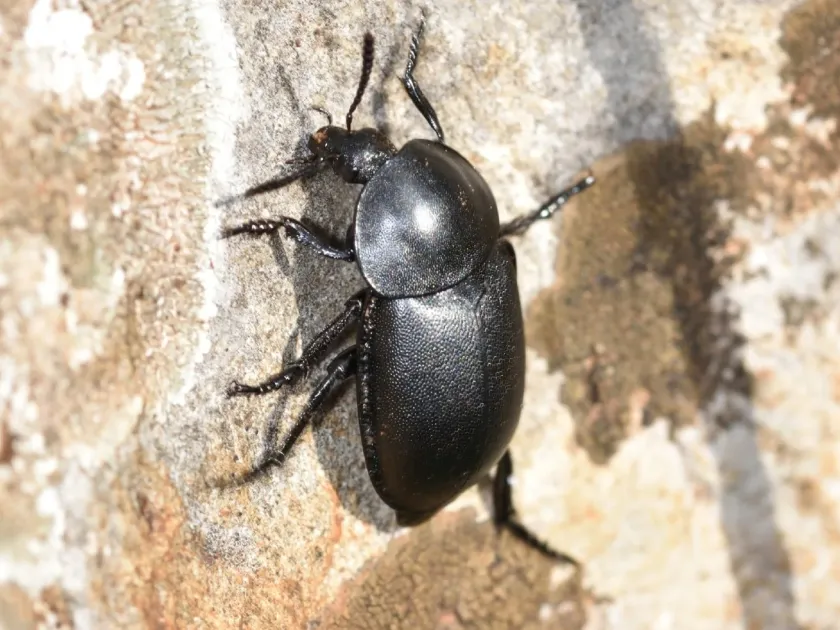
The adult beetle measures 10–14 mm in length. Its body is oval, flattened, and possesses a smooth, glossy black appearance. The wide pronotum and streamlined shape facilitate its movement through dense vegetation and soil litter.
The head is relatively small but equipped with powerful mandibles specifically adapted for piercing and crushing the shells of snails. The antennae have a distinct club-shaped tip, which is a classic feature of the silphid family.
Larvae are campodeiform, highly mobile, and flattened. Their bodies are covered with dark, hardened sclerotized plates, allowing them to remain protected while actively hunting their soft-bodied prey in the dark.
The lifecycle involves complete metamorphosis, consisting of the egg, three larval stages, pupa, and adult. Adults typically overwinter in the soil or under debris, emerging in early spring.
What it damages
Ablattaria laevigata is not considered a crop pest. On the contrary, it is an essential beneficial insect in agricultural ecosystems and home gardens due to its specialized predatory habits.
By preying on slugs and snails, these beetles act as a natural check on populations of mollusks that are responsible for significant damage to vegetable crops, including leafy greens, strawberries, and cabbage.
There is no evidence of this beetle causing direct damage to plants. They are strictly carnivorous and focus their energy on locating and consuming prey, making them a natural ally for farmers and gardeners.
The beetle's presence indicates a functioning natural ecosystem where biological control mechanisms are at work. Promoting their population helps reduce the need for synthetic molluscicides.
In cases where high snail populations exist, these beetles provide an effective and free service by reducing the damage to young seedlings and garden plants throughout the growing season.
When it appears
Adult activity peaks from April through August. They are most active during the twilight hours and at night, which is when they typically hunt for mollusks in damp, shaded environments.
The larval stage, which is the most aggressive feeding phase, usually occurs in June and July. During this time, they are highly dependent on moisture and presence of available snail prey.
During extended dry or hot weather, the beetles retreat into the soil to avoid dehydration. They enter a period of reduced activity until more favorable, humid conditions return to the soil surface.
Pupation takes place in the soil in late summer. After emergence, the new generation of adults prepares for the upcoming winter by seeking sheltered spots under leaf litter or decaying organic matter.
The density of the population is tightly linked to the availability of mollusks in the area. A consistent supply of prey is essential for the beetle's successful reproduction and survival.
Control measures
There is no need for control measures against Ablattaria laevigata, as they are beneficial organisms. The primary goal for an agronomist is to ensure the preservation of this species.
Avoid using broad-spectrum insecticides, as these chemicals will kill both the pests and the natural predators. This disruption often leads to a resurgence of the very pests the farmer is trying to control.
Maintaining a balanced environment is key. Providing mulch, logs, or undisturbed patches of vegetation offers the necessary shelter for beetles to rest during the day and survive the winter.
If molluscicides are absolutely necessary to manage an infestation, use localized bait stations rather than broadcast spraying to minimize the impact on the beneficial beetle population.
- Avoid non-selective insecticide use.
- Provide natural habitat through leaf litter and mulch.
- Encourage biological control rather than chemical intervention.
Taxonomy
- Latin name
- Ablattaria laevigata
- Order
- Coleoptera (beetles)
- Family
- Silphidae
- EPPO code
- ABLALA
Discussion
No discussions yet — be the first.