
Common burying beetle
Necrophorus vespillo
Description
How to identify
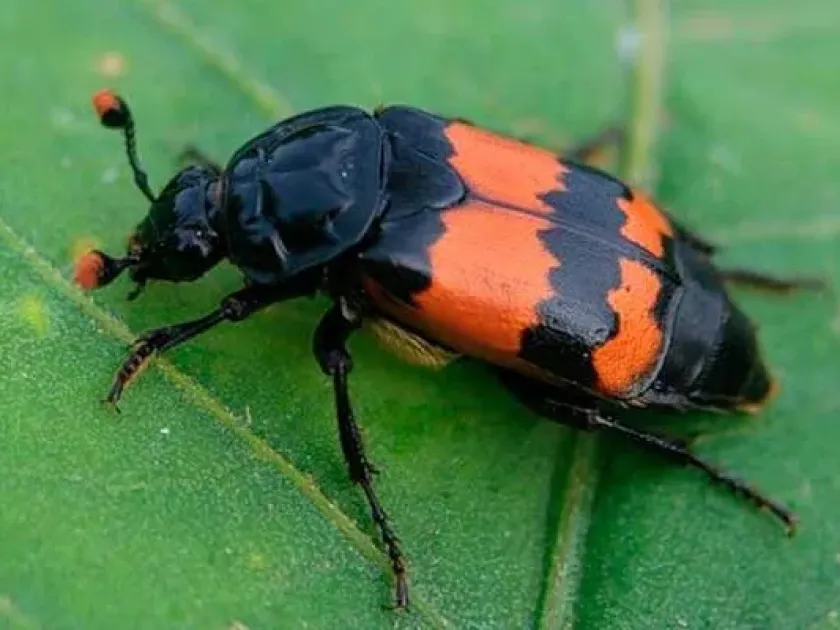
The common burying beetle (Necrophorus vespillo) belongs to the Silphidae family and is easily identified by its distinctive appearance.
The beetle typically reaches 12–22 mm in length, featuring a black body with two orange-red bands across its elytra, providing a warning coloration.
They possess club-shaped antennae that house specialized chemoreceptors, allowing them to detect the odor of a carcass from several kilometers away.
The legs of these beetles are specialized for efficient digging, as they bury small animal remains to create a food source for their larvae.
While they spend most of their time in the soil, they are not typically seen during daylight hours as they are mostly nocturnal or crepuscular.
What it damages
It is critical to note that the common burying beetle is not a plant pest and does not feed on crops, roots, or any plant tissues.
Often misidentified as a pest due to its presence in the soil, the beetle is purely a scavenger that helps decompose organic animal matter.
Because they actively move soil while burying carcasses, they are sometimes mistakenly blamed for damage to root systems or vegetable crops.
There is absolutely no record of this species causing agricultural damage or yield loss, making it ecologically harmless to farming operations.
Farmers and gardeners should recognize these beetles as beneficial organisms that assist in nutrient cycling and soil sanitation.
When it appears
These beetles are primarily active during the warmer months, ranging from late spring through late summer when carcasses are available for reproduction.
Their life cycle consists of a complete metamorphosis, where the larvae develop inside a buried carcass prepared by the parents.
As the ambient temperature rises, adult beetles emerge from their winter dormancy in the deeper soil layers to begin their breeding season.
The survival and density of the local population depend entirely on the availability of small vertebrate carcasses rather than the presence of crops.
After the breeding cycle is complete, the new generation of adults seeks out sheltered spots in the ground to hibernate throughout the winter.
Control measures
Since the common burying beetle is not a pest, there are no recommended control measures or insecticide treatments for this species.
Applying pesticides to eliminate these beetles is discouraged as it disrupts the beneficial soil fauna and is an unnecessary use of chemicals.
If their presence is undesirable, simply maintaining a clean field and removing any dead animals will prevent the beetles from settling in that area.
Integrated pest management strategies prioritize the protection of beneficial scavengers to maintain a healthy ecosystem balance.
- Maintain field sanitation by removing animal remains.
- Avoid unnecessary chemical pesticide usage.
- Promote soil health by preserving natural scavengers.
Taxonomy
- Latin name
- Necrophorus vespillo
- Order
- Coleoptera (beetles)
- Family
- Silphidae
- EPPO code
- NECOVE
Discussion
No discussions yet — be the first.