
Royal palm bug
Xylastodoris luteolus
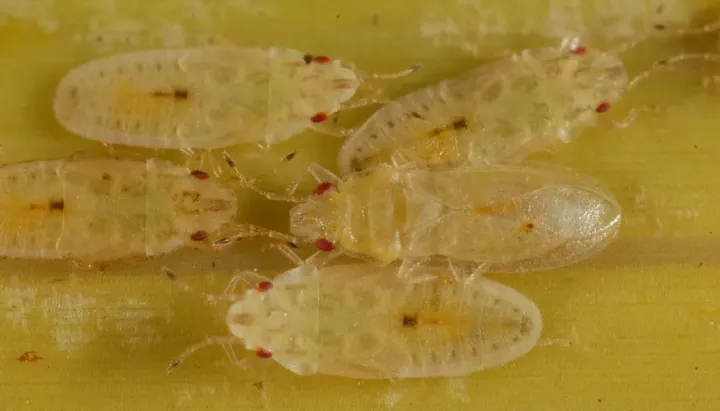
Description
How to identify
The Royal palm bug (Xylastodoris luteolus) is a minute insect belonging to the family Thaumastocoridae of the order Hemiptera. Adult bugs are approximately 2 mm in length and feature a flattened body typically colored in light yellow to brownish hues.
Due to their microscopic size and cryptic behavior, they are often difficult to detect during the early stages of infestation. They prefer to live deep within the folded parts of young palm fronds.
The life cycle includes the egg stage, five nymphal instars, and the adult stage. Eggs are primarily deposited along the veins on the undersides of young leaves, making them well-hidden from predators and initial inspections.
Development rates are highly dependent on temperature, with warmer climates facilitating faster life cycles. A complete generation can develop in just a few weeks under optimal conditions, leading to rapid population spikes.
These pests generally overwinter as adults or late-stage nymphs within the canopy, allowing them to resume feeding and reproduction immediately when favorable weather returns.
What it damages
The primary host for this pest is the Royal palm (Roystonea regia), though it can also infest various other decorative palm species, causing significant aesthetic and health decline.
Both adults and nymphs feed by piercing the plant tissue and extracting cellular sap. This feeding activity targets the most tender, growing leaves, which significantly impacts the palm's vigor.
Feeding results in chlorosis and necrotic spotting on the foliage. As the damage progresses, the leaves lose their green color, turn brown, and may eventually wither and drop prematurely.
Severe infestations cause a distorted growth pattern, leading to stunted fronds and a weakened tree that is prone to secondary issues like fungal infections or other insect attacks.
In landscaping and urban settings, the aesthetic impact is severe, as the canopy loses its vibrant green color and appears thin, withered, and generally unhealthy.
Signs of infestation
Initial signs of an infestation include the appearance of tiny yellow or brown spots on the leaflets, which indicate where the bugs have been feeding on the sap.
Evidence of feeding is often accompanied by the presence of small, dark fecal spots on the underside of the leaves and white, shed exuviae (cast skins) left behind by nymphs after molting.
Affected foliage tends to curl and dry out at the edges. A heavily infested tree will often have a dull, greyish or bronzed appearance instead of its natural healthy green color.
Newly emerging leaves may appear shredded or deformed. If the infestation is severe, the canopy may appear sparse due to the premature shedding of damaged leaves.
Detection can be confirmed by gently shaking young fronds over a white tray or paper, which will cause the small bugs to fall off, making them visible against the light background.
Control measures
Systemic insecticides are the preferred method for managing Royal palm bugs, as they are translocated throughout the tree, effectively poisoning the bugs as they feed on the sap.
For large trees in urban landscapes, systemic trunk injections are highly effective, as they provide long-lasting control without the drift associated with traditional canopy spraying.
Contact insecticides can provide temporary relief in lower-canopy infestations, but they require thorough coverage of the underside of all leaves to be effective.
Cultural practices include regular monitoring of the palm's canopy and pruning heavily damaged leaves to remove large populations of the pest from the tree.
- Implement a regular scouting program for early detection.
- Maintain tree health through proper fertilization and irrigation.
- Consult with local extension services to determine the best chemical application window.
Taxonomy
- Latin name
- Xylastodoris luteolus
- Order
- Hemiptera (bugs, aphids, leafhoppers)
- Family
- Lygaeidae
- EPPO code
- XYLDLU
Discussion
No discussions yet — be the first.