
Plane tree bug
Arocatus
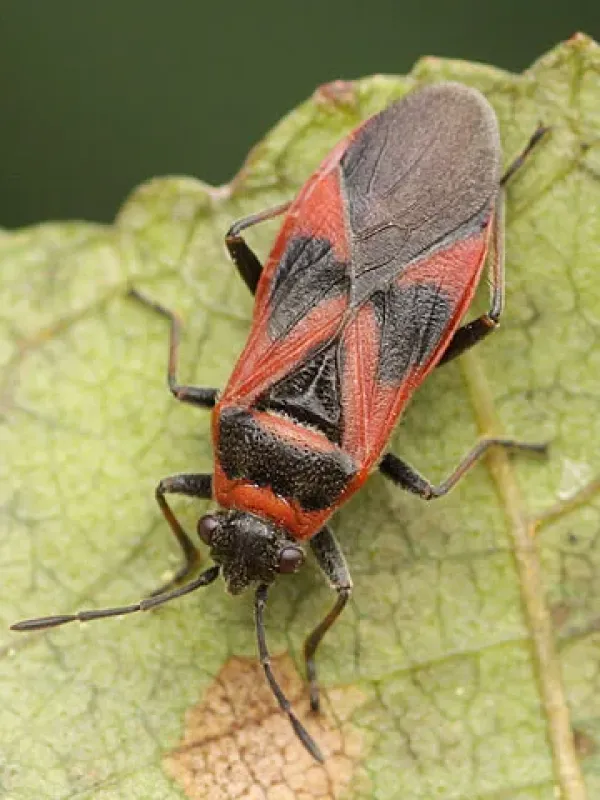
Description
How to identify
The plane tree bug, scientifically known as Arocatus melanocephalus, belongs to the Lygaeidae family within the order Hemiptera. These insects are easily recognized by their distinct black and reddish-brown coloration.
An adult bug typically measures between 6 to 8 mm in length. Its head and pronotum are predominantly black, while the wings feature reddish markings, providing a camouflage effect against the tree bark.
Nymphs of this species resemble smaller versions of the adults but lack fully developed wings. They often exhibit a brighter, reddish abdomen, which makes them highly visible when they cluster together in groups.
Like many members of its order, the bug is equipped with a piercing-sucking mouthpart. This adaptation allows it to feed efficiently on the sap of its host plant, causing physiological stress to the tree over time.
They are primarily associated with the genus Platanus. Their presence is usually localized to these trees, where they form dense colonies, especially during warmer months of the year.
What it damages
The primary host for Arocatus melanocephalus is the plane tree. The insects feed on the sap, which can cause premature yellowing, wilting of leaves, and general weakening of the tree's vitality if the infestation is severe.
Beyond the direct impact on trees, these bugs are considered a nuisance in urban areas. In late autumn, they often migrate toward buildings, entering homes and offices to find shelter for the winter.
Although mature trees can usually tolerate moderate feeding, heavy infestations can lead to decreased vigor and increased susceptibility to secondary environmental stressors or other pests.
The aesthetic value of urban parklands is often diminished by the presence of large colonies on tree trunks and the subsequent accumulation of their excrement on nearby structures.
While primarily a plant pest, their mass migration behavior poses a significant social challenge, often requiring management interventions even when the biological damage to the trees remains within manageable limits.
When it appears
The life cycle of the plane tree bug is strongly influenced by temperature changes throughout the year. Adults typically overwinter in protected areas, such as bark crevices or wall gaps.
Spring emergence occurs as temperatures rise. The bugs move from their hibernation sites back onto plane trees to begin their feeding cycle and start the process of reproduction.
Egg-laying usually occurs within the fissures of the bark. Throughout the summer, the population grows as nymphs hatch and begin to feed on the tender sap of the host plant.
Peak abundance is generally observed in mid-to-late summer. During this time, high-density colonies are found on the trunks and branches of plane trees, taking advantage of the active sap flow.
As autumn approaches, the insects begin to disperse. This pre-hibernation movement often leads to their congregation on vertical surfaces, including the facades of nearby houses and residential buildings.
Signs of infestation
The most prominent sign of an infestation is the visible clustering of adults and nymphs on the bark of plane trees. These aggregations can cover significant portions of the trunk.
Affected trees may show signs of canopy thinning or discolored leaves. This is the result of continuous sap extraction, which disrupts the tree’s internal nutrient transport and photosynthetic capacity.
Small chlorotic spots or necrotic lesions on the leaves, appearing as tiny dots, are indicative of feeding damage caused by the bug's proboscis piercing the leaf tissue.
A noticeable accumulation of dark fecal spots on the bark and nearby infrastructure serves as a clear indication of a long-standing and high-density population living in the tree.
In cases of massive infestations, a characteristic odor may be detected near the infested trees, which is a defensive mechanism employed by the bugs when disturbed.
Control measures
Effective control in urban landscapes relies on a combination of monitoring and targeted interventions. Chemical control using approved contact insecticides is common during the nymphal growth stages.
Physical maintenance, such as carefully removing loose bark from tree trunks during the winter, can drastically reduce the number of overwintering sites available to the pests.
Sanitation practices, including the raking and disposal of leaf litter, help interrupt the life cycle and reduce the population density for the following season.
For residential areas, sealing gaps around windows and using insect screens is recommended to prevent the bugs from entering homes during their autumn migration period.
- Application of targeted insecticides.
- Mechanical removal of loose bark.
- Removal and disposal of leaf litter.
- Installation of window screens.
- Monitoring population levels during peak periods.
Taxonomy
- Latin name
- Arocatus
- Order
- Hemiptera (bugs, aphids, leafhoppers)
- Family
- Lygaeidae
- EPPO code
- AROKSP
Discussion
No discussions yet — be the first.