
Black horntail
Xeris spectrum
Description
How to identify
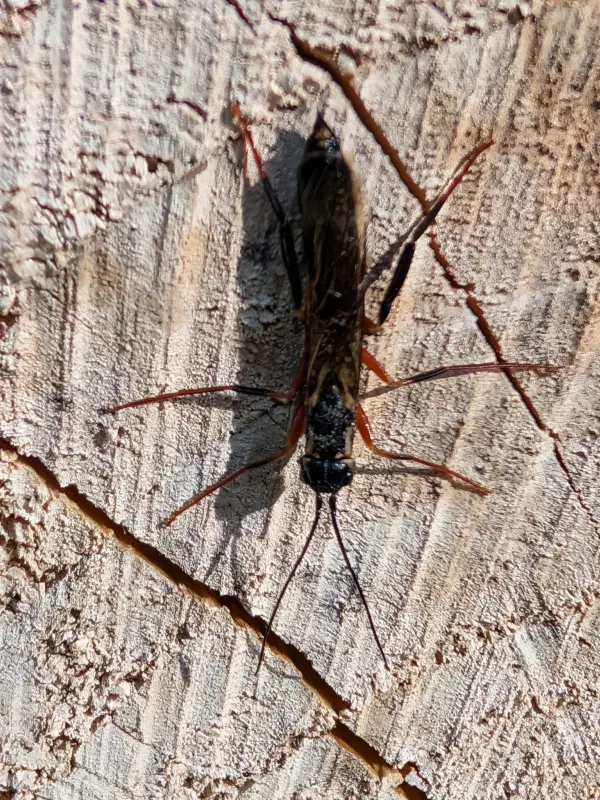
The black horntail (Xeris spectrum) is a species of wood wasp belonging to the family Siricidae (order Hymenoptera). Adults resemble large wasps but lack the characteristic narrow "waist" found in many other related species.
The body of the adult is primarily black, often with a slight metallic sheen. Females range from 15 to 30 mm in length and possess a prominent, rigid ovipositor that resembles a horn, which is used to deposit eggs deep into wood.
Males are generally smaller and exhibit distinct features such as flattened hind tibiae. Adults are non-feeding insects, focusing their short adult lifespan entirely on reproduction and dispersal.
The biology of the black horntail is intimately linked to the health of coniferous forests. They typically target stressed, dying, or recently felled timber to ensure their offspring have suitable resources for development.
Larvae are cream-colored, cylindrical, and equipped with a small, sharp spine at the end of the abdomen. They spend their entire developmental period hidden within the timber, carving out tunnels as they feed.
What it damages
The black horntail primarily infests coniferous species, with a particular preference for fir, spruce, and pine. They are most attracted to trees that are already weakened by disease, fire, or other pest outbreaks.
Healthy, vigorous trees are usually resistant to attacks, as their natural resin pressure effectively seals off the points where the female attempts to deposit her eggs, preventing larvae from establishing.
The economic impact of this pest is centered on the structural degradation of wood. The deep, circular tunnels created by the larvae significantly lower the grade of timber, making it unsuitable for high-quality construction or fine woodworking.
Furthermore, the horntail acts as a vector for various wood-decay fungi. As larvae bore through the tree, they spread these fungi, which accelerate wood rot and cause further structural collapse of the timber.
For the timber industry, this pest represents a significant risk to stored logs and lumber. Without proper monitoring and hygiene protocols, entire stockpiles can become infested and lose substantial market value.
When it appears
The adult flight period typically occurs during the summer months, spanning from June to August. During this window, adults emerge, mate, and search for suitable host trees for egg-laying.
The larval stage is prolonged and can last anywhere from one to three years, depending on environmental conditions, the moisture content of the wood, and the overall nutritional value of the host.
Pupation occurs within the wood during the spring or early summer. Upon completion of the metamorphosis, the adult bores a clean, circular exit hole to emerge from the timber and restart the cycle.
Development cycles can be significantly delayed in dry, processed timber. This creates an issue where insects may emerge inside homes or buildings from infested lumber that was harvested years prior.
Warm, dry summers tend to favor the development and survival of the species, often leading to increased activity levels and higher population densities in affected forest areas.
Signs of infestation
The most diagnostic sign of an infestation is the presence of perfectly circular exit holes, roughly 5–7 mm in diameter, on the surface of the bark or finished lumber.
Small pits on the bark, left by the female's ovipositor during the egg-laying process, may be visible. In some cases, localized resinosis (resin bleeding) occurs at these points as the tree attempts to defend itself.
Internal tunnels are circular and tightly packed with fine, sawdust-like frass. This pattern of damage distinguishes horntail activity from the galleries of various bark beetles, which are usually much shallower and distinct.
A decline in tree vigor, characterized by yellowing needles and eventual crown dieback, often indicates that the tree is heavily infested and unable to transport water and nutrients properly.
Fresh piles of frass at the base of trees or under log stacks are clear indicators of active larval boring and indicate that the infestation is currently in progress.
Control measures
The cornerstone of management is professional forest hygiene, which includes the prompt removal and utilization of dead or dying timber before the adults emerge to infest new trees.
Proper timber storage is critical to preventing damage. Storing logs in well-ventilated, dry locations and keeping them off the ground minimizes the appeal of the wood to foraging females.
For industrial lumber, heat treatment (kiln drying) is the most effective method for controlling the pest. Standard heat treatment schedules are sufficient to eliminate larvae at any stage of development.
Biological control relies on the protection of natural predators and parasitoids, particularly ichneumonid wasps, which seek out and parasitize horntail larvae within the wood.
Chemical control is generally impractical in forest settings due to the larvae's protected lifestyle. In storage facilities, insecticides may offer limited protection, but physical and thermal methods remain far superior.
Taxonomy
- Latin name
- Xeris spectrum
- Order
- Hymenoptera
- Family
- Siricidae
- EPPO code
- XERISE
Discussion
No discussions yet — be the first.