
California horntail
Sirex californicus
Description
How to identify
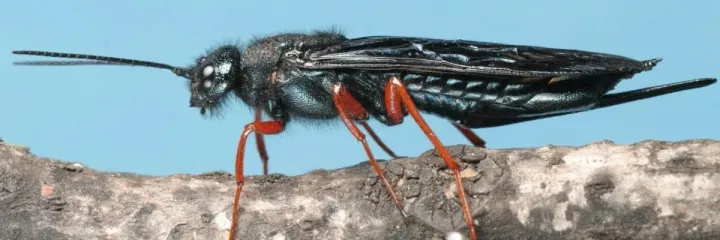
The California horntail Sirex californicus is a large member of the Siricidae family within the Hymenoptera order. Adult insects exhibit a cylindrical body shape, typically measuring 3 to 4 cm in length, often colored in dark blue-black or metallic shades.
Females are characterized by a prominent, horn-like ovipositor at the end of their abdomen. This structure, which resembles a sting, is used exclusively for drilling into wood to deposit eggs rather than for stinging humans.
Males are generally smaller than females and are easily distinguished by the presence of bright orange patches on their hind legs and abdomen. Larvae are white, cylindrical, and lack prolegs, reflecting their specialized adaptation to burrowing through dense wood fibers.
Accurate identification often requires professional entomological expertise due to the morphological similarities between various Sirex species, particularly concerning wing structure and leg pigmentation.
A key biological marker for identification is the association with Amylostereum fungi. The female introduces these fungal spores during egg-laying to initiate wood decay, which is essential for the larvae's digestive process.
What it damages
The California horntail primarily targets conifer species, including pines and firs. It shows a strong preference for trees that are stressed, weakened by drought, or recently felled in forest environments.
Larvae feed by creating deep, winding tunnels within the wood of the tree trunk. These galleries destroy the vascular system, preventing the transport of water and nutrients throughout the tree.
The tunnels are filled with frass, a dense mixture of wood shavings and excrement, which prevents airflow and encourages the spread of secondary wood-decay fungi within the stem.
While the pest typically attacks compromised trees, high-density infestations can eventually lead to attacks on healthy trees, significantly accelerating the mortality rate in forest stands.
The economic impact is significant for the timber industry, as infested wood sustains structural degradation, rendering it unsuitable for high-quality construction or carpentry work.
When it appears
Adult emergence and flight activity typically occur during the warmer summer months. During this period, females actively search for host trees that provide suitable conditions for their offspring.
The developmental life cycle from egg to adult usually spans between one and several years. This duration is highly dependent on environmental temperatures and the moisture content of the host tree.
Larvae overwinter inside the woody tissue. They continue to tunnel and grow even in colder months, provided that the internal temperature of the tree remains within the physiological limits for their development.
The emergence of adults leaves distinct, perfectly circular holes on the bark, marking the completion of the insect's life cycle and the beginning of a new generation.
Population surges are frequently linked to periods of extreme drought, which lower the tree's natural resin defense and make it more susceptible to female oviposition attempts.
Signs of infestation
The most visible indicator of an infestation is the presence of circular exit holes, approximately 3 to 6 mm in diameter, scattered across the surface of the bark.
Fine, powdery wood dust, known as frass, accumulates near the base of the tree or within bark crevices, indicating active feeding by larvae deep within the trunk.
Crown symptoms often include the premature yellowing or browning of needles, which signals that the vascular tissues have been severely disrupted by larval gallery formation.
Small, pin-sized pits on the bark surface may be observed, which are caused by the female's ovipositor during the process of evaluating the tree or laying eggs.
Discoloration of the sapwood, often caused by the symbiotic fungi introduced by the horntail, provides a clear internal sign of colonization when the tree is cross-sectioned.
Control measures
The most effective management strategy involves rigorous sanitation practices, including the prompt removal and disposal of weakened, diseased, or fallen trees to minimize breeding grounds.
Restricting the movement of raw timber from infested areas is crucial to prevent the accidental introduction of the California horntail into previously unaffected forest regions.
Biological control, primarily through the introduction or preservation of natural parasitoids such as certain wasp species, is widely considered the most sustainable long-term solution.
Chemical control is rarely effective for large-scale forest protection because the larvae reside protected deep within the wood, safe from topically applied insecticides.
- Monitoring population levels using pheromone-based traps.
- Enhancing forest health through proper silvicultural thinning.
- Promoting the survival of natural entomophagous predators.
- Mandatory phytosanitary inspections of exported timber products.
Taxonomy
- Latin name
- Sirex californicus
- Order
- Hymenoptera
- Family
- Siricidae
- EPPO code
- SIRXCA
Discussion
No discussions yet — be the first.