
Woodwasp
Sirex
Description
How to identify
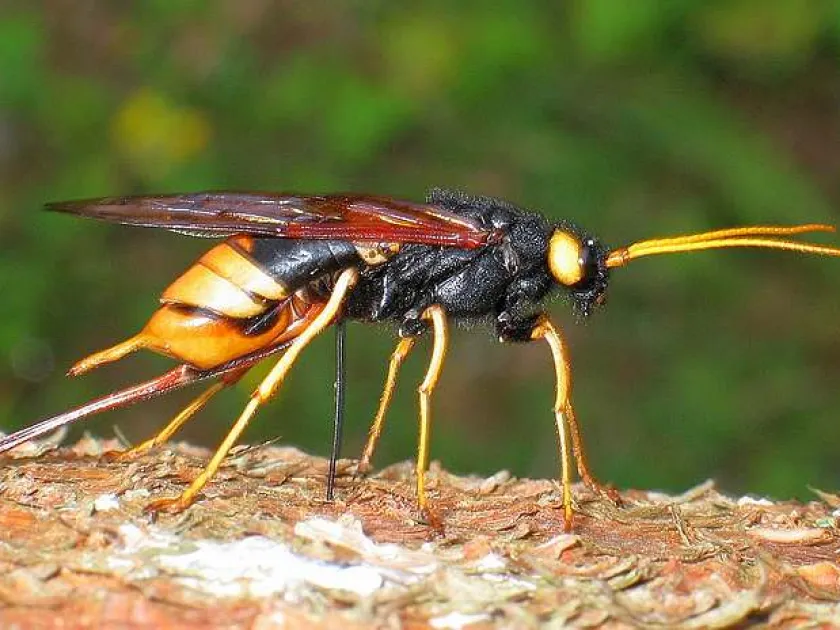
Woodwasps (family Siricidae, order Hymenoptera) are large insects that resemble wasps but lack the narrow waist characteristic of true wasps. Adult females typically measure 25–40 mm in length.
Females possess a long ovipositor, which is often mistaken for a stinger. They have a cylindrical body with a distinctive thorn-like projection at the end of the abdomen, which identifies them as members of this family.
The coloration of these insects varies from metallic blue or black to yellowish-brown with cross-bands, depending on the specific species, such as the invasive Sirex noctilio.
Larvae are whitish, cylindrical, and possess poorly developed thoracic legs. At the rear end of the larva's body, there is a distinct horny spine that aids in movement through the wood galleries.
Males are generally smaller than females and exhibit a dark coloration, sometimes with reddish markings, making them easily distinguishable during field observations.
What it damages
The primary hosts for woodwasps are coniferous trees, including spruce, fir, cedar, and pine. The pest prefers stressed, diseased, or freshly cut timber for oviposition.
Damage is caused by larvae that bore deep tunnels into the wood. During feeding, they destroy the timber's structure, significantly reducing the commercial value of the wood.
A crucial aspect of their pathogenicity is the symbiosis with Amylostereum fungi. When laying eggs, the female injects fungal spores into the wood, which causes white rot and facilitates larval digestion.
Affected trees rapidly lose resistance to other pests and diseases. Heavy infestation often leads to the death of even mature, seemingly healthy trees.
The economic impact involves not only timber loss but also the requirement for emergency harvesting of infested forest stands to prevent further spread of the population.
When it appears
The flight period for adult woodwasps in temperate climates usually occurs in the second half of summer, typically from July through August or September.
During this time, females are highly active, searching for suitable trees to oviposit. They use sensory organs to detect the level of tree stress and physiological state.
Eggs are deposited directly into the sapwood. After hatching, the larvae begin boring deeper into the wood, where they spend the majority of their life cycle.
The developmental cycle of the pest can range from one to three years, depending on environmental conditions, ambient temperature, and the state of the host tree.
Pupation occurs at the end of the gallery, closer to the bark surface, after which the adult insect chews a circular exit hole and emerges.
Signs of infestation
The primary sign of infestation is the appearance of neat, circular exit holes, 4–7 mm in diameter, which appear on the bark after the emergence of the new generation.
Evidence of the pest's presence includes resin droplets exuding from oviposition puncture sites, made by the female while checking the suitability of the tree.
General yellowing and wilting of the needles, along with discoloration of the crown, are often observed, indicating impaired vascular function due to fungal and larval activity.
Upon close inspection of the trunk, fine sawdust, known as "frass," can be found; this is a product of larval feeding activity within the wood.
Increased woodpecker activity on the trunks of affected trees is a characteristic visual cue, as they forage for larvae, leaving distinct bark damage.
Control measures
The most important preventive measure is forest health monitoring and the prompt sanitary removal of infested or dead trees before the next generation emerges.
Strict adherence to the timelines for removing freshly cut timber from forest areas is essential to prevent infestation during the spring and summer flight seasons.
Biological control methods include the use of natural parasitoids, such as the parasitic wasp Rhyssa persuasoria, which effectively reduces pest population numbers.
Pheromone traps are used in forestry management to monitor flight dynamics and implement timely protective measures for the stands.
- Regular clearing of debris and fallen timber from the forest.
- Maintaining high sanitary conditions in coniferous stands.
- Restriction of timber movement from designated quarantine zones.
Taxonomy
- Latin name
- Sirex
- Order
- Hymenoptera
- Family
- Siricidae
- EPPO code
- SIRXSP
Discussion
No discussions yet — be the first.