
Blue horntail
Sirex cyaneus
Description
How to identify
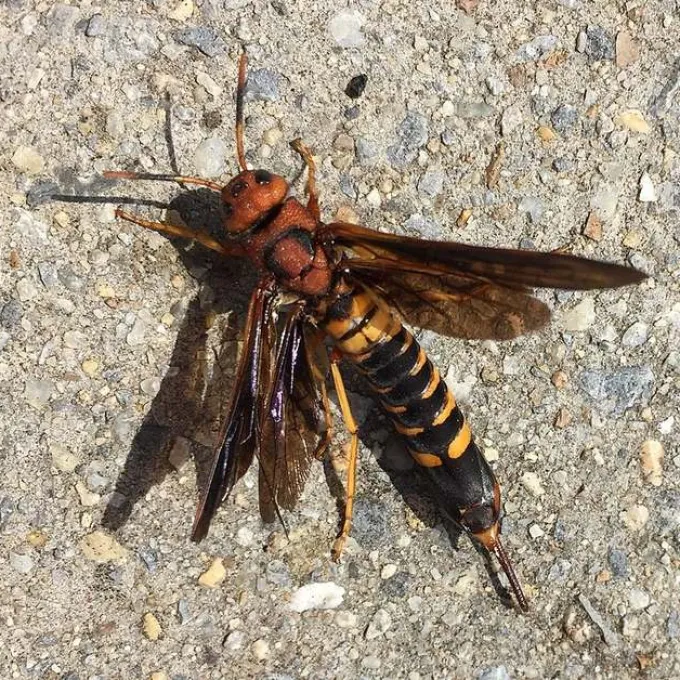
The blue horntail (Sirex cyaneus) belongs to the order Hymenoptera, family Siricidae. The adult insect is a large creature reaching 30–40 mm in length, characterized by a metallic blue or dark shiny body coloration.
Females possess a long ovipositor, which looks like a thorn or horn, giving the family its common name. The wings are transparent with a slight yellowish tint, and the legs are typically dark.
The larva is legless, cylindrical, and white or yellowish, featuring a small horn-like appendage at the rear of its body. The larval head capsule is well-developed, enabling it to bore through dense wood effectively.
The pupa develops inside the tree trunk, gradually transitioning into an adult insect. This transformation process is completely hidden from view, making early visual detection extremely difficult.
Males and females can be distinguished by size and leg coloration; males often have bright orange segments on their hind legs, while females have a more uniform body color.
What it damages
This pest primarily attacks coniferous tree species, including spruce, fir, pine, and larch. The blue horntail poses the greatest threat to stressed, unhealthy, or fallen trees in forest ecosystems.
In forest stands, the blue horntail frequently colonizes trees damaged by windthrow, fire, or primary pest outbreaks. In nurseries and timber yards, even healthy-looking trees can be susceptible if stressed.
Larvae create deep, winding tunnels inside the wood, moving toward the center of the trunk. This disrupts the tree's vascular system and leads to significant degradation of timber quality and commercial value.
Beyond mechanical damage, the horntail transmits symbiotic fungi that cause wood rot. This symbiosis assists the larvae in digesting wood components, accelerating the structural destruction of the trunk.
Severe infestations can lead to premature tree dieback and reduced resistance to environmental stressors such as high winds or heavy snow accumulation.
When it appears
Adult emergence typically occurs during the summer months, from late June through August. Females actively search for suitable hosts to lay eggs, guided by the chemical cues released by stressed or weakened wood.
The life cycle of the blue horntail can last from one to several years, depending on regional climatic conditions and the health status of the host tree. In colder northern regions, development often takes two years.
The female inserts eggs deep into the wood using her ovipositor, along with fungal spores. These spores begin to colonize the wood around the larval channel, providing a food source for the developing larvae.
The emergence of adults is marked by the boring of round exit holes, typically 4 to 7 mm in diameter. This emergence usually coincides with the peak of summer activity.
Adults have a relatively short lifespan; their primary function is mating and egg-laying to ensure the survival of the next generation.
Signs of infestation
The most common sign of infestation is the presence of perfectly round exit holes on the bark or exposed wood. These holes look as if they were drilled with a fine precision bit.
Small pinpoint lesions, sometimes accompanied by resin flow, may be visible on the bark where the female has laid her eggs. This is a defensive response by the tree against the intruder.
Inside the wood, tunnels packed with fine frass (wood dust) indicate an active infestation. Unlike many bark beetles, horntail tunnels go deep into the heartwood of the tree.
Changes in the tree canopy, such as yellowing and shedding needles, serve as an indirect indicator. However, in the early stages, the tree may appear entirely healthy to the naked eye.
The characteristic gnawing sound of larvae can sometimes be heard in quiet environments near an infested tree, confirming active wood boring.
Control measures
The primary control measure is timely sanitation harvesting and the removal of infested trees from the forest to prevent population buildup and further spread.
Adhering to proper forestry practices is essential: logs should be processed or moved from the forest quickly to avoid storage during the summer flight season when females are searching for hosts.
Biological control methods include the introduction of parasitic wasps, such as species of the genus Rhyssa, which effectively target and parasitize horntail larvae within the wood.
For high-value timber in storage, heat treatment (kiln drying to lethal temperatures) or chemical fumigation may be used where environmental regulations permit to ensure the wood is pest-free.
- Regular monitoring of forest stand health.
- Rapid processing of harvested timber.
- Maintaining vigorous tree growth through proper silviculture.
- Encouraging natural predators and parasitoids in the ecosystem.
Taxonomy
- Latin name
- Sirex cyaneus
- Order
- Hymenoptera
- Family
- Siricidae
- EPPO code
- SIRXCY
Discussion
No discussions yet — be the first.