
Ermak Woodwasp
Sirex ermak
Description
How to identify
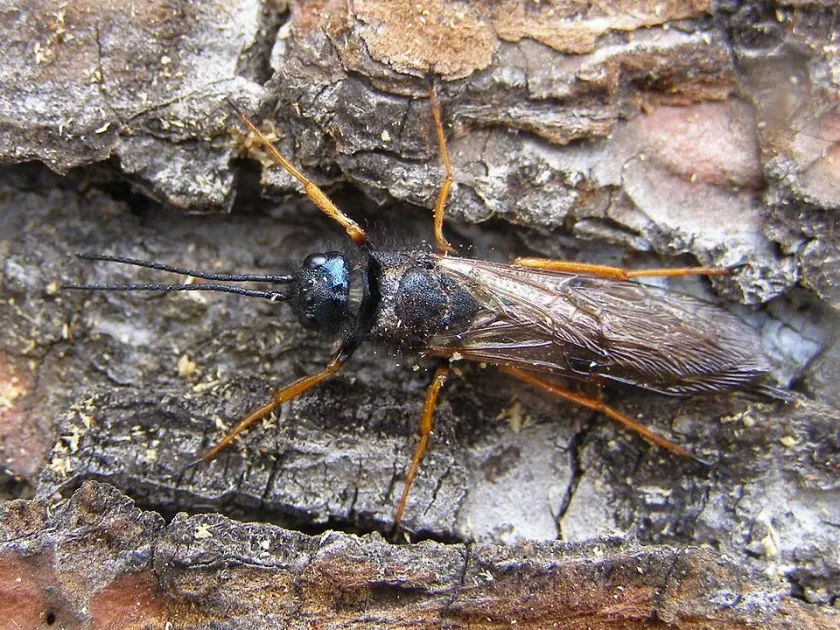
The Ermak woodwasp (Sirex ermak) is a large insect belonging to the family Siricidae (horntails). Adults are cylindrical in shape, reaching lengths of up to 40 millimeters, and are typically black with a distinct metallic blue or greenish luster.
Females are easily distinguished by their long, needle-like ovipositor, which they use to inject eggs and symbiotic fungi deep into the wood of coniferous trees. Males differ in appearance, often featuring thickened hind legs and occasionally reddish markings on their limbs.
The larvae are white or cream-colored, with a cylindrical body and a robust head capsule designed for boring through hard timber. They lack fully developed legs, relying on the structural configuration of their body to navigate within the wood.
Taxonomically, this species is classified within the order Hymenoptera. Unlike social wasps, woodwasps do not possess a sting and are harmless to humans, though they represent a significant ecological and economic threat to forest ecosystems.
Identification in the field requires close observation of flight patterns and the specific shape of the ovipositor in females. Their size and coloration are key characteristics that distinguish them from other wood-boring species in the region.
What it damages
The Ermak woodwasp primarily attacks coniferous tree species, with a particular preference for spruce (Picea) and fir (Abies). Healthy trees are rarely targeted; the pest typically selects trees weakened by drought, disease, or prior insect infestation.
Damage occurs when larvae bore long, meandering tunnels deep into the heartwood of the tree. These tunnels disrupt the flow of water and nutrients, which significantly impairs the tree's physiological function and can lead to rapid decline.
A secondary, yet equally devastating, form of damage is caused by the symbiotic fungi introduced by the female during oviposition. These fungi digest wood fibers and create wood rot, which compromises the timber's structural integrity.
The cumulative effect of larvae boring and fungal decay results in tree death. For forestry operations, this means that affected trees lose their commercial value as the wood becomes riddled with holes and discolored by decay.
Economic losses are compounded by the fact that even slightly damaged trees may become unsuitable for construction or high-quality manufacturing, forcing landowners to harvest early or suffer total loss.
When it appears
Adult Ermak woodwasps generally emerge during the summer months, typically peaking in June and July. This is the period when they are most active in flying and seeking out host trees for reproduction.
The life cycle of this species is complex and usually spans two to three years. The duration of the cycle is largely determined by climate conditions and the specific physiological state of the host tree.
Females search for suitable hosts using chemical cues (volatile compounds) released by stressed trees. Once a host is selected, the female drills into the wood to lay her eggs, a process that can take several minutes or even hours.
Larvae develop within the host tree for the vast majority of their life cycle. They pass through several larval instars while feeding on the fungus-inoculated wood, staying protected from external weather and most predators.
Upon completing their development and pupation, the adults emerge by chewing circular exit holes through the bark. These holes are the most visible sign of the pest's life cycle being completed within the wood.
Signs of infestation
The most reliable sign of an Ermak woodwasp infestation is the presence of perfectly round exit holes on the tree trunk. These holes are approximately 5 to 8 millimeters in diameter and provide clear evidence of past emergence.
Accumulated wood dust and frass at the base of the tree or caught in bark crevices are typical indicators of active larval boring inside the stem. This debris is often very fine and granular in appearance.
Needle discoloration, ranging from yellowing to premature browning, is a common symptom of a stressed tree. This progressive decline often starts at the top of the crown and spreads downward as the vascular system fails.
External evidence of predator activity, such as deep excavations or holes made by woodpeckers, strongly suggests the presence of larvae inside the tree. Woodpeckers are often the first to detect an infestation.
If the bark is peeled back, one can observe the characteristic galleries or tunnels created by the larvae. These galleries are typically tightly packed with frass and are associated with characteristic blue or black fungal staining.
Control measures
The most effective method for controlling the Ermak woodwasp is the prompt sanitation cutting of infested trees. Removing these trees before the new generation of adults emerges is vital for preventing the spread of the infestation.
Forest management practices should prioritize the rapid removal of logging debris and slash, which can provide breeding grounds for woodwasps. Keeping the forest floor clean is a standard preventive measure.
Biological control plays a significant role in maintaining the population balance. Encouraging the presence of natural enemies, such as ichneumonid parasitoid wasps, is essential for long-term pest management.
Monitoring programs using pheromone-baited traps or visual inspections of tree health allow foresters to identify outbreaks at an early stage, which is crucial for successful containment.
Because the larvae are deep within the wood, chemical treatments are generally ineffective and environmentally damaging. Forest resilience, achieved through proper silviculture and maintaining a diverse ecosystem, remains the best defense.
Taxonomy
- Latin name
- Sirex ermak
- Order
- Hymenoptera
- Family
- Siricidae
- EPPO code
- SIRXER
Discussion
No discussions yet — be the first.