
Morrison's woodwasp
Xeris morrisoni
Description
How to identify
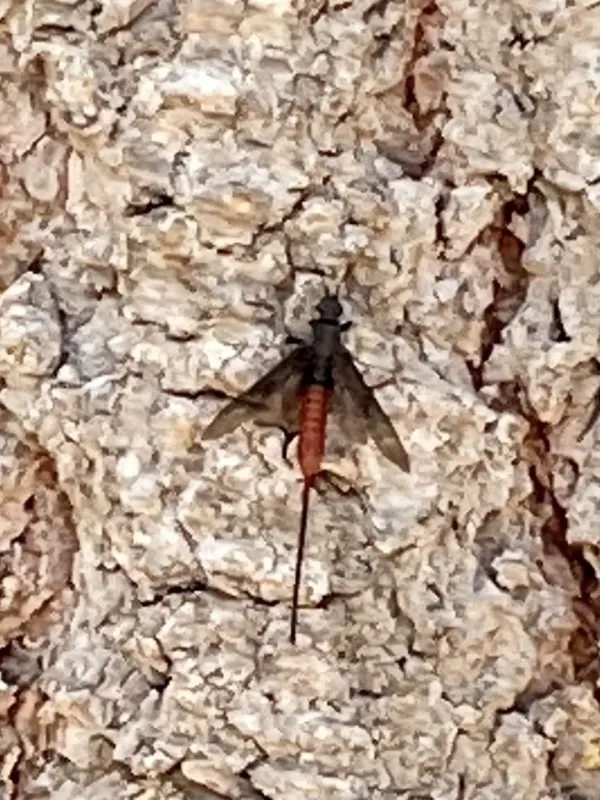
Morrison's woodwasp (Xeris morrisoni) is a species of sawfly belonging to the family Siricidae. The adult insect is a slender, dark-colored wasp measuring approximately 15–25 mm in length.
Females are equipped with a long, specialized ovipositor, which they use to insert eggs deep into the wood of host trees. The head is robust, housing powerful mouthparts adapted for wood-boring activities.
The larvae are cylindrical, whitish in color, and possess vestigial legs. They live concealed inside the woody tissues of trees, feeding and creating tunnels throughout their development.
Adults are rarely seen due to their secretive nature and short lifespan. Identification often relies on finding signs of infestation rather than spotting the adult wasps themselves.
Morphological characteristics vary slightly by region, but the general features of Siricidae are consistent, allowing entomologists to confirm the species through specimen examination.
What it damages
Morrison's woodwasp primarily targets coniferous tree species, particularly those in the Pinaceae and Cupressaceae families, which serve as their natural hosts.
The pest typically attacks stressed or weakened trees. Factors like drought, fire damage, or previous infestations by other wood-boring insects significantly increase the risk of colonization.
Healthy, vigorous trees often resist attacks by producing copious amounts of resin, which acts as a physical barrier to the female's ovipositor and the larvae's feeding progress.
Heavy infestations can lead to significant forest loss or degradation of ornamental conifer stands, reducing the aesthetic and economic value of the trees.
The tunnels excavated by larvae weaken the structural integrity of the timber, making the trees susceptible to subsequent fungal rot and opportunistic infections.
When it appears
The flight period for adult Morrison's woodwasps generally occurs during the warmer months, typically peaking from late spring through the summer.
Activity is most intense on hot, dry days, as these conditions are optimal for finding suitable host trees and facilitating the mating process.
The life cycle varies based on environmental conditions and can span from one to three years, including the egg, larval, pupal, and adult stages.
Larvae remain active throughout the year within the woody material, continuing their development even during periods of moderate temperature fluctuations.
Pupation occurs in a specialized chamber prepared by the larva near the surface of the wood, after which the adult chews its way out to begin the cycle again.
Signs of infestation
The most prominent sign of an infestation is the presence of perfectly round exit holes, approximately 3–5 mm in diameter, on the surface of the tree bark.
The accumulation of frass, or fine wood dust, caught in bark crevices or at the base of the trunk, indicates that larvae are actively feeding within the wood.
Small resin droplets or streaks on the trunk might mark the spots where a female previously drilled to insert her eggs, though these are easily overlooked.
Progressive wilting or yellowing of needles, often starting in specific branches or the crown, serves as an indicator of internal damage to the tree's vascular system.
- Circular exit holes in the trunk.
- Accumulation of wood dust in bark fissures.
- General decline in tree vigor.
- Gradual dieback of the tree top.
Control measures
Effective management starts with strict sanitation: removing and destroying weakened, diseased, or fallen trees that could harbor breeding populations of the woodwasp.
Maintaining high tree vigor through proper irrigation and fertilization is critical, as healthy conifers are much better equipped to defend themselves naturally.
Pheromone traps may be employed to monitor adult populations during the flight season, helping to time any necessary interventions on the property.
Chemical control via systemic insecticides is generally limited in effectiveness due to the larvae's deep, protected life within the wood.
In cases of minor infestations, pruning and destroying the affected branches is recommended to minimize the risk of the population spreading to healthy neighbors.
Taxonomy
- Latin name
- Xeris morrisoni
- Order
- Hymenoptera
- Family
- Siricidae
- EPPO code
- XERIMO
Discussion
No discussions yet — be the first.