
Woodwasp
Xeris
Description
How to identify
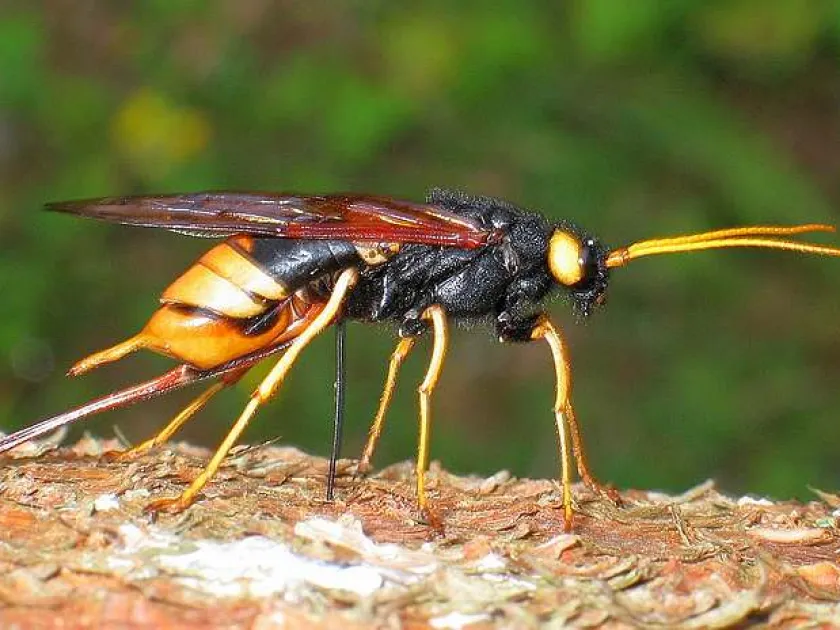
The woodwasp, belonging to the genus Xeris within the Siricidae family, is a type of horntail wasp. Although they resemble hornets in appearance, they do not possess a sting; instead, the females have a long, sturdy ovipositor used for egg-laying.
Adult insects have a cylindrical, elongated body, typically black or dark blue with a metallic sheen. Females often measure between 30 and 40 mm, while males are generally smaller in size.
The name "horntail" comes from the horn-like projection at the tip of the abdomen. The female's ovipositor is significantly longer than the abdomen, allowing it to penetrate deep into tree trunks during the reproduction process.
The larvae are white, legless, and possess a cylindrical body with a well-developed thoracic region. A distinct chitinous spine on the posterior end assists them in navigating through their tunnels within the wood.
Unlike the related Sirex genus, Xeris species do not carry symbiotic fungi in specialized organs known as mycangia, which is a key distinguishing biological feature between these two groups.
What it damages
These pests primarily target coniferous trees, including spruce, pine, fir, and larch. They prefer stressed, weakened, or recently felled timber rather than healthy, vigorous trees.
The economic impact is primarily related to the structural damage of the wood. Larvae bore deep tunnels into the trunks, which significantly degrades the quality and market value of the timber.
Woodwasps play a role in forest ecology by accelerating the colonization of dead or dying trees. Their tunnels often serve as entry points for secondary wood-boring insects and various fungal pathogens.
In timber yards, woodwasps cause substantial losses if logs remain unbarked during the warmer months, providing the insects with perfect conditions for rapid infestation.
While they are rarely the primary cause of healthy forest death, their activity reduces the grade of wood products and shortens the lifespan of timber left in forest conditions.
When it appears
Adult activity peaks during the summer months, typically from June through August. During this period, fertilized females search for suitable trees, guided by chemical cues released by stressed or drying wood.
The life cycle is relatively long, ranging from one to three years depending on environmental conditions and the quality of the host wood. Development is significantly slower in cooler climates.
Pupation takes place deep within the tree trunk. Before pupating, the larva creates a tunnel reaching close to the outer surface of the bark, ensuring the adult has an easier exit path.
The emergence of an adult is marked by the boring of a perfectly circular hole in the bark. During exceptionally hot years, the active period may start earlier, increasing the potential for infestation.
Overwintering occurs at the larval stage within the wood. This protects them from harsh winter temperatures and many natural predators, ensuring a high survival rate during the cold season.
Signs of infestation
The most visible sign of an infestation is the presence of perfectly round exit holes, about 4–8 mm in diameter, which indicate that adults have completed their life cycle and emerged.
Piles of fine wood dust, known as frass, found at the base of trees or in crevices of the bark, are clear indicators that larvae are actively boring tunnels inside the trunk.
Close inspection of the bark might reveal tiny puncture marks left by females during oviposition, although these are often difficult to spot without professional training.
The condition of the tree canopy can also be an indicator; yellowing or wilting needles often signify that the tree's vascular system has been damaged by internal pests.
When infested wood is processed, internal examination reveals deep, straight tunnels running perpendicular to the tree rings, often packed with larval excrement.
Control measures
The primary method of control is the prompt removal of dead, dying, or wind-thrown trees from the forest, ensuring they are harvested before the adult woodwasps emerge.
For timber storage, rapid debarking is highly effective. Removing the bark makes the logs significantly less attractive to females for egg-laying, effectively interrupting the life cycle.
Pheromone traps are used for monitoring population levels, allowing forest managers to track activity and take timely action if infestation thresholds are reached.
The conservation of natural parasitoids, such as specific ichneumon wasps, is crucial. These natural enemies can locate larvae deep within the wood, naturally limiting the woodwasp population.
Chemical control is rarely practiced in large-scale forestry due to difficulty and cost. Instead, silvicultural practices, including proper timber rotation and storage, remain the standard defense.
Taxonomy
- Latin name
- Xeris
- Order
- Hymenoptera
- Family
- Siricidae
- EPPO code
- XERISP
Discussion
No discussions yet — be the first.