
Common carpet
Xanthorhoe fluctuata
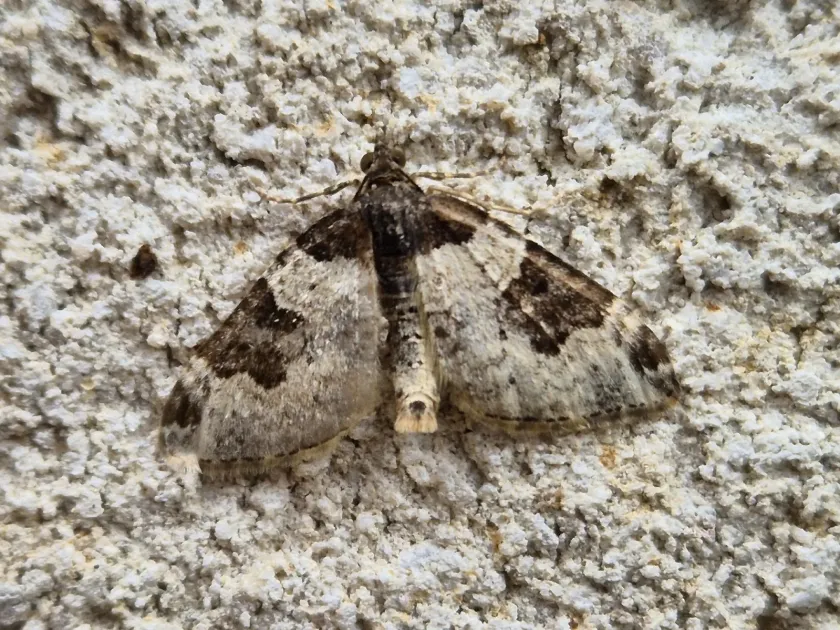
Description
How to identify
The Common carpet moth (lat. Xanthorhoe fluctuata) is a small moth belonging to the Geometridae family. Adult moths have a wingspan of approximately 25–30 mm. Their wings feature a distinct pattern of grayish-brown markings, providing excellent camouflage.
The larvae, known as loopers, typically measure around 25 mm in length. They exhibit a variety of shades from light green to brown, allowing them to blend seamlessly with the leaves of their host plants.
The life cycle encompasses four stages: egg, larva, pupa, and adult. In temperate climates, this species typically completes two generations within a single growing season.
Hibernation usually occurs in the pupal stage, buried in the soil or nestled among decaying vegetation, which ensures the survival of the population during harsh winter months.
Adult moths are primarily nocturnal or crepuscular, meaning they are most active during dusk and throughout the night, often escaping notice during daylight hours.
What it damages
The primary food sources for the larvae are plants belonging to the Brassicaceae (Cruciferous) family. The pest frequently targets crops such as cabbage, radish, horseradish, and mustard.
In addition to cultivated vegetables, the larvae can thrive on wild cruciferous weeds, which serve as vital reservoirs for the species throughout the season.
The most significant damage is caused by the voracious larvae feeding on the leaf tissue. This herbivory reduces the plant's ability to photosynthesize and significantly impacts commercial quality.
Severe infestations can lead to stunted plant growth and overall weakening of the crop, making it more susceptible to secondary environmental stresses.
The presence of larval frass on leaves not only devalues the produce but also creates ideal conditions for the colonization of opportunistic bacteria and fungi.
When it appears
The first generation of adults typically emerges in May, coinciding with the critical early growth phase of young vegetable crops in the garden.
A second generation of adults appears during mid-summer, usually spanning July and August, when vegetable plants are actively developing their foliage or heads.
The timing of larval development is heavily influenced by ambient temperature and humidity levels, with warm and damp weather accelerating the life cycle.
Active feeding stages occur throughout the summer months, necessitating vigilant monitoring and proactive management by agricultural practitioners.
As autumn temperatures begin to decline, the life cycle slows, and the individuals transition into the pupal stage for winter diapause.
Signs of infestation
The most recognizable indicator of an infestation is the presence of irregular, notched holes in the leaves of cruciferous crops caused by larval feeding.
- Notched or ragged edges on the leaves.
- The accumulation of small, dark fecal pellets on the leaf surface or within the plant's central whorl.
- The presence of larvae resting on the underside of leaves or along the major leaf veins.
- Reduced vigor or general signs of distress in the affected plant population.
Due to the excellent camouflage of the larvae, careful inspection of the lower leaf surfaces is required to accurately assess population levels during the growing season.
Monitoring should be conducted regularly, as early detection significantly improves the efficacy of both biological and chemical control measures.
Control measures
Aggressive management of cruciferous weeds in and around the field is the most effective cultural method for reducing the primary food source of the moth.
Deep autumn tilling or soil cultivation helps to disturb the soil, exposing and destroying pupae that are preparing for winter hibernation.
Biological insecticides, particularly those containing Bacillus thuringiensis, offer an effective and environmentally responsible approach for managing larval populations.
When infestation levels exceed economic thresholds, authorized systemic or contact insecticides may be applied, ensuring all safety and waiting period instructions are followed.
Implementing a robust crop rotation strategy, avoiding cruciferous crops in the same plot for at least three to four years, is essential for sustainable pest suppression.
Taxonomy
- Latin name
- Xanthorhoe fluctuata
- Order
- Lepidoptera (butterflies)
- Family
- Geometridae
- EPPO code
- LAREFL
Discussion
No discussions yet — be the first.