
Olive moth
Abraxas pantaria
Description
How to identify
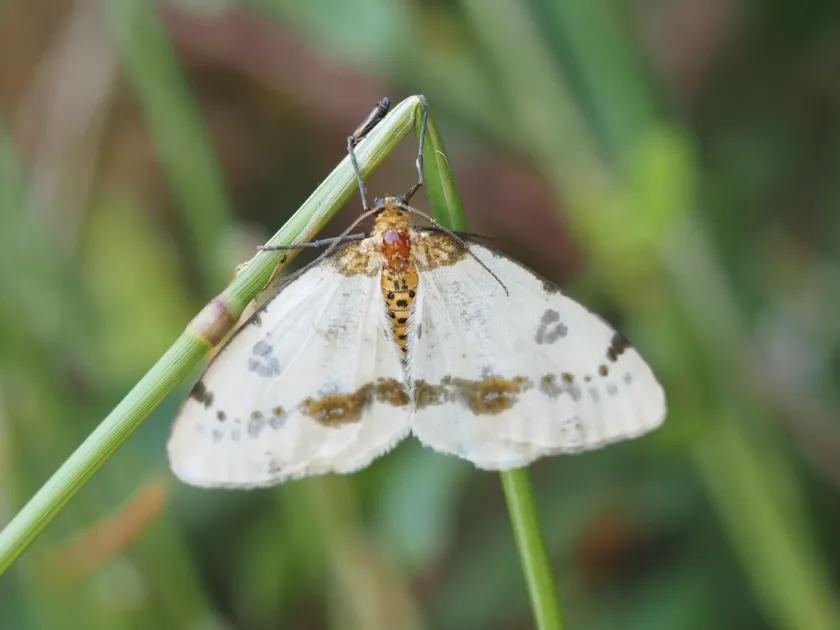
The olive moth (scientific name: Abraxas pantaria) belongs to the family Geometridae within the order Lepidoptera. It is a distinct species known for its specialized diet and specific morphological features.
Adult moths have a wingspan of approximately 40 to 50 mm. Their wings feature a pale, cream-colored base with numerous dark brown or grey spots and bands, providing excellent camouflage against tree bark.
The larvae, known as loopers or inchworms, exhibit the characteristic movement of the family Geometridae. They move by arching their bodies to bring the hind legs toward the front legs, creating a distinctive loop.
The life cycle encompasses four stages: egg, larva, pupa, and adult. The insect typically undergoes a complete metamorphosis, with the number of generations per year depending on the regional climate.
Overwintering usually occurs during the larval stage. Small caterpillars seek refuge in bark crevices or among curled leaves to survive cold temperatures until the return of spring growth.
What it damages
The primary host plant for Abraxas pantaria is the olive tree (Olea europaea). The larvae feed exclusively on leaves and tender shoots, causing significant structural damage to the tree's foliage.
In cases of high infestation, the caterpillars can cause severe defoliation. This loss of leaf area drastically reduces the tree's ability to photosynthesize, directly impacting yield potential and oil accumulation.
Repeated defoliation over several consecutive years weakens the olive trees, making them susceptible to secondary infections and environmental stresses like drought or heatwaves.
Young nursery trees are particularly vulnerable, as even minor larval feeding can stunt their growth and disrupt the development of a healthy, productive canopy structure.
While olive trees are the preferred host, larvae may occasionally be found on related plant species in the Oleaceae family if local populations are dense and food resources are limited.
When it appears
The spring activity of larvae aligns with the flushing of new leaves on olive trees. This is the period when monitoring efforts are most critical to prevent early-season population explosions.
Adult moths typically emerge in early to mid-summer. Following mating, females lay eggs on the underside of leaves, ensuring that hatching larvae have immediate access to food.
The peak of larval activity usually occurs during the warm summer months. During this time, they feed aggressively and grow rapidly, completing their development before the onset of cooler weather.
Effective pest management relies on monitoring the adult flight using pheromone traps, which provides early warning signs of the next generation's emergence in the olive orchard.
Weather conditions significantly impact the life cycle. Warmer winters may lead to higher survival rates for overwintering larvae, resulting in greater pest pressure in the following season.
Signs of infestation
The first sign of infestation is often the presence of skeletonized leaves, where only the tough veins remain, or leaves with irregularly notched edges caused by larval feeding.
Small dark pellets of larval frass (excrement) scattered on the leaves or the ground beneath the tree canopy are strong indicators of an active colony of caterpillars feeding above.
Caterpillars often use silk to tie leaves together or create protective webs. Finding these webbed, curled leaves is a reliable method for locating the larvae during the day.
Significant branch thinning or patchy defoliation across the canopy provides clear evidence that the population has reached an economically damaging level.
Using light traps at night can confirm the presence of adult moths in the area, helping growers identify potential infestation sites before heavy feeding damage becomes widespread.
Control measures
Biological control methods, such as applying Bacillus thuringiensis (Bt) based formulations, are highly effective against young larvae while sparing beneficial insects and natural predators.
Chemical control should be employed only when necessary, choosing selective insecticides that minimize impact on non-target species and adhering to pre-harvest intervals for safety.
Good horticultural practices, such as proper tree pruning, improve canopy ventilation and light penetration, which reduces the suitability of the tree for larval development.
- Regular monitoring of canopy density and leaf integrity.
- Deployment of pheromone traps for early detection.
- Encouragement of natural enemies like predatory wasps and birds.
- Sanitary pruning of infested branches.
- Judicious use of chemical sprays as a last resort.
An Integrated Pest Management (IPM) approach ensures sustainable olive production by prioritizing low-toxicity interventions and ecological balance over routine chemical reliance.
Taxonomy
- Latin name
- Abraxas pantaria
- Order
- Lepidoptera (butterflies)
- Family
- Geometridae
- EPPO code
- ABRXPA
Discussion
No discussions yet — be the first.