
Orange moth
Agriopis aurantiaria
Description
How to identify
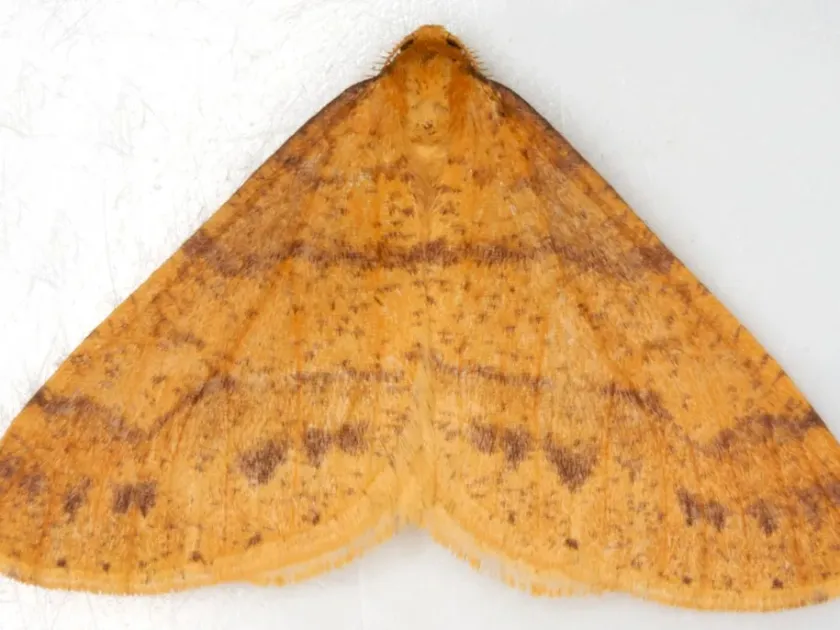
The orange moth Agriopis aurantiaria is a member of the Geometridae family. It exhibits significant sexual dimorphism, with males possessing ochre-orange wings adorned with dark cross-bands, while females are flightless and resemble small spiders.
Adults are typically active in late autumn, often during cold nights. Males have slender bodies and feathery antennae, enabling them to locate females in low temperatures when most other insects are inactive.
Larvae (caterpillars) are typical loopers, moving in a rhythmic looping motion. They hatch in early spring and develop through several instars before completing their cycle by early summer.
The caterpillar's color ranges from yellowish-green to brown, often featuring dark longitudinal stripes that provide camouflage among the branches and unfolding leaves.
The life cycle involves pupation in the soil. Upon reaching maturity, the larvae descend to the ground, spin a cocoon, and remain in diapause in the soil throughout the summer and early autumn.
What it damages
This species is a polyphagous pest, meaning it attacks a wide variety of deciduous trees. It frequently infests commercial orchards, forest nurseries, and parkland trees.
Primary host plants include apple, pear, plum, and cherry trees. In addition to fruit species, the larvae readily feed on oak, birch, and hazel, which serves as a reservoir for populations near orchards.
The damage is primarily caused by caterpillars consuming buds during early spring and subsequently skeletonizing the foliage as the tree enters its main growing season.
Severe infestations can lead to complete defoliation, which severely depletes the tree's energy reserves, weakens its immune system, and significantly reduces the potential yield for the season.
Repeated yearly defoliation makes trees more susceptible to environmental stressors, such as winter frost or drought, and increases the risk of secondary pathogen infections.
When it appears
Adult moths emerge in late autumn, typically between October and November. This unique timing allows them to breed and lay eggs when predator activity is minimal.
Females lay eggs in bark crevices or near bud scales, where they overwinter. These eggs are hardy and adapted to survive harsh winter temperatures without damage.
Hatching occurs in spring, precisely synchronized with the bud burst phase of the host trees. The larvae feed actively for about 4 to 6 weeks depending on local climate conditions.
By late May or early June, the caterpillars descend from the canopy to the soil. They burrow into the ground to create pupal chambers and remain dormant until the next autumn cycle begins.
Monitoring should be conducted by checking trunks for adult females in late autumn and evaluating caterpillar densities per branch during the initial stages of bud development.
Signs of infestation
Early signs of infestation include damaged, unopening buds in spring and small, ragged holes appearing in newly emerged leaves as the larvae grow.
Observing the behavior of the caterpillars provides a clear sign of infestation; when disturbed, they often drop from the leaves, suspended by a thin silk thread.
Heavy droppings (frass) under the tree canopy or visible silk webbing on the foliage are reliable indicators of significant larval activity in the upper parts of the tree.
The presence of bare branches or severe leaf thinning in late spring serves as a visible marker of high caterpillar population pressure in the garden.
Small holes in the soil surface beneath the tree canopy during early summer indicate that the larvae have successfully pupated and are hidden underground.
Control measures
Cultural control involves tilling the soil beneath the canopy in late summer or autumn to disturb the pupae in the ground, exposing them to frost and soil predators.
Installing sticky bands around tree trunks during early autumn acts as a mechanical barrier, preventing the wingless females from climbing up to lay eggs.
If the pest threshold is exceeded, application of systemic or contact insecticides during the larval feeding stage in spring provides effective population suppression.
Biological control using Bacillus thuringiensis is an excellent, environmentally friendly option that specifically targets caterpillars without harming beneficial insects.
Enhancing natural biodiversity by encouraging insectivorous birds and predatory insects provides long-term suppression of the orange moth population in the orchard.
Taxonomy
- Latin name
- Agriopis aurantiaria
- Order
- Lepidoptera (butterflies)
- Family
- Geometridae
- EPPO code
- HIBEAU
Discussion
No discussions yet — be the first.