
Clouded magpie
Abraxas sylvata
Description
How to identify
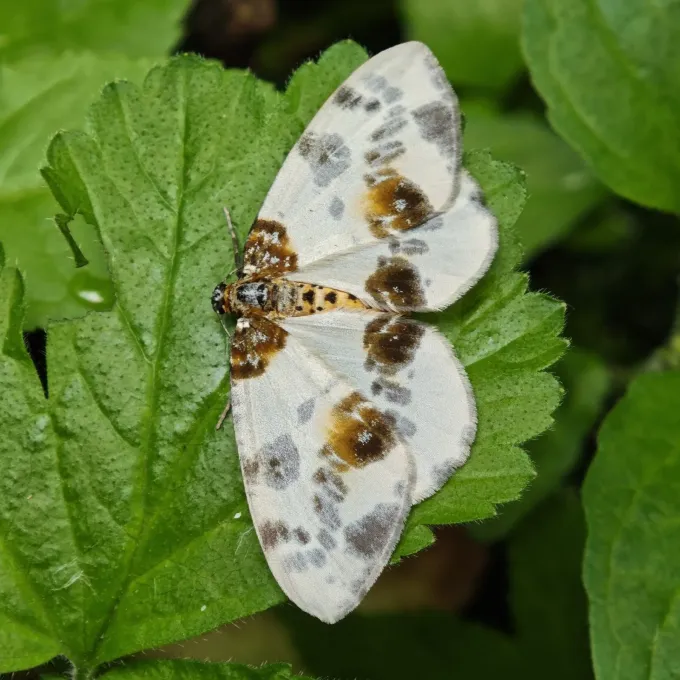
The clouded magpie (lat. Abraxas sylvata) is a moth belonging to the order Lepidoptera and the family Geometridae. It is a visually distinctive moth with a wingspan of approximately 40 to 50 mm.
The moth's wings have a complex, beautiful pattern of white base color with greyish-brown patches and subtle yellowish streaks. This camouflage makes it blend perfectly with the bark and leaves of its host trees.
The caterpillar of this species is typical for the Geometridae family, known for its looping movement. It grows up to 40 mm in length and possesses coloring that provides excellent protection against predators.
The pupa is dark, shiny, and encased in a loose cocoon. It is usually found within the leaf litter or just below the surface of the soil, where it remains safe during the winter months.
Like all moths of this family, Abraxas sylvata undergoes a complete metamorphosis involving the egg, larva, pupa, and adult stages, each playing a crucial role in its life strategy.
What it damages
The clouded magpie primarily feeds on various deciduous trees, including Elm (Ulmus), Alder (Alnus), Beech (Fagus), and Cherry (Prunus padus), among others.
In years of outbreak, the caterpillars can strip a tree of its foliage, which severely hampers the plant's ability to photosynthesize and store energy for the following season.
Early-stage larvae skeletonize the undersides of leaves, while mature caterpillars consume the entire leaf blade, leaving only the primary veins behind.
Chronic infestation can lead to stunted tree growth, increased susceptibility to diseases, and in severe cases, the dieback of upper branches or the entire tree.
In ornamental and urban forestry, the aesthetic damage caused by the clouded magpie is significant, making it a target for integrated pest management programs.
When it appears
Adult moths are typically active during the summer months, specifically from June to July, which is the primary period for mating and egg-laying.
The larval stage begins to feed in late summer, with activity peaking between August and September as the caterpillars grow rapidly before finding a place to pupate.
The species overwinters as a pupa, sheltered in the soil or under layers of dead leaves, allowing it to survive low winter temperatures until spring arrives.
As spring temperatures rise, the pupae complete their development, and the adult moths emerge, completing the yearly cycle of the pest's development.
Effective monitoring should be conducted in early summer to track moth populations and predict potential caterpillar pressure on susceptible tree species.
Signs of infestation
The most noticeable sign of infestation is irregular, ragged holes in the foliage, which progress from minor damage to large defoliated patches.
Observing small, dark droppings (frass) on the leaves or on the ground beneath the canopy is a clear indicator that caterpillars are actively feeding above.
Caterpillars often use silk to bind leaves together, creating shelters that protect them from weather and predators, which can be seen upon close inspection of the canopy.
A thinning, translucent canopy is a major symptom of severe damage, as the loss of leaf area allows more light to pass through the branches than normal.
An unusual influx of moths toward light sources during the night in July can serve as a warning sign of a potential population increase for the coming season.
Control measures
Biological control using Bacillus thuringiensis sprays is highly effective and environmentally friendly, targeting the caterpillars without harming beneficial insects or birds.
Encouraging natural predators such as birds and predatory wasps in forested areas is a sustainable way to keep moth populations below the economic injury level.
In high-value ornamental areas, systemic insecticides can be applied if monitoring data indicates that the population threshold has been exceeded.
Cultural practices, such as clearing leaf litter from around the base of trees in autumn, help reduce the number of overwintering pupae and limit next year's infestation.
Installing pheromone or light traps allows for precise timing of interventions, ensuring that management strategies are as efficient and ecologically sound as possible.
Taxonomy
- Latin name
- Abraxas sylvata
- Order
- Lepidoptera (butterflies)
- Family
- Geometridae
- EPPO code
- ABRXSY
Discussion
No discussions yet — be the first.