
Xanthochilus
Xanthochilus
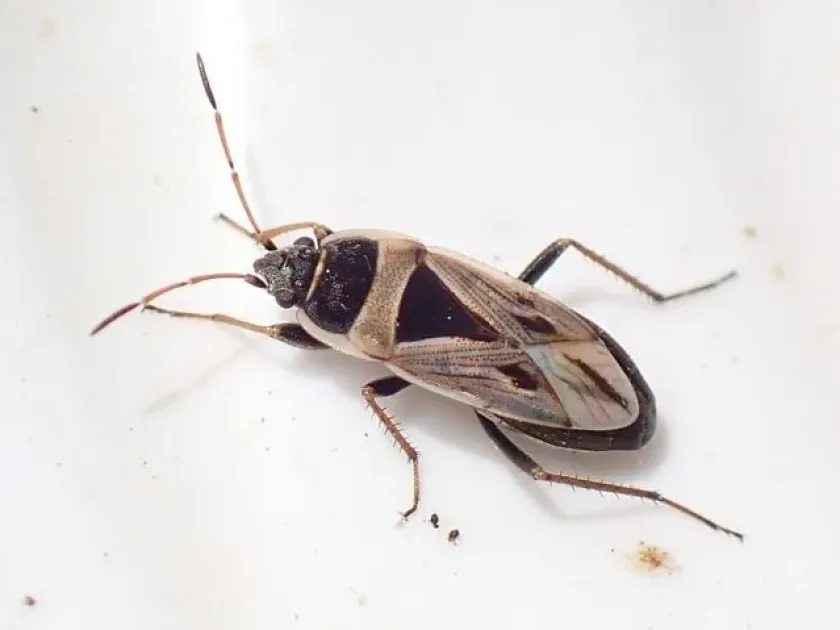
Description
How to identify
Xanthochilus is a genus of insects in the family Lygaeidae (ground bugs) belonging to the order Hemiptera. One of the most common species encountered in agricultural landscapes is the spotted Xanthochilus.
Adult insects have an elongated body, typically measuring between 6 to 8 millimeters in length. Their coloration generally ranges from brownish-yellow to dark, with distinct contrasting spots on the hemelytra (wing covers).
The head of these bugs is relatively large, featuring well-developed compound eyes. The pronotum is expanded and often exhibits a pale border or specific pattern, which serves as a key identifier during field inspections.
The nymphs of Xanthochilus undergo several developmental stages, gradually increasing in size and adopting a coloration similar to the adults. They exhibit similar behavior, concentrating on the vegetative and reproductive organs of host plants.
For accurate species identification, agronomists are advised to use a 10x magnifying glass to examine the base of plants and leaf axils, particularly during early morning or evening hours when insect activity is higher.
What it damages
The pest primarily affects cereal crops, including wheat, barley, and oats. During dry summer conditions, Xanthochilus may migrate to fields of millet and other grain crops.
Xanthochilus is also frequently found on wild grasses, which serve as reservoirs for infestation and provide initial food sources for the insects before they colonize commercial fields.
Significant damage occurs during the heading and grain-filling stages, as the insects suck sap from the soft plant tissues, leading to metabolic disruption and impaired growth.
Feeding by these bugs results in plant weakening and a decrease in crop quality. High pest populations can lead to shriveled grains and a substantial reduction in the overall market value of the harvest.
Damage caused by these bugs during stressful weather conditions exacerbates the overall stunted appearance of the crops, reducing the plants' natural resistance to other pathogens and diseases.
When it appears
Insect activity begins in early spring when daily average temperatures exceed +10-12 degrees Celsius, coinciding with the tillering phase of cereal crops.
The most intense feeding and reproduction of Xanthochilus occur in mid-summer, especially during drought periods, when insects actively move through the field in search of succulent plants.
Adults typically overwinter in windbreaks, under plant debris, in stubble, or within the litter layer, where they are shielded from severe frosts and adverse environmental factors.
The life cycle of this pest is closely linked to the phenology of agricultural crops. Depending on the regional temperature regime, one or two generations may develop within a single season.
In autumn, following harvest, the insects gradually migrate to their overwintering sites, where they remain in diapause until the following spring, which is a critical factor when planning fall soil tillage.
Signs of infestation
In the early stages of infestation, it is difficult to detect the pest visually; however, characteristic white spots or discoloration on leaves at the site of bug punctures eventually become noticeable.
During field inspections in dry weather, one can observe clusters of insects at the base of stems or in sheltered areas of the plants where humidity levels remain slightly higher.
An indirect sign is general premature yellowing and wilting of certain field sections, which is often misidentified as drought stress or root rot infections.
- Presence of dry, shriveled grains observed during the threshing of sample sheaves.
- Detection of adult bugs and nymphs on ears during the milk-ripeness stage.
- Visible damage to leaf blades appearing as necrotic spots.
When monitoring fields systematically using an entomological sweep net, even a small number of pests can lead to significant damage, making early identification essential.
Control measures
The primary control measure involves proper agronomic practices aimed at eliminating weeds, which act as pest reservoirs, particularly wild cereal species.
Timely deep autumn plowing effectively destroys overwintering sites for Xanthochilus, which significantly reduces the pest population for the following agricultural season.
If the economic threshold of damage is exceeded, the application of systemic or contact-stomach insecticides approved for use on cereal crops is recommended.
The optimal time for chemical treatment is during the stem elongation or early heading stage, when the pest population reaches maximum density within the fields.
Biological control methods include the use of natural entomophages, such as egg parasitoids, which effectively limit population growth within the natural environment.
Taxonomy
- Latin name
- Xanthochilus
- Order
- Hemiptera (bugs, aphids, leafhoppers)
- Family
- Lygaeidae
- EPPO code
- XANCSP
Discussion
No discussions yet — be the first.