
Norwegian wasp
Vespula norvegica
Description
How to identify
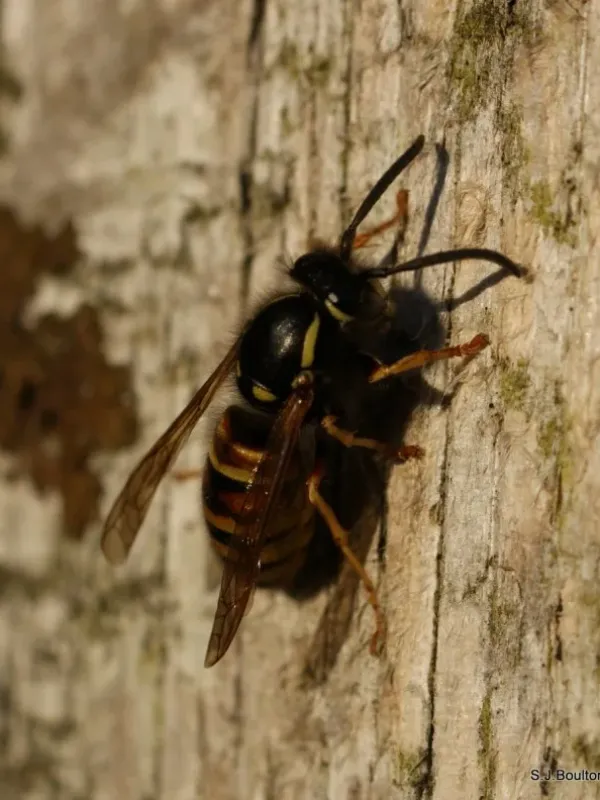
The Norwegian wasp (Latin: Vespula norvegica) belongs to the order Hymenoptera, family Vespidae. It resembles the common wasp but displays more prominent reddish or orange tints on its abdomen.
Queens of this species reach 18–20 mm in length, while workers range from 11 to 15 mm. A key identification feature is their nesting behavior: they construct small, often open or semi-open nests attached to tree branches or shrubs.
The body is covered with characteristic yellow and black stripes, though pigmentation patterns may vary. Workers have black antennae, and the head features well-developed mandibles adapted for chewing fibrous plant materials and foraging.
Larvae develop in wax-paper cells created by workers from chewed wood mixed with saliva. The development of offspring is strictly monitored by adult workers who maintain the colony's microclimate.
This species is eusocial, forming colonies that exist only for one season. In autumn, all workers die, and only fertilized young queens hibernate in sheltered areas, such as tree bark or crevices in structures.
What it damages
While adult wasps are entomophagous, feeding on small insects, their economic damage to agriculture occurs during the fruit ripening period. Wasps actively damage the flesh of berries and fruits.
They pose a particular threat to vineyards and stone fruit orchards. By piercing the skin of fruits, wasps facilitate the development of fungal diseases, specifically grey mould and various types of rot.
While feeding on fruits, wasps often collect nectar and sap, leading to crop spoilage. Multiple punctures make the fruits unsuitable for storage and transport, causing rapid fermentation and decay.
Beyond direct crop damage, the presence of wasp nests near workplaces poses a health risk due to their aggressive defense behavior. This complicates agrotechnical care and harvesting activities.
It is important to note that Norwegian wasps also provide benefits by preying on numerous harmful insects, such as caterpillars; however, the balance between benefit and crop damage often shifts toward the latter at high population densities.
When it appears
The activity of the Norwegian wasp begins in late spring when the overwintered queen searches for a site to build her first nest and lay eggs for the first generation.
The peak of worker population and activity in the garden occurs in the second half of summer when major orchard crops are ripening. This is when the most significant fruit damage is observed.
With the onset of autumn cold, colony activity decreases sharply. By October, most individuals die, and the species' life cycle enters a diapause phase for young fertilized queens.
Monitoring the appearance of the first queens in spring allows agronomists to prevent the formation of large nests near valuable plantations. Using pheromone or food traps is most effective early in the season.
Temperature significantly affects the rate of brood development. Prolonged warm periods in summer contribute to a rapid increase in the population, requiring enhanced control measures.
Signs of infestation
The primary sign of the Norwegian wasp is the discovery of paper-like nests suspended from branches of shrubs, fruit trees, or under the eaves of outbuildings.
On the surface of ripening grapes, plums, or pears, small, deep holes surrounded by necrotic tissue appear. Clusters of wasps are often observed around these damage sites.
Damaged fruits begin to rot quickly, emitting a characteristic fermentation smell that further attracts other wasps and pests, such as fruit flies.
Increased insect activity during morning and daytime hours in areas with ripening crops is a direct signal to initiate protection. Wasps fly actively between the food source and the nest.
The appearance of empty cells in a nest or physical destruction of the nest suggests predation by birds or other animals, which sometimes leads to disorientation and increased aggression in the remaining workers.
Control measures
The most effective method is early nest eradication before the mass emergence of workers. The procedure should be performed in the evening or at night when insects are least active.
The use of food traps with attractants based on fermented juices, sugar, or beer can significantly reduce worker populations during the peak fruit ripening season.
To protect vineyards and berry bushes, it is recommended to use specialized protection nets or fruit bags to prevent insect access. This is the most environmentally friendly method.
If large colonies are discovered near workspaces, the use of contact insecticides may be necessary, though their application on fruits is strictly prohibited during the harvest period.
- Regular pruning of trees to identify hidden nests.
- Removing fallen fruits from the ground, which serve as a food source.
- Using fine-mesh netting to cover valuable crop varieties.
Taxonomy
- Latin name
- Vespula norvegica
- Order
- Hymenoptera
- Family
- Vespidae
- EPPO code
- VESPNO
Discussion
No discussions yet — be the first.