
Eumenes
Eumenes
Description
How to identify
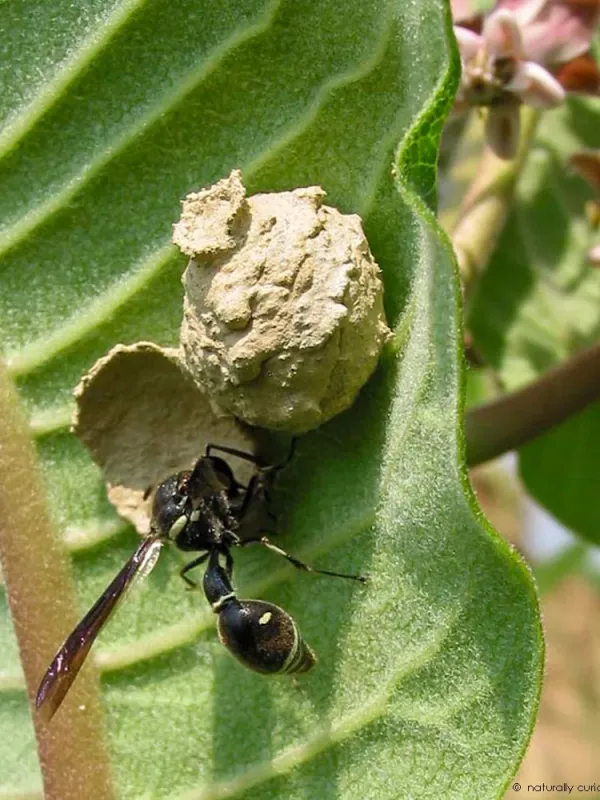
Eumenes, commonly known as potter wasps, is a genus of solitary wasps belonging to the family Vespidae, recognizable by their slender bodies.
They possess a distinct petiole, which is a thin, stem-like segment connecting the thorax to the abdomen, giving them a very elegant appearance.
Unlike yellowjackets or hornets, these wasps do not live in colonies; each female is responsible for building her own individual nest and provisioning it.
The coloration of Eumenes varies significantly between species, though most feature striking yellow, white, or red markings against a black base.
Their size is relatively modest, and they are generally non-aggressive towards humans unless handled directly or threatened.
What it damages
Potter wasps are not plant pests; they do not consume foliage, stems, or fruits of agricultural crops as their primary food source.
Instead, they serve as excellent biological control agents, as they hunt caterpillars and beetle larvae to provide food for their developing offspring.
Any perceived damage is strictly mechanical, occurring only when they attach their mud nests to the delicate stems of garden plants.
These nests are harmless to the overall vitality of the plant and generally do not hinder the normal growth or fruit-bearing capacity of the crop.
In fact, their presence in a garden indicates a healthy ecosystem where natural predation helps regulate the populations of herbivorous insects.
When it appears
The seasonal activity of Eumenes begins in late spring, as warmer temperatures trigger the emergence of adults from their wintering sites.
Throughout the summer, they remain active as they focus on hunting for prey and constructing their characteristic earthen structures.
By autumn, the life cycle enters a phase where larvae pupate inside their nests, preparing to overwinter until the following spring.
The peak of their activity usually coincides with the mid-summer abundance of caterpillars in agricultural and horticultural environments.
Environmental factors such as rainfall and humidity can affect the mud-gathering success of females, which in turn influences nest density.
Signs of infestation
The most prominent sign of potter wasp presence is the presence of small, expertly crafted mud pots attached to plant stems or walls.
These structures are remarkably hard and durable, protecting the developing wasp larva from environmental stress and natural predators.
The absence of typical herbivore damage symptoms like shredded or skeletonized leaves around the nest confirms the insect's non-phytophagous nature.
After a larva completes its development, it emerges from the nest, leaving behind a small, clean exit hole that can be observed upon close inspection.
Observing a wasp in flight while carrying a ball of moist soil is a direct behavioral sign that nest construction is taking place nearby.
Control measures
From an agronomic perspective, Eumenes are considered beneficial insects, and no control measures are required to manage their population.
If the physical presence of nests on ornamental plants is undesirable, they can be removed manually without harming the plants or the garden.
Indiscriminate use of broad-spectrum insecticides should be avoided, as it would destroy these natural allies that help suppress crop-damaging pests.
Promoting a garden environment that supports pollinators and predatory insects is a far superior strategy for long-term crop health.
- Manual removal of nests if necessary
- Avoiding unnecessary insecticide application
- Supporting natural predator habitats
Taxonomy
- Latin name
- Eumenes
- Order
- Hymenoptera
- Family
- Vespidae
- EPPO code
- EUMNSP
Discussion
No discussions yet — be the first.