
Long-cheeked wasp
Dolichovespula
Description
How to identify
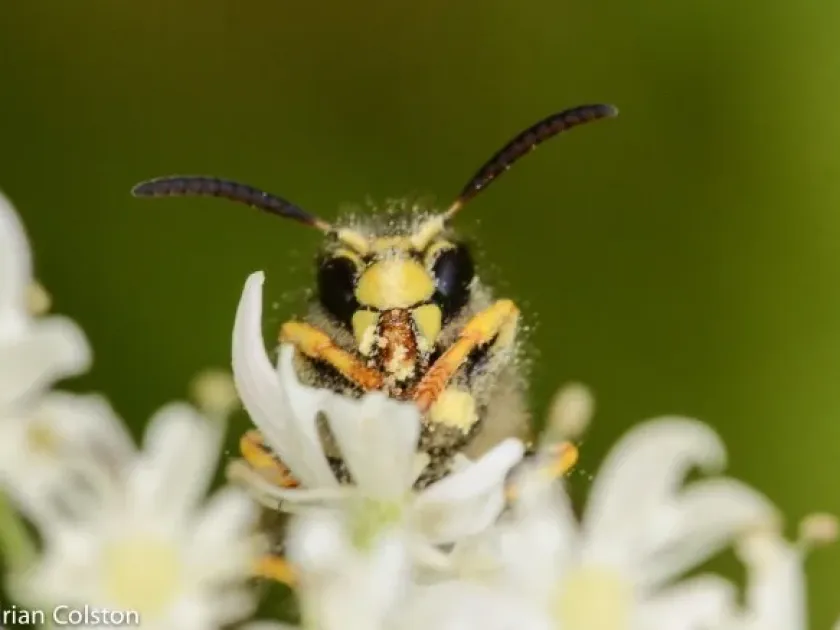
The long-cheeked wasp belongs to the family Vespidae, order Hymenoptera. The genus is distinguished by the elongated space between the base of the mandibles and the lower edge of the compound eye, known as the malar space.
These wasps feature the typical black and yellow warning coloration common to social wasps. Workers are generally 12–15 mm in length and possess a slender, well-defined waist.
Unlike many other species, their nests are often globular or pear-shaped and are typically suspended from tree branches or architectural features, with the entrance located at the bottom.
They are generally less aggressive than the common yellowjacket, though they can be defensive if their nest is directly disturbed or threatened by sudden movements.
Correct identification often requires close examination of head morphology, which is why professional entomological identification is recommended for accurate site assessments.
What it damages
The primary agricultural impact of these wasps is their consumption of ripening fruits and berries. They chew through the skin of grapes, raspberries, strawberries, pears, and stone fruits.
Once the fruit skin is compromised, it leads to rapid degradation and loss of commercial value, as the fruits become unsightly and physically damaged.
These feeding sites serve as entry points for secondary pathogens, such as brown rot (Monilinia spp.) and other fungal infections that can spoil entire clusters or trees.
Their presence attracts secondary pests, including various fly species and ants, which exploit the damaged fruit, further exacerbating the decay process in the orchard.
While wasps may incidentally consume smaller insect pests, this minor beneficial impact is far outweighed by the direct financial losses caused during the harvest season.
When it appears
The colony cycle begins in spring when the overwintered queen emerges to establish a nest and produce the first generation of worker wasps.
Population density peaks in mid-to-late summer, coinciding with the maturation of many fruit crops, which provides the colony with a high-energy carbohydrate source.
The workers' foraging activity is most intense during these months as they seek sugars to support the growing brood and the colony's nutritional needs.
In autumn, the cycle winds down as the workers and males die, leaving only the newly mated queens to find protected sites for winter hibernation.
Understanding this seasonal progression is vital for growers, as preemptive management should be implemented well before the fruit reaches peak ripeness.
Signs of infestation
Visible punctures and hollowed-out sections on the surface of ripening fruits are the most definitive sign of wasp activity in an orchard or vineyard.
The presence of gray, paper-like spherical nests suspended in trees, shrubs, or under the eaves of sheds provides clear evidence of a resident colony.
High concentrations of wasps gathering around dropped fruits or damaged produce are classic indicators of an established foraging route.
A consistent, audible buzzing in the canopy of fruit trees during sunny afternoon hours suggests that the wasps are actively harvesting in the area.
The appearance of fermenting fruit odors accompanied by secondary mold growth is another reliable sign that wasp damage has occurred.
Control measures
The most effective strategy involves the deployment of specialized wasp traps containing attractants (such as fruit juice, sugar syrup, or fermented bait) placed strategically around the orchard perimeter.
Sanitation is key: prompt removal of fallen fruit and the immediate harvest of ripened crops prevent wasps from establishing a reliable food source on the property.
When necessary, nests should be neutralized at night when the entire colony is inactive and located inside, utilizing appropriate insecticides and professional protective gear.
In high-value viticulture or orchards, the use of physical exclusion netting is highly effective in preventing wasps from reaching the developing fruit clusters.
Avoid leaving organic waste, discarded food, or sugary liquids in open containers near crops, as these act as potent lures for scout wasps looking for new food supplies.
Taxonomy
- Latin name
- Dolichovespula
- Order
- Hymenoptera
- Family
- Vespidae
- EPPO code
- DOLVSP
Discussion
No discussions yet — be the first.