
Bald-faced hornet
Vespula maculata
Description
How to identify
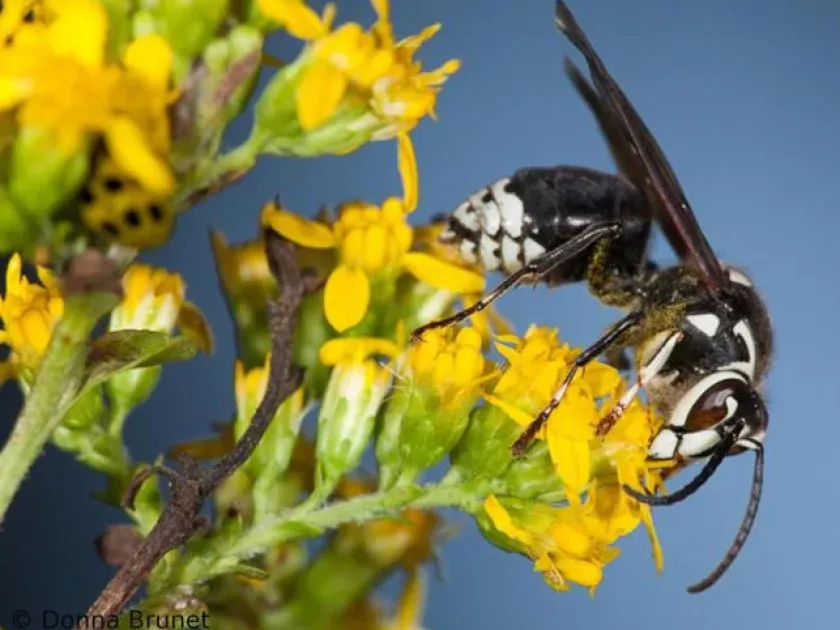
The bald-faced hornet (Dolichovespula maculata) is a large social insect belonging to the Vespidae family. It is easily recognized by its black body and distinct white/cream markings on the face and abdomen.
Adult workers typically reach lengths of up to 25 mm. Unlike many other hornets, they are named for their white, hair-covered faces, which stand out significantly against their dark thorax and abdomen.
These insects construct large, aerial paper nests, often located in trees, bushes, or on the eaves of structures. These nests are composed of chewed wood fibers mixed with saliva.
The colony starts in the spring when a queen emerges from hibernation. By late summer, the colony reaches its maximum size, housing hundreds of workers capable of defending the nest aggressively.
Though they are beneficial predators of other insects, their diet also includes sugar sources, leading them to damage orchard crops during the peak of summer and autumn.
What it damages
Bald-faced hornets cause damage to fruits, including apples, pears, plums, and grapes. They use their mandibles to break the skin of ripe fruit to access the sweet juices inside.
Once a fruit is punctured, it becomes highly susceptible to secondary infections like brown rot, which can quickly spread and destroy large quantities of the harvest.
In addition to fruit damage, they can strip bark from young trees and shrubs to collect fibers for nest construction, often resulting in the death of small branches or twigs.
The economic impact on commercial orchards can be significant, as damaged fruit is unmarketable and the presence of hornets creates hazardous conditions for seasonal workers.
Their presence often encourages other secondary pests, such as various species of flies and common wasps, to congregate on the damaged fruit, complicating pest management programs.
When it appears
The life cycle begins in late spring, as queens establish new nest sites after surviving the winter. Workers begin to appear in early summer to support the expanding colony.
Peak activity occurs throughout July and August when the worker population is at its highest, leading to an increased demand for carbohydrate-rich food sources like ripening fruit.
Activity remains high into September, making this a critical period for orchard management as the hornets become more aggressive in their foraging efforts.
Colony activity declines in late autumn. Workers and the current queen die, while new fertile queens find protected locations to hibernate through the winter months.
Monitoring for colony development during early summer is essential to minimize damage before the harvest season reaches its climax.
Signs of infestation
Frequent observation of hornets feeding on ripening fruit in the orchard is the most common sign of their presence and indicates a nearby colony.
The presence of large, football-shaped paper nests located in tree branches or on buildings is a definitive indicator of an established hornet population.
Damaged fruit with deep, irregularly shaped cavities is a hallmark of hornet feeding, distinct from the shallower damage caused by birds or other mammals.
Visible bark scraping on small twigs and branches provides evidence that the insects are actively harvesting materials for nest construction in the vicinity.
Increased defensive behavior near the nest, marked by loud buzzing and high-speed flight toward any perceived intruder, is a clear sign that a colony is active.
Control measures
Locating and removing nests during the early stages of colony development is the most effective way to prevent future damage to the orchard.
Implementing attractant traps containing sugar-based bait and insecticides can help reduce the population of foraging workers in commercial or home gardens.
Using protective netting over fruit clusters or trees is an environmentally friendly way to prevent hornets from accessing and damaging the ripening crop.
Sanitation practices, such as the prompt removal of fallen fruit and proper pruning of orchard debris, are essential to minimize attractants for the hornets.
Professional pest control services should be consulted when dealing with large, established nests, as these insects can become very aggressive when threatened.
Taxonomy
- Latin name
- Vespula maculata
- Order
- Hymenoptera
- Family
- Vespidae
- EPPO code
- VESUMA
Discussion
No discussions yet — be the first.