
German wasp
Vespula germanica
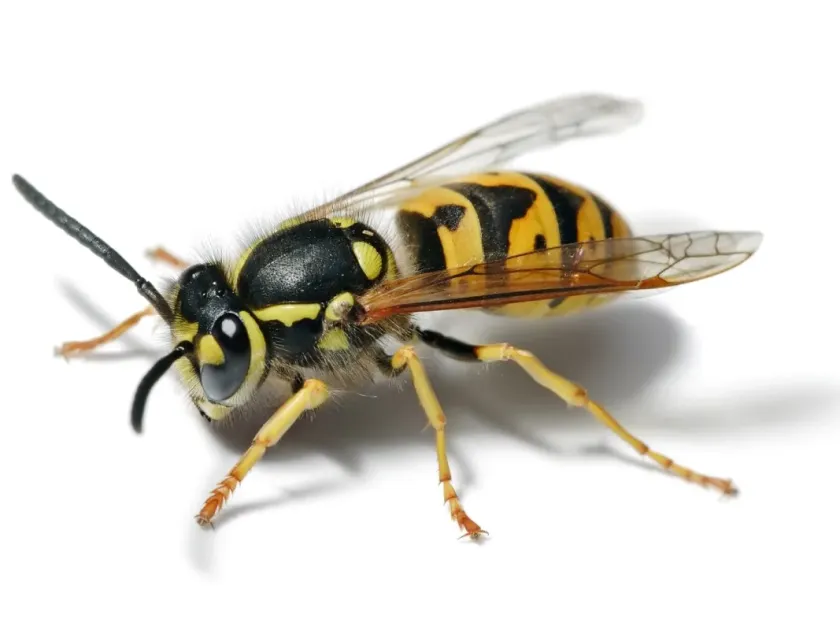
Description
How to identify
The German wasp (Vespula germanica) is a member of the Vespidae family, widely recognized for its social structure and complex colony life cycle.
Physically, it displays the typical yellow and black warning coloration, with a distinctive feature of three small black dots located on its clypeus.
Colonies are led by a queen, supported by thousands of workers who construct elaborate nests made from chewed wood fibers, creating a paper-like material.
Nests are often hidden in cavities, underground burrows, or within building structures, making them difficult to locate until the population peaks.
As a highly successful species, they adapt quickly to various environments, frequently encroaching on agricultural lands and human habitats.
What it damages
The German wasp is considered a significant agricultural pest due to its habit of feeding on sugary substances found in ripening fruits.
Orchard crops such as grapes, apples, pears, peaches, and berries are particularly susceptible to damage caused by the wasps' mandibles.
By breaching the skin of the fruit, they facilitate the entry of pathogens and promote rapid rot, rendering the produce unmarketable.
In vineyards, these wasps can decimate entire clusters, leaving only empty skins and seeds behind, which leads to substantial financial losses.
Furthermore, they pose a danger to farm workers during harvest, as they become extremely aggressive when their food sources or nesting sites are disturbed.
When it appears
The life cycle begins in spring when overwintering queens emerge to establish new colonies and lay the first batches of eggs.
The population grows steadily throughout the early summer, reaching its maximum density and activity levels in late August and September.
This peak coincides with the harvest time for most stone fruits and grapes, which explains why the damage becomes most apparent during this period.
As autumn transitions into winter, the colony begins to collapse, with most individuals dying off as temperatures drop significantly.
Only newly mated queens survive to hibernate in protected locations, ensuring the continuation of the species for the following season.
Signs of infestation
The most obvious sign of an infestation is the frequent presence of wasps around ripening fruit, especially in the late summer heat.
Visible physical damage to fruit surfaces, such as small holes or hollowed-out berries in grapes, indicates active foraging by German wasps.
Consistent flight paths of wasps heading toward specific points in buildings, fences, or the ground often lead to the discovery of hidden nests.
The presence of fermented fruit smells in the garden is a classic indicator that wasps have been feeding on damaged, rotting produce.
- Hollowed-out fruit skins.
- High activity around harvestable crops.
- Discovery of paper-like nests in structural cavities.
Control measures
Effective control requires locating and treating nests directly, ideally during the cooler hours of the day when wasps are less active.
Using targeted insecticide sprays or dusts in suspected nesting sites can drastically reduce local populations and prevent further crop damage.
Trapping techniques utilizing attractants like diluted fruit juice or sugar water can help capture foragers and mitigate the pressure on fruit trees.
Sanitation practices, such as removing fallen and overripe fruit promptly, are essential to minimize attractants and discourage wasps from visiting.
Physical exclusion methods, including netting for grapes or individual fruit bagging, provide a successful barrier against wasp feeding in orchards.
Taxonomy
- Latin name
- Vespula germanica
- Order
- Hymenoptera
- Family
- Vespidae
- EPPO code
- VESPGE
Discussion
No discussions yet — be the first.