
Austrian yellowjacket
Vespula austriaca
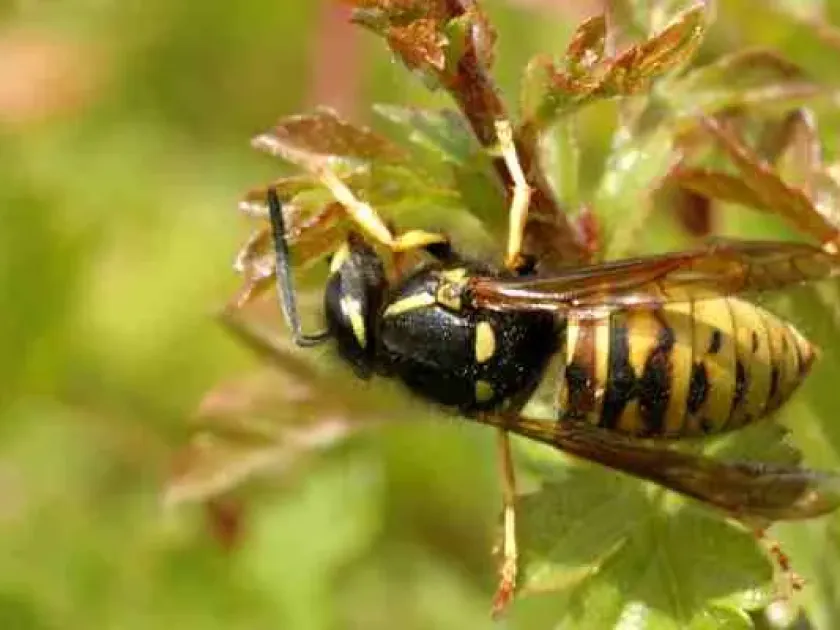
Description
How to identify
The Austrian yellowjacket (Vespula austriaca) is a species of social wasp belonging to the family Vespidae.
It is unique because it is an obligate social parasite, meaning it lacks a worker caste of its own.
The queen can be identified by slightly more robust morphology and specific abdominal patterns compared to common wasp species.
As a parasite, it relies entirely on the host colony, typically Vespula rufa, to raise its brood.
These wasps are distributed throughout the Palearctic region and parts of North America in temperate habitats.
What it damages
The primary damage caused by these wasps involves feeding on the juice of ripened fruits, including grapes, berries, and stone fruits.
By breaking the skin of the fruit, they facilitate the entry of secondary pathogens like fungi, leading to crop decay.
Their presence increases the overall density of wasp populations in an orchard, impacting the activity of beneficial pollinators.
Agricultural workers are at risk of stings when these wasps defend their hijacked nests near work areas.
While the wasp itself is not a primary herbivore, its impact on fruit quality can be significant in heavily infested areas.
When it appears
The life cycle of the Austrian yellowjacket is synchronized with the seasonal development of its host colony.
Overwintering queens emerge in late spring to search for an active nest of the host wasp species.
In mid-summer, the parasite invades the host nest and begins laying eggs to be reared by the host's workers.
The larval stage is completed within the host nest, and new reproductive individuals emerge late in the season.
The adult activity period typically spans from June through September depending on the local climate conditions.
Signs of infestation
Presence of the Austrian yellowjacket is usually indicated by the observation of morphological differences within a wasp nest.
Increased aggression in host nests may be a behavioral indicator that a parasite queen has taken over the colony.
Observation of adult wasps feeding on fruits in late summer often points to nearby nesting sites.
Locating nests in the ground or wall voids is the most reliable way to confirm the species population on a property.
Physical inspections of nests often show an unusually high number of reproductive individuals by the end of the season.
Control measures
Direct control is rarely necessary unless the wasp colony poses a nuisance or safety threat to agricultural workers.
Managing the host wasp species, such as Vespula rufa, generally leads to a decrease in the parasitic population.
Using bait traps filled with sugary liquids or protein-based attractants helps in monitoring and reducing adult populations.
Insecticide applications directed at nest entrances should be performed at night when colony activity is at its lowest.
Good sanitation practices, such as clearing fallen fruit and sealing potential nesting sites in structures, are effective preventive measures.
Taxonomy
- Latin name
- Vespula austriaca
- Order
- Hymenoptera
- Family
- Vespidae
- EPPO code
- VESUAU
Discussion
No discussions yet — be the first.