
Asian hornet
Vespa velutina
Description
How to identify
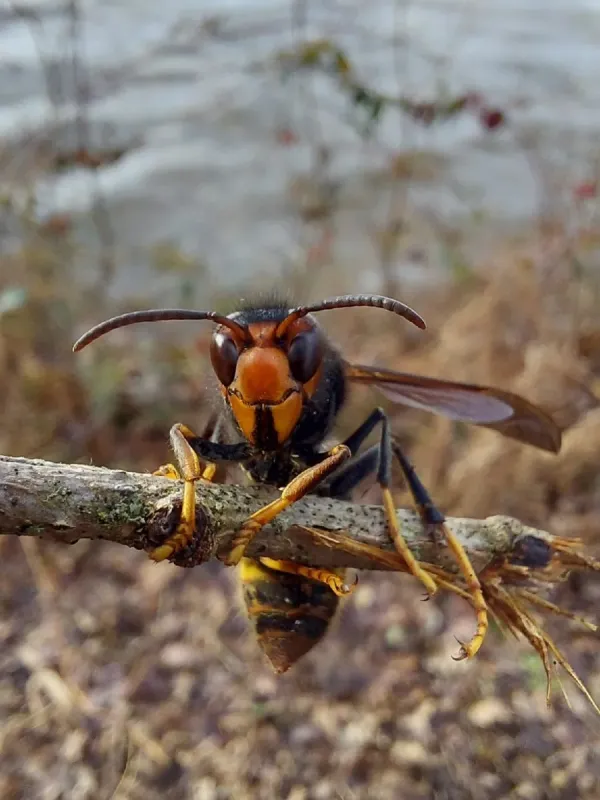
The Asian hornet (Vespa velutina) is a species of social wasp in the Vespidae family. It is significantly smaller than the European hornet, with workers measuring approximately 20–25 mm in length, while queens can grow up to 30 mm.
It is characterized by a dark brown or black body with a velvety appearance. A distinct visual identifier is the wide orange band on the abdomen and, most notably, the bright yellow or pale tips on its legs, which distinguish it from other local hornet species.
Their nests are spherical or pear-shaped and are typically found in high tree crowns, though they occasionally build them in shrubs, walls, or man-made structures. A single mature colony can hold thousands of individual hornets.
The life cycle begins in spring when the overwintered queen emerges to establish a new primary nest. Once the first generation of workers emerges, they take over the construction and foraging duties, allowing the queen to focus solely on egg-laying.
As an invasive species, Vespa velutina has spread across various regions, often thriving in environments that provide both sufficient prey (insects) and carbohydrate sources (fruit juices).
What it damages
The primary agricultural impact of the Asian hornet is its status as a severe predator of honeybees (Apis mellifera). They hover in front of hives, capturing returning foragers and drastically weakening the hive population, which leads to reduced honey production and total colony collapse.
Furthermore, they cause significant damage to fruit production. They feed on ripening fruits such as grapes, figs, peaches, and berries, consuming the pulp and damaging the outer skin, which leaves the crop vulnerable to spoilage and disease.
Damaged fruits become centers for rot and attract other pests, including vinegar flies and various fungi, rendering the remaining fruit in the cluster or tree unsuitable for harvest or sale.
In addition to direct damage, their presence disrupts the local ecosystem by outcompeting native predators for food resources and preying upon beneficial pollinators, which impacts overall agricultural biodiversity.
Their defensive behavior makes them a risk to agricultural workers during routine operations like harvesting or maintenance in orchards where nests are present, especially when they are threatened.
When it appears
The activity season typically begins in early spring, when queens emerge from winter hibernation to forage and scout for suitable nest-building sites. Controlling the queens during this time is the most effective way to prevent future colonies.
Peak worker activity occurs from mid-summer until late autumn. During this stage, the colony requires high protein intake to feed larvae, leading to increased hunting activity near beehives and orchards.
As the weather cools and frost approaches, the worker population declines. The new queens leave the nest to find secure overwintering sites, often hiding in soil, protected cavities, or wood piles until the following spring.
Monitoring for nests should be systematic throughout the summer. Locating and neutralizing nests before the reproductive phase (late summer/early autumn) is essential for limiting the dispersal of new queens for the next season.
Late autumn is usually characterized by the end of colony growth, but awareness remains necessary as disturbed or late-season nests can still be highly aggressive.
Control measures
Trapping is a widely used control method. By using selective traps with bait such as sugar syrup, beer, or fruit juice, beekeepers can capture workers and reduce the immediate pressure on their hives, although this does not eliminate the source nest.
The most effective long-term solution is the location and destruction of nests. Professionals use advanced detection methods, including thermal imaging and telescopic equipment, to neutralize nests safely, especially when they are situated high in trees.
Apiary protection involves installing restrictive mesh or guards at the hive entrance. These devices allow honeybees to pass through while preventing hornets from entering or effectively attacking the bees at the flight entrance.
Sanitation in orchards is crucial. Removing fallen, overripe fruit reduces the available food sources for hornets, making the area less attractive for foraging individuals during the late summer months.
- Early spring queen trapping.
- Systematic nest identification and destruction.
- Apiary entrance protection mesh.
- Public education and reporting initiatives.
Taxonomy
- Latin name
- Vespa velutina
- Order
- Hymenoptera
- Family
- Vespidae
- EPPO code
- VESPVE
Discussion
No discussions yet — be the first.