
Asian giant hornet
Vespa mandarinia
Description
How to identify
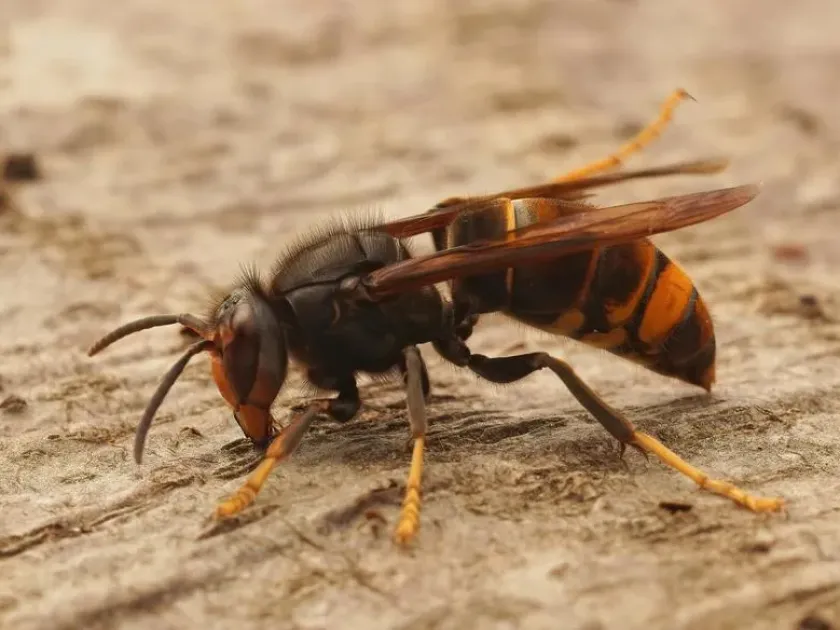
The Asian giant hornet (Vespa mandarinia) is the world's largest hornet species. Workers typically reach lengths of 40–50 mm, while queens can be even larger, making them significantly bigger than common European hornets.
Their head is a distinct bright orange, contrasting with the dark brown thorax. The abdomen features alternating bands of yellow and brown, providing an easy visual reference for field identification.
These hornets possess massive, toothed mandibles capable of crushing the exoskeletons of their prey. Their stinger is remarkably long and can deliver a large volume of potent venom, posing a health risk to humans and animals.
Flight is characterized by a loud, buzzing sound audible from several meters away. Their body proportions and flight pattern are heavy and powerful compared to smaller vespids found in temperate regions.
They prefer nesting in lowland forests and mountainous areas, often choosing abandoned rodent burrows or tree cavities. The choice of nesting site is critical for the survival of the queen during the early stages of colony formation.
What it damages
The primary agricultural impact of the Asian giant hornet is its devastating effect on honeybee populations. As apex predators in the insect world, they view honeybee colonies as an ideal source of protein for their brood.
During the "slaughter phase," hornet scouts mark the hive with pheromones, followed by a mass attack. They kill bees by decapitating them, which allows them to clear the hive's defenses rapidly and harvest bee larvae.
The destruction of honeybee colonies leads to a catastrophic loss of pollination services for fruit, vegetable, and nut crops. This creates an indirect but significant economic burden on the agricultural sector.
While adults feed on plant sap and nectar, the dependency on insect prey makes them a threat to the biodiversity of local ecosystems. They can suppress populations of other beneficial insects and natural predators.
Although they do not feed directly on plant tissues in a way that damages produce like caterpillars do, their influence on the ecological balance and pollinator health makes them high-priority pests for farmers.
When it appears
The life cycle begins in spring when overwintered queens emerge from their dormant state. They spend significant time scouting for suitable nesting sites and preparing the initial cells for the first generation of workers.
As summer progresses, the colony reaches its full size. By late summer and early autumn, the demand for protein for the developing brood peaks, leading to increased predatory activity on honeybee hives.
In autumn, the colony produces reproductive individuals, including new queens and males. Once mating occurs, the new queens seek protected locations for hibernation, which is essential to continue the cycle the following year.
The duration of the active season is strictly determined by local temperatures. In warmer climates, colonies may remain active longer, but they are generally limited by the onset of cold weather in winter.
Colony growth is exponential throughout the summer, meaning early detection of the initial queen or small colonies is vital for preventing larger-scale outbreaks later in the season.
Control measures
Physical barriers are the first line of defense for beekeepers. Installing custom-made entrance reducers or "hornet guards" on hives prevents the large hornets from entering while allowing honeybees to continue foraging.
Trapping is an effective way to reduce the number of foraging workers. Baits involving wine, vinegar, and sugar are commonly used to attract workers to traps, which helps monitor activity and lower the pressure on local bee populations.
Locating and eliminating the nest is the only way to fully eradicate a threat in a specific area. This process requires specialized equipment, including thick protective suits designed to resist the long stingers of these insects.
Maintaining a clean agricultural environment is essential to reduce attracting hornets. This includes the prompt removal of fallen, overripe fruit and avoiding large amounts of food waste near apiaries.
- Installation of specialized hive entrance guards.
- Deployment of baited traps for worker hornets.
- Professional nest destruction using protective safety gear.
- Sanitation protocols to minimize attractants in the vicinity.
Taxonomy
- Latin name
- Vespa mandarinia
- Order
- Hymenoptera
- Family
- Vespidae
- EPPO code
- VESPMA
Discussion
No discussions yet — be the first.