
Vatiga
Vatiga
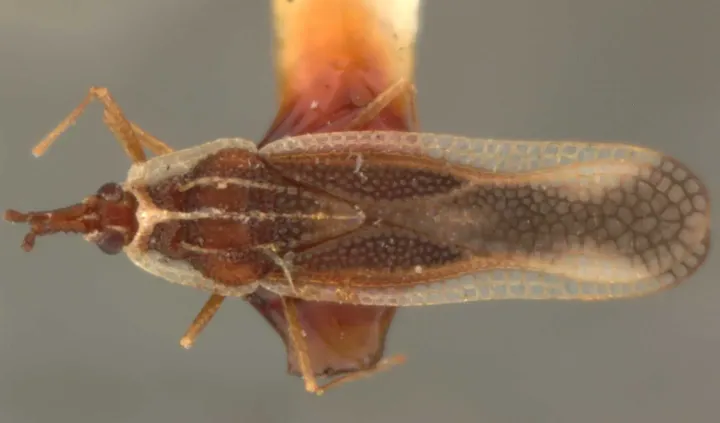
Description
How to identify
Vatiga is a genus of lace bugs belonging to the family Tingidae (order Hemiptera). These insects are named for the intricate, reticulated, lace-like appearance of their pronotum and elytra, which feature complex cell-like patterns.
Adult Vatiga specimens are minute insects, typically measuring between 3 and 5 millimeters in length. Their bodies are dorsoventrally flattened, often exhibiting a pale brown or grayish coloration that provides camouflage against leaf surfaces.
The biology of this pest is specialized for tropical and subtropical environments. Females deposit eggs into plant tissue, usually on the underside of leaves along the veins, providing offspring with a stable and protected environment.
The life cycle progresses through several nymphal stages. These nymphs resemble the adults but lack functional wings and undergo progressive development until they reach maturity, spanning several weeks per generation.
In optimal conditions of high humidity and heat, Vatiga populations can expand rapidly. Because multiple generations can occur within a single growing season, they are capable of inflicting consistent pressure on crops.
What it damages
The primary host for the Vatiga genus is cassava (Manihot esculenta). The pests utilize their piercing-sucking mouthparts to penetrate the plant's epidermis, extracting cellular sap from the parenchyma tissue.
Besides cassava, various species of Vatiga may occupy secondary wild hosts within the Euphorbiaceae family. These reservoirs often complicate pest management programs on commercial farming sites.
Economic impact is driven by the depletion of plant nutrients, which directly inhibits the plant's ability to store starch in root tubers. This reduces overall yield quantity and quality significantly.
The feeding process leads to reduced photosynthetic efficiency, causing the plant to prioritize survival over development, which stunts the growth of the tubers and the maturation of the stems.
Plants weakened by heavy Vatiga infestations often suffer from secondary stress, including reduced vigor and increased susceptibility to fungal or bacterial pathogens that infiltrate feeding sites.
Signs of infestation
Initial symptoms are characterized by stippling or chlorotic spots on the upper leaf surface. These spots correspond to individual feeding punctures where the chlorophyll has been depleted.
As feeding continues, these spots coalesce, resulting in widespread leaf yellowing (chlorosis). Eventually, leaves turn brown, desiccate, and fall off, which can lead to severe defoliation of the crop.
The presence of adult bugs and nymphs on the abaxial (bottom) side of the leaves is a key indicator. They are often accompanied by dark, sticky spots of excrement left behind on the foliage.
Observation of cast skins (exuviae) left after nymphal molting on the underside of leaves provides further evidence of an active, breeding population occupying the plant canopy.
- Chlorotic stippling on the upper leaf surface.
- Development of yellowed or necrotic leaf patches.
- Presence of sticky, dark excrement spots on leaf undersides.
- Accumulation of shed nymphal skins.
- Premature yellowing and abscission (dropping) of leaves.
Control measures
The most sustainable strategy for Vatiga management involves the utilization of resistant cassava cultivars that exhibit natural tolerance or antibiosis toward lace bug feeding.
Cultural control measures, including rigorous weed management and proper crop rotation, are essential for limiting the survival of Vatiga populations during off-season periods.
Biological control options, such as the application of entomopathogenic fungi like Beauveria bassiana, have shown efficacy in suppressing population spikes without broad-spectrum chemical impact.
Chemical intervention should be restricted to instances where infestation levels exceed economic thresholds. Systemic insecticides are generally preferred as they ensure protection of the plant tissues targeted by the pests.
Nitrogen management is crucial; preventing over-fertilization helps maintain balanced plant growth, making the host less attractive for excessive colonization by the insects.
Taxonomy
- Latin name
- Vatiga
- Order
- Hemiptera (bugs, aphids, leafhoppers)
- Family
- Tingidae
- EPPO code
- VATISP
Discussion
No discussions yet — be the first.