
Cotton lace bug
Corythaica costata
Description
How to identify
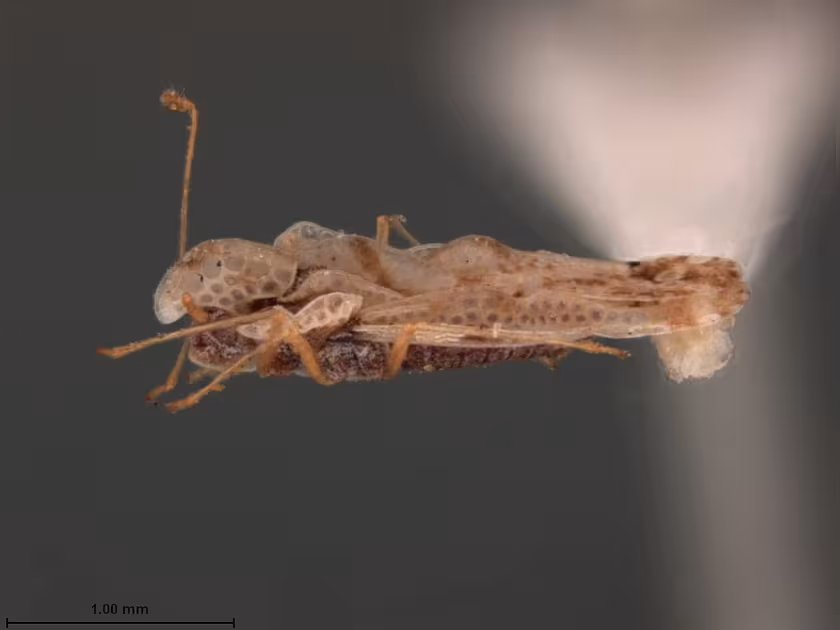
The cotton lace bug (Corythaica costata) belongs to the order Hemiptera and the family Tingidae. It is named for the intricate, net-like, lace-like appearance of its wings and pronotum, which are transparent and highly delicate.
Adults are small, typically measuring between 3 and 4 millimeters in length. Their body coloration ranges from pale yellow to light brown, providing camouflage while they feed on the undersides of leaves.
Nymphs possess a different morphology from adults; they are wingless and often covered with various spines and tubercles. These structures help them remain attached to the plant surface and defend against potential predators.
Females deposit their eggs in small clusters, typically on the underside of leaves. The eggs are often covered with a dark, hardened secretion that protects them from environmental stressors and desiccation.
These insects prefer secluded habitats, usually congregating in the lower canopy of the host plants where the humidity is higher and the insects are protected from direct solar radiation and temperature extremes.
What it damages
While the cotton plant is the primary host for Corythaica costata, this pest is known to feed on various other species within the Malvaceae and Solanaceae families, making it a significant threat in diverse cropping systems.
Both adults and nymphs cause damage by using their piercing-sucking mouthparts to feed on plant sap. By inserting their stylets into the leaf tissue, they extract nutrients and disrupt cellular function.
During the feeding process, the lace bug introduces salivary enzymes into the plant tissue. These enzymes break down chlorophyll, resulting in the characteristic chlorotic spotting and loss of photosynthetic efficiency.
Severe infestations can lead to premature leaf senescence, curling, and eventually abscission. This significantly stresses the plant, reducing its ability to produce high-quality fibers or fruit.
Furthermore, the lace bug's feeding activities can cause physical damage that creates entry points for various phytopathogens, potentially leading to secondary fungal or bacterial infections in the host plant.
When it appears
The activity of the cotton lace bug is highly correlated with seasonal temperature patterns. In tropical and subtropical regions, the pest can complete several generations within a single growing season.
Overwintering typically occurs in the adult stage. The bugs seek refuge in plant debris, fallen leaves, or soil crevices, emerging when temperatures rise and favorable host plants become available in the spring.
Peak population densities are generally observed during mid-summer, when optimal heat and humidity conditions accelerate the life cycle, leading to rapid expansion of the insect colonies on crop foliage.
As the season progresses toward autumn, decreasing temperatures and shorter photoperiods trigger the insects to migrate toward overwintering sites, where they enter a state of diapause until the following spring.
Early-season scouting is crucial for managing this pest. Monitoring should begin as soon as the seedlings emerge to detect initial colonization and implement control measures before populations reach economic damage thresholds.
Signs of infestation
The earliest symptom of lace bug infestation is the appearance of small, pale or yellowish spots on the upper leaf surface, which correspond to feeding sites located on the underside of the leaf.
Close inspection of the lower leaf surface usually reveals the presence of both adults and nymphs, often accompanied by small black spots, which are the insect's excrement that clutters the leaf tissue.
As the infestation progresses, the affected leaves may exhibit curling or mottled chlorosis. In advanced stages, the foliage becomes brittle, turns brown, and drops prematurely, affecting overall plant vigor.
The "lacy" pattern of damage is unique. Once the chlorophyll is removed, the remaining leaf tissue often appears as a transparent or whitish network, making the plant look severely depleted and sick.
- Stippled chlorotic spots on the upper leaf surface.
- Accumulation of small black excrement droplets on leaf undersides.
- Leaf curling, browning, and premature abscission.
- Direct observation of insects with lace-like wing structures.
Control measures
Cultural control is the cornerstone of managing Corythaica costata. Thorough post-harvest sanitation, including the removal of crop residues and deep plowing, effectively eliminates overwintering habitats.
Implementing a robust crop rotation strategy helps to interrupt the life cycle of the pest. Controlling weeds, particularly those related to the Malvaceae family, is essential to reduce secondary hosts in the field.
Chemical control may be necessary in high-pressure situations. The use of systemic insecticides is generally more effective, provided they are applied during the early nymphal stages when the insects are most vulnerable.
To avoid the development of insecticide resistance, it is critical to rotate chemical classes. Furthermore, choosing selective insecticides helps to preserve natural enemies, such as lacewings and spiders, which contribute to biological control.
Integrated Pest Management (IPM) practices, including the use of pheromone traps and regular field scouting, are recommended to maintain population levels below the economic threshold and ensure sustainable crop protection.
Taxonomy
- Latin name
- Corythaica costata
- Order
- Hemiptera (bugs, aphids, leafhoppers)
- Family
- Tingidae
- EPPO code
- CORCCO
Discussion
No discussions yet — be the first.