
Eggplant lace bug
Corythaica cyathicollis
Description
How to identify
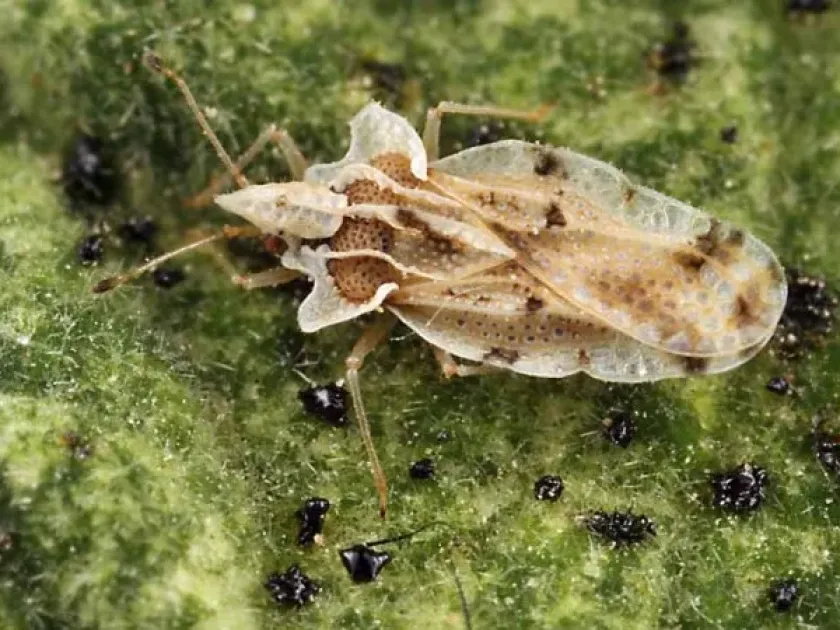
The Eggplant lace bug (Corythaica cyathicollis) belongs to the Tingidae family, characterized by the intricate, net-like appearance of their wings and pronotum, which resembles fine lace under microscopic observation.
Adult insects are tiny, typically measuring 3–4 mm in length. Their coloration ranges from pale gray to brownish, providing excellent camouflage against the foliage of host plants.
The head and thorax possess lateral expansions that give the bug its distinct, flattened profile. Nymphs, or immature stages, appear similar to adults but lack fully developed wings and are covered in small spines.
This species undergoes hemimetabolous development, meaning they skip the pupal stage. The nymphs are highly active and begin feeding on plant sap shortly after hatching.
Their physical structure is adapted for survival in diverse climatic conditions, allowing them to thrive and reproduce rapidly whenever host plants are available.
What it damages
The primary hosts for Corythaica cyathicollis are plants in the Solanaceae family. They are considered a significant pest in eggplant cultivation, causing substantial economic losses.
In addition to eggplants, they are frequently found on potatoes, tomatoes, and various solanaceous weeds, which serve as alternative food sources and reservoirs for the pest population.
Both nymphs and adults feed by piercing the epidermal tissue with their needle-like mouthparts. They drain cellular contents, specifically targeting the chlorophyll-rich tissues of the leaves.
The feeding activity disrupts the plant's photosynthetic process, leading to a significant reduction in overall plant vigor, stunted growth, and delayed fruit development.
Severe infestations cause massive leaf yellowing and necrosis, which can result in significant yield loss if left unmanaged during the critical growing stages.
When it appears
The life cycle of the lace bug is heavily influenced by ambient temperature and humidity levels. In warmer regions, they can produce multiple overlapping generations within a single season.
Adults typically overwinter in sheltered locations, such as crop debris, soil crevices, or under the bark of nearby trees, emerging when spring temperatures begin to rise.
Once active, females deposit eggs in clusters on the undersides of leaves. The duration of the life cycle is inversely proportional to temperature: warmer weather accelerates development.
Peak population densities are usually observed mid-summer, when the environmental conditions are optimal for the rapid maturation of nymphs into reproductive adults.
As autumn approaches and temperatures drop, the bugs begin to search for overwintering sites, marking the end of the active feeding phase on the crops.
Signs of infestation
The initial signs of infestation manifest as small, chlorotic stippling or white spots on the upper surface of the leaves, resulting from the bugs' feeding punctures.
As the infestation progresses, these spots coalesce, creating larger bleached patches that give the leaf a marbleized or washed-out appearance.
Examining the underside of the leaf usually reveals a colony of bugs, their shed skins (exuviae), and small black fecal droplets, confirming the presence of the pest.
Affected leaves eventually curl, dry out, and drop prematurely. The plant looks withered, and the quality of the fruit is compromised due to poor nutrient transport.
- Stippling and chlorosis on leaf surfaces.
- Presence of insect colonies and fecal spots on leaf undersides.
- Premature leaf senescence and wilting.
Control measures
Cultural control measures include the thorough removal and destruction of crop residues after harvest to eliminate overwintering sites for the adult bugs.
Sanitation practices also involve removing solanaceous weeds from field margins to prevent the buildup of pest populations near the main crop.
Biological control, utilizing natural predators such as lady beetles, lacewings, and predatory bugs, can help manage populations in integrated pest management programs.
Chemical control requires the timely application of insecticides. It is critical to target the undersides of the leaves to ensure direct contact with the feeding insects.
Rotating insecticide classes is recommended to prevent the development of resistance, ensuring that the control strategy remains effective throughout the season.
Taxonomy
- Latin name
- Corythaica cyathicollis
- Order
- Hemiptera (bugs, aphids, leafhoppers)
- Family
- Tingidae
- EPPO code
- CORCCY
Discussion
No discussions yet — be the first.