
Australian painted lady
Vanessa kershawi
Description
How to identify
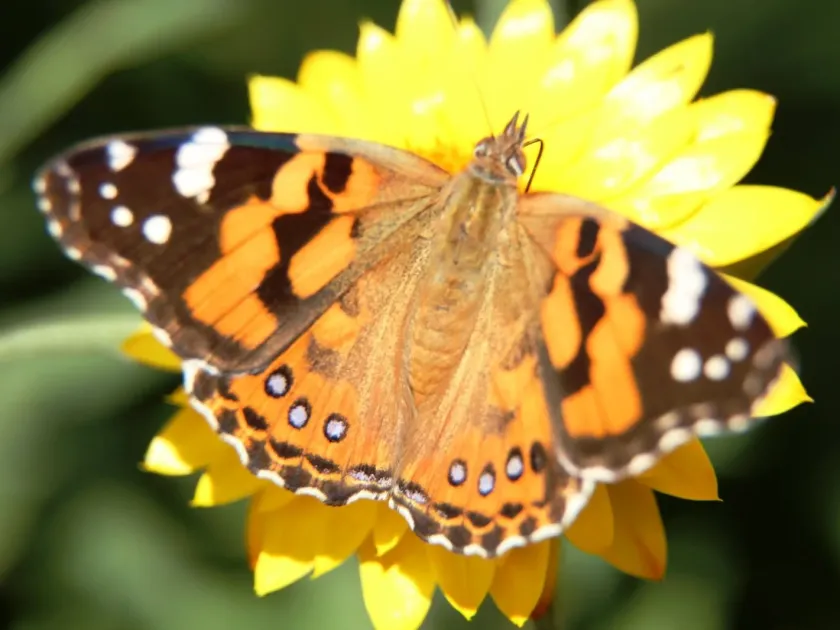
The Australian painted lady (Vanessa kershawi) is a diurnal butterfly belonging to the Nymphalidae family. Adults are characterized by an orange-brown wing pattern with distinctive black and white spots, typically spanning 40–50 mm.
Larvae (caterpillars) pass through several instars, exhibiting a dark coloration with longitudinal stripes and fine dorsal spines. These morphological traits help them remain camouflaged on their host plants.
The pupa is typically brown or greenish, providing excellent protection against avian predators when attached to plant residues or stems. The life cycle involves a complete metamorphosis process.
This species is a highly mobile migrant, often appearing in fields abruptly after traveling long distances. Their unpredictable movement patterns make them a challenging pest to forecast.
It is morphologically similar to other Vanessa species but can be distinguished by the lack of prominent eyespots on the underside of the hindwings, which is a key identification feature.
What it damages
The primary damage is caused by the larval stage, which feeds voraciously on the foliage of various herbaceous plants. They represent a significant threat to industrial and vegetable crops.
Key crops susceptible to damage include sunflowers, soybeans, pulses, and various brassicas. Caterpillars consume leaf tissue, often leaving only the coarse vein structure behind.
In cases of large-scale infestations, the caterpillars can cause total defoliation, leading to stunted plant growth and a drastic reduction in overall yield.
Beyond the loss of leaf area, the larvae may damage terminal buds or growing points, causing plant deformation and increased vulnerability to environmental stress.
Feeding wounds created by the larvae provide entry points for secondary infections, such as bacterial or fungal rots, which further compromise the health of the host crop.
When it appears
The life cycle is closely synchronized with climate and migration patterns. Mass emergence typically occurs during the warmer months, ranging from late spring through autumn.
Development from egg to adult takes approximately 3 to 5 weeks, depending on ambient temperatures and the availability of suitable host plant biomass.
The period of peak activity usually occurs mid-summer, as multiple generations may overlap, causing cumulative damage to the crop throughout the vegetative stage.
Population density declines towards the end of the season as food sources diminish and natural enemies, including parasitoid wasps and predatory insects, increase in activity.
Because these insects are migratory, sudden outbreaks can occur even in regions where the species is not permanently established or was not observed in previous seasons.
Signs of infestation
The earliest visual indication of an infestation is the presence of skeletonized or partially consumed leaves, particularly in the upper canopy of the plant.
Small dark granular droppings, known as frass, are often visible on the soil surface beneath the infested plants or caught on the leaf surfaces below the feeding sites.
Caterpillars can usually be found by inspecting the underside of the leaves, where they often retreat to avoid the heat of the midday sun.
Some larvae use silk threads to fold or roll leaves together, creating protective shelters; the presence of these tied leaves is a specific indicator of larval activity.
During heavy infestations, the physical sound of active larval feeding may be audible in quiet conditions near the crop, signaling a critical need for intervention.
Control measures
Integrated pest management (IPM) for the Australian painted lady involves a combination of cultural, biological, and chemical strategies to mitigate economic losses.
Cultural methods include rigorous weed control, as many common weeds serve as secondary host plants for the larvae before they migrate into primary crop fields.
Biological control leverages natural enemies and the use of microbial insecticides containing Bacillus thuringiensis, which specifically target younger larval instars.
Chemical intervention should be based on economic thresholds and involves the application of registered insecticides with systemic or contact-stomach action.
- Regular field monitoring using pheromone traps to detect migration waves.
- Timely application of insecticides at the first signs of mass larval hatch.
- Post-harvest tillage to destroy pupae residing in plant debris or soil.
Taxonomy
- Latin name
- Vanessa kershawi
- Order
- Lepidoptera (butterflies)
- Family
- Nymphalidae
- EPPO code
- VANSKE
Discussion
No discussions yet — be the first.