
Yellow woodwasp
Urocerus xanthus
Description
How to identify
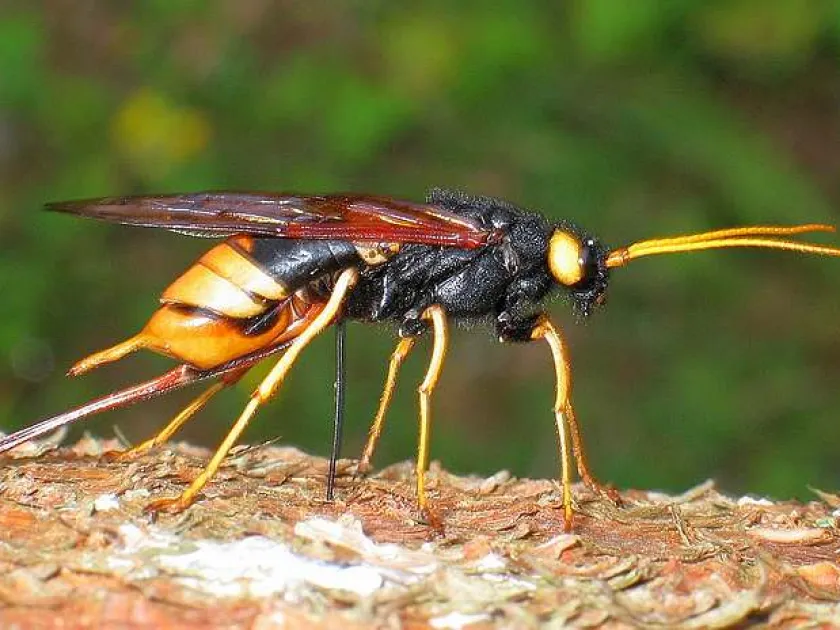
The yellow woodwasp (Urocerus xanthus) is a large insect belonging to the family Siricidae within the order Hymenoptera. Adults are notable for their impressive size, often reaching lengths of 30 to 40 mm.
The body coloration is typically yellow-brown, featuring distinct patterns on the abdomen. Females possess a long, prominent ovipositor, which is a characteristic feature used to drill into wood during the egg-laying process.
Their wings are generally transparent with a slight yellowish or smoky tint, which distinguishes them from other similar-looking species of wasps found in forest environments.
The larvae are cylindrical, cream-colored, and feature a robust head and a distinct chitinous spine at the posterior end of the body, which is a key diagnostic characteristic for the genus Urocerus.
Adults are most commonly observed during their flight period, where they are seen landing on coniferous tree trunks to find suitable locations for oviposition.
What it damages
This species primarily targets various conifer species, such as spruce, fir, and pine, especially those that are already stressed, weakened by environmental factors, or recently felled.
The damage is caused primarily by the larvae, which bore deep, circular tunnels into the wood. This activity destroys the internal structure of the tree and disrupts the transport of water and nutrients.
The economic impact is significant as the tunnels bored by the larvae render the affected timber unsuitable for high-quality structural or decorative lumber applications.
Infestation by yellow woodwasp often serves as a precursor to further tree decay, as the weakened tree becomes susceptible to secondary colonization by bark beetles and various fungal pathogens.
Severe infestations can lead to the overall decline and eventual death of the tree, creating gaps in forest stands that may require urgent management and harvest intervention.
When it appears
The flight period of the adult woodwasp typically occurs during the warmer summer months, spanning from mid-summer through early autumn depending on regional climate variations.
The life cycle of Urocerus xanthus is long-term and often complex, frequently requiring two to three years to complete development from egg to adult emergence.
After finding a suitable host, the female inserts her eggs deep into the sapwood and heartwood, accompanied by a symbiotic fungus that helps digest the wood for the developing larvae.
Larval development takes place entirely within the wood, where they continuously feed and tunnel in complex patterns that grow in diameter as the larvae mature and gain size.
Upon reaching the pupal stage, the insects move closer to the outer surface of the bark, where they transform into adults before cutting their way out through circular emergence holes.
Signs of infestation
The most prominent sign of infestation is the appearance of perfectly circular emergence holes on the bark, measuring between 5 and 8 mm in diameter, left by departing adults.
Fine, powdery wood dust, known as frass, appearing on the bark surface or at the base of the tree is a clear indicator that larvae are actively boring within the trunk.
Premature yellowing or browning of the needles, especially when it occurs out of season or sporadically across the canopy, may suggest extensive internal damage to the wood.
While the egg-laying sites created by the female are small, keen observers may spot the tiny, localized punctures on the bark that mark where the ovipositor was inserted.
In cases of heavy infestation, subtle scratching or gnawing sounds can sometimes be detected by the human ear in calm, quiet conditions within the affected forest stand.
Control measures
Management strategy focuses primarily on sanitation, specifically the prompt removal and destruction of infested, diseased, or wind-thrown trees to prevent population outbreaks.
Silvicultural practices should prioritize the rapid extraction and processing of felled timber to minimize the window of time available for woodwasps to lay eggs in fresh logs.
Chemical control is rarely effective or practical for forest-wide infestations due to the cryptic nature of the larvae living deep inside the wood tissue.
Biological control, which involves the protection and introduction of natural parasitoid wasps, is often the most sustainable method for keeping woodwasp numbers below damaging thresholds.
- Implement regular forest health monitoring programs.
- Ensure rapid turnover of harvested timber from the forest site.
- Preserve natural predators and parasitoids in the local ecosystem.
Taxonomy
- Latin name
- Urocerus xanthus
- Order
- Hymenoptera
- Family
- Siricidae
- EPPO code
- URCEXA
Discussion
No discussions yet — be the first.