
Banded horntail
Urocerus sah
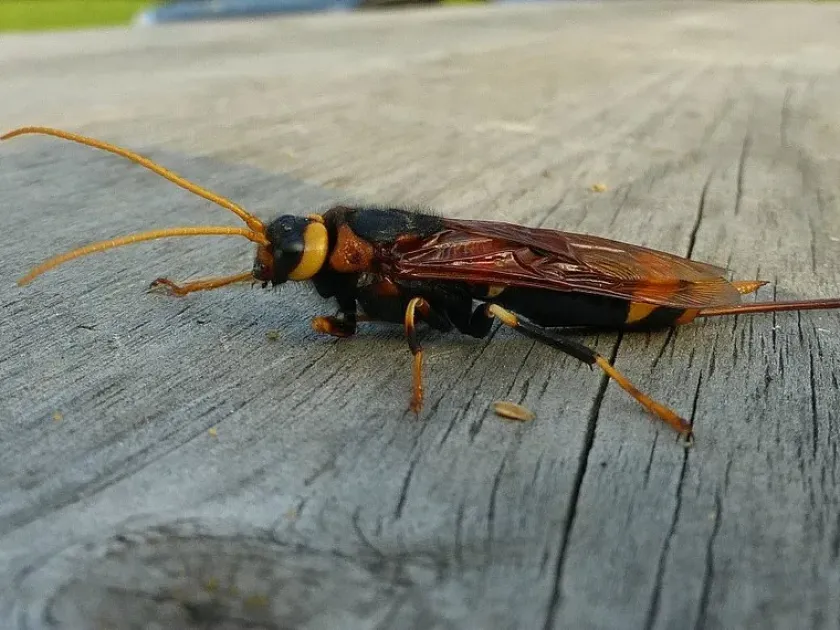
Description
How to identify
The Banded horntail (Urocerus sah) is a species of wood wasp belonging to the family Siricidae (order Hymenoptera). Adults are large insects, with females typically measuring between 30 and 40 mm in length.
These insects are characterized by a cylindrical, dark-colored body, often with metallic blue or black reflections. Females possess a long, needle-like ovipositor used for drilling into wood.
Larvae of the Banded horntail are creamy white, cylindrical, and possess a distinct dark, spine-like structure at the tip of the abdomen, which is a key diagnostic feature.
The life cycle is complex and typically spans one to three years. The larvae spend their entire developmental phase inside the wood, feeding on the xylem of coniferous trees.
Emergence of the adult wasp occurs during the summer months, when they bore their way out of the timber, leaving behind characteristic circular exit holes.
What it damages
The primary hosts of the Banded horntail include various coniferous species such as pine, spruce, and fir. It primarily attacks stressed, dying, or recently felled timber.
Larval activity involves creating deep, winding galleries within the wood. These tunnels are densely packed with frass (wood powder), which significantly compromises the structural integrity of the timber.
Economic damage is severe in the timber industry, as tunnels degrade the grade of lumber, often rendering it unsuitable for high-quality construction or carpentry work.
While healthy, vigorous trees are rarely the primary target, severe outbreaks can occur in forest stands weakened by environmental stress, fire damage, or other secondary infestations.
The presence of this insect poses significant phytosanitary challenges for the international trade of lumber, as wood products must be certified pest-free to prevent spread.
Signs of infestation
The most visible sign of infestation is the presence of perfectly circular, smooth-edged exit holes on the surface of the bark or lumber, usually ranging from 6 to 8 mm in diameter.
Oviposition sites on tree trunks appear as tiny, shallow punctures made by the female's ovipositor. These marks may occasionally exude small amounts of resin.
While the larvae pack their tunnels with frass, small piles of sawdust-like material may sometimes be found near the base of the tree or on the surface of stored logs.
Increased woodpecker activity on coniferous trees can serve as a biological indicator of an existing wood wasp infestation, as birds drill the bark to feed on the larvae.
In cases of heavy infestation, the crown of the tree may show signs of yellowing or needle drop, reflecting the disruption of water and nutrient transport due to larval tunneling.
Control measures
Effective management begins with strict sanitation practices, including the prompt removal and processing of infested or fallen timber from forest sites.
In sawmills and storage yards, wood should be processed rapidly or protected under conditions that prevent female wasps from reaching the logs to lay eggs.
Kiln-drying of lumber is the most reliable method to ensure the total destruction of larvae and eggs, as the required temperatures effectively sterilize the wood products.
Monitoring populations using pheromone-baited traps allows foresters to track seasonal activity and implement timely salvage logging operations if thresholds are exceeded.
Promoting forest health through proper silvicultural management, such as thinning and maintaining stand vigor, reduces the availability of suitable hosts for the Banded horntail.
Taxonomy
- Latin name
- Urocerus sah
- Order
- Hymenoptera
- Family
- Siricidae
- EPPO code
- URCESA
Discussion
No discussions yet — be the first.