
Giant woodwasp
Urocerus gigas
Description
How to identify
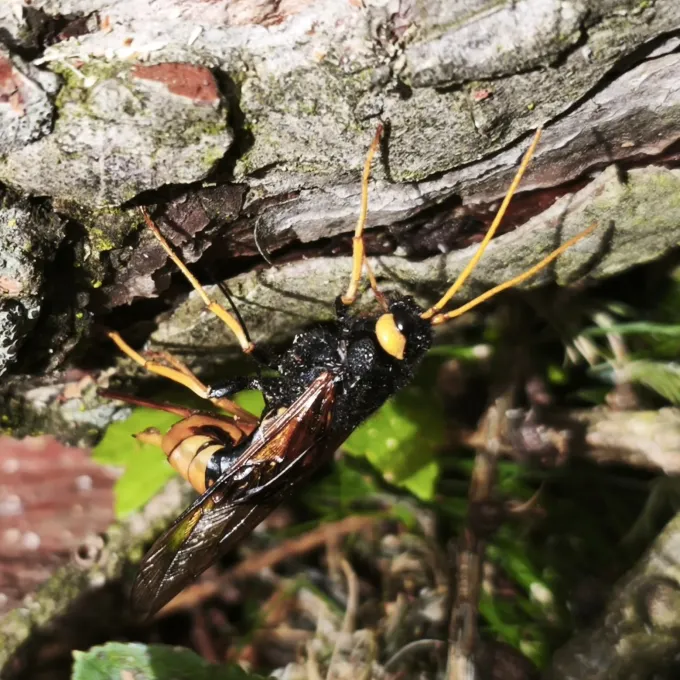
The Giant woodwasp (Latin: Urocerus gigas) is a large insect belonging to the Siricidae family. Despite its wasp-like appearance, it is not aggressive and does not sting humans.
Females are quite impressive in size, reaching up to 50 mm in length. They are characterized by a long, needle-like ovipositor used to deposit eggs deep into the wood.
Males are significantly smaller, usually around 30 mm, and possess a reddish-brown coloration. They lack the long ovipositor, which is a key trait for distinguishing between the sexes.
Larvae are cylindrical and creamy white, featuring powerful mandibles. They are equipped with a small, sharp horn on the posterior end of their body, which is a signature characteristic.
The lifecycle of this insect can span between two and three years, largely depending on environmental conditions, humidity levels, and the health of the host tree.
What it damages
This pest primary targets coniferous trees such as spruce, fir, pine, and larch. It favors weakened, storm-damaged, or recently felled timber for its development.
The damage is caused by the larvae, which tunnel deep into the heartwood of the tree. These galleries destroy the internal structure and strength of the timber.
In the timber industry, the Giant woodwasp is considered a serious technical pest. Infested wood is often rejected due to the presence of numerous boreholes and internal tunnels filled with sawdust.
For healthy standing trees, infestation is usually secondary. It often indicates that the tree is already suffering from drought stress, fungal infection, or other damage.
The economic impact can be significant in forest management, particularly when large volumes of fallen timber are left in the forest during the peak flight season.
When it appears
Adult woodwasps are most active during the summer months, typically from June through August. During this period, they emerge from the wood to mate and reproduce.
Females search for suitable host trees and use their ovipositors to drill into the wood, where they deposit their eggs in small clusters to ensure larval survival.
After hatching, the larvae begin to feed and tunnel inward. They spend the vast majority of their life cycle feeding on the wood inside the trunk of the tree.
The pupation stage occurs during the spring or early summer. The larva creates a small chamber near the surface of the bark, preparing for its final transformation.
The emergence of the adult wasp is marked by the creation of a perfectly circular hole in the bark, signaling that the insect has completed its development and left the tree.
Signs of infestation
The most visible sign of an infestation is the presence of perfectly round exit holes, approximately 5–7 mm in diameter, on the surface of the tree trunk or timber.
Sawdust or fine wood powder, known as frass, found near the base of the tree or on the bark is a clear indicator of active larval tunneling inside the wood.
Visible decline in the tree's canopy, such as browning or thinning of needles, can suggest a severe infestation that has compromised the tree's hydraulic system.
During quiet periods, one might hear a faint scratching or crunching sound coming from the trunk, caused by the larvae feeding inside the dense wood structure.
Small pin-sized puncture marks on the bark represent the locations where females have inserted their ovipositors to lay eggs, though these are often difficult to spot.
Control measures
The most effective strategy for managing the Giant woodwasp is strict forest hygiene and the rapid removal of dead or dying trees from the woodland area.
- Promptly remove and utilize storm-damaged or fallen timber.
- Avoid storing fresh softwood logs near healthy standing forests.
- Use pheromone traps to monitor and reduce local adult populations.
- Maintain tree health through proper forestry practices to prevent stress.
- Treat harvested timber with professional-grade preservatives or kiln drying.
Chemical control is rarely effective against larvae residing deep within the wood, making preventive forestry management the primary tool for mitigating damage.
In cases where timber is stored, ensuring a dry and clean environment can significantly lower the risk of infestation by adult females searching for egg-laying sites.
Taxonomy
- Latin name
- Urocerus gigas
- Order
- Hymenoptera
- Family
- Siricidae
- EPPO code
- URCEGI
Discussion
No discussions yet — be the first.