
California horntail
Urocerus californicus
Description
How to identify
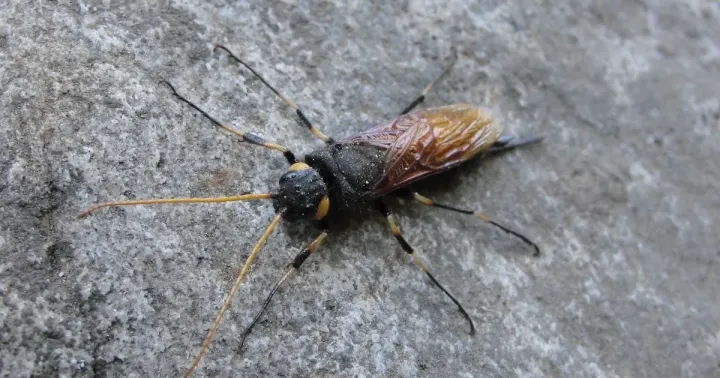
The California horntail (Urocerus californicus) is a large wood-wasp belonging to the Siricidae family, order Hymenoptera, known for its size and distinct appearance.
Adult females can grow up to 40 mm in length and are characterized by a black body with striking yellow markings on the abdomen and legs.
The most distinguishing feature of the female is a long, needle-like ovipositor used for drilling into wood to lay eggs beneath the bark.
Larvae are cylindrical, whitish in color, and possess a distinct cornus (a small spike) on the rear end of the abdomen to help navigate tunnels.
Adult males are typically smaller than females and lack the long ovipositor, generally appearing more slender and uniform in their coloration.
What it damages
The California horntail primarily targets conifer species, including firs, pines, and spruces, acting as a significant technical pest in forest ecosystems.
It prefers weakened, stressed, or recently felled trees, where the moisture content remains suitable for the development of the larvae.
The larvae bore deep, winding galleries throughout the wood, which severely degrades the structural integrity and market value of the timber.
In cases of high infestation, the pest can attack healthy trees, causing branch dieback and overall decline in the health of the individual tree.
Their tunneling activities not only cause mechanical damage but also facilitate the entry of wood-decaying fungi and other pathogens into the tree trunk.
When it appears
The life cycle of the California horntail is largely dictated by environmental temperatures, typically peaking during the warmer summer months.
Adults emerge during mid-to-late summer, when they actively seek suitable host trees for mating and subsequent oviposition.
Once eggs are laid, the larvae remain inside the wood for an extended period, which can last from one to three years depending on moisture conditions.
Pupation occurs within the wood, often near the surface, allowing the adult to chew its way out upon reaching maturity.
The duration of the life cycle is quite flexible and often depends on the nutritional quality and the drying rate of the infested wood.
Signs of infestation
One of the most obvious signs of infestation is the presence of perfectly round exit holes, about 5–8 mm in diameter, on the surface of the bark.
Evidence of egg-laying can sometimes be found as small, circular pits or punctures on the surface of the trunk where the female inserted her ovipositor.
Frass, or fine wood dust, may accumulate at the base of the tree or within bark crevices, indicating active larval boring deeper inside the wood.
Internal damage, only visible when cutting the wood, consists of tightly packed galleries filled with boring dust, which significantly weakens the log.
The crown of an infested tree may show signs of yellowing or browning needles as the tunneling disrupts the normal flow of nutrients.
Control measures
Sanitation is the most effective management tool, involving the removal and destruction of infested or recently downed trees before the insects emerge.
Proper timber management, such as removing logging slash and storing logs away from susceptible stands, helps prevent the buildup of pest populations.
Trapping adults using pheromone-based lures can be useful in monitoring population levels and reducing the number of breeding females in specific areas.
Encouraging natural biological controls, such as parasitic wasps that hunt horntail larvae, is a sustainable way to maintain forest health.
Chemical treatments are generally impractical in large forests but may be used on processed timber piles if they are at risk of being attacked.
Taxonomy
- Latin name
- Urocerus californicus
- Order
- Hymenoptera
- Family
- Siricidae
- EPPO code
- URCECA
Discussion
No discussions yet — be the first.