
Woodwasp
Urocerus
Description
How to identify
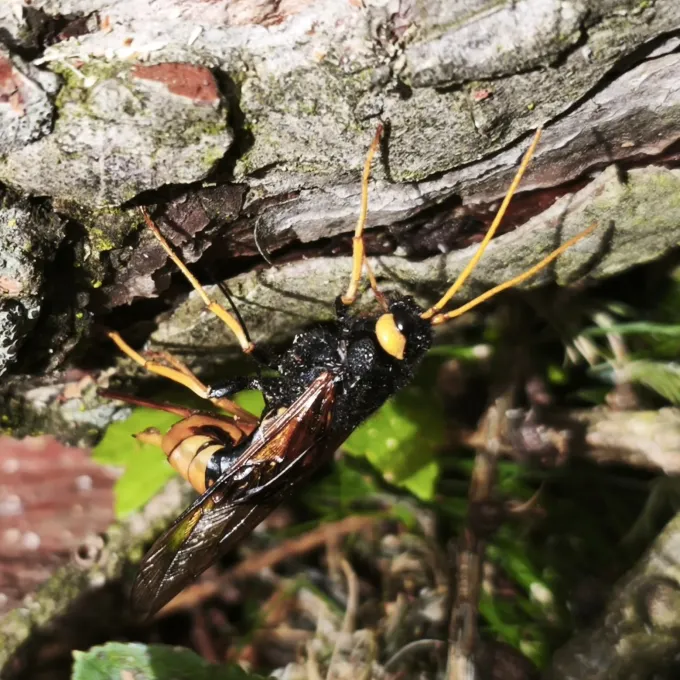
The woodwasp (Urocerus), belonging to the Siricidae family within the Hymenoptera order, is a large, stout insect that superficially resembles a wasp but lacks the constricted "waist."
Females possess a long, needle-like ovipositor that is often mistaken for a dangerous stinger, though it is strictly used for egg-laying and is harmless to humans.
Adult woodwasps exhibit variable coloration, often appearing black, blue, or brownish-yellow, depending on the specific species and region.
The larvae are cream-colored, cylindrical, and notable for the small, hard, horn-like projection located at the posterior end of their body.
Development occurs entirely within the wood, making detection difficult until the adults eventually bore out of the tree to complete their life cycle.
What it damages
Woodwasps primarily attack coniferous trees, particularly spruce, fir, pine, and larch, causing significant concern in forestry and timber industries.
They generally target stressed, dying, or recently felled timber, though high populations can occasionally result in attacks on otherwise healthy trees.
Damage is caused by larvae boring deep galleries into the wood, which severely compromises the structural integrity of the timber.
This internal tunneling leads to widespread degradation, rendering lumber unsuitable for high-quality construction or carpentry purposes.
Beyond timber loss, the presence of these insects can lead to the introduction of fungal pathogens that accelerate the decay of the wood.
When it appears
The adult flight period typically occurs during the warmer summer months, usually spanning from June through August when temperatures favor mating activity.
During this time, the female uses her ovipositor to deposit eggs deep into the sapwood of a host tree, often favoring trees that are already suffering from environmental stress.
The larval stage is the longest part of the life cycle, where they spend one to three years feeding on wood tissue and growing inside the tree.
Overwintering takes place within the protective environment of the tree trunk, allowing the larvae to survive even harsh winter conditions.
Pupation occurs near the surface of the bark, after which the emerging adult bores a perfectly circular exit hole to venture outside.
Signs of infestation
The most prominent sign of a woodwasp infestation is the presence of perfectly circular exit holes on the surface of the bark or the cut wood.
Fine, powdery wood dust, known as frass, often accumulates in bark crevices or at the base of the tree, indicating larval boring activity.
A noticeable decline in tree health, such as premature needle discoloration or top-dying, can serve as a warning sign of an internal infestation.
During the summer months, sighting large, wasp-like insects resting on tree trunks is a strong indicator of active egg-laying sites.
- Perfectly round exit holes (4–7 mm in diameter)
- Accumulation of fine wood dust (frass)
- Top-dieback or unhealthy foliage appearance
- Sightings of adults landing on tree trunks in summer
Control measures
Effective management begins with strict sanitation practices, including the prompt removal and processing of infested timber before the adults emerge.
Proper forest hygiene, such as removing fallen trees or thinning stressed stands, helps prevent the build-up of woodwasp populations in vulnerable areas.
Biological control methods involve the preservation and introduction of natural parasitoids, which are specific types of wasps that prey on woodwasp eggs and larvae.
For stored timber, moisture control and keeping logs under specific conditions can significantly reduce the attractiveness of the wood to female wasps.
Regular monitoring of forest health and timber stocks is crucial to catching infestations early and minimizing the economic impact of this wood-boring pest.
Taxonomy
- Latin name
- Urocerus
- Order
- Hymenoptera
- Family
- Siricidae
- EPPO code
- URCESP
Discussion
No discussions yet — be the first.